Trump Just Amplified This: Gold to $10,000 Before Year-End | Jim Rickards
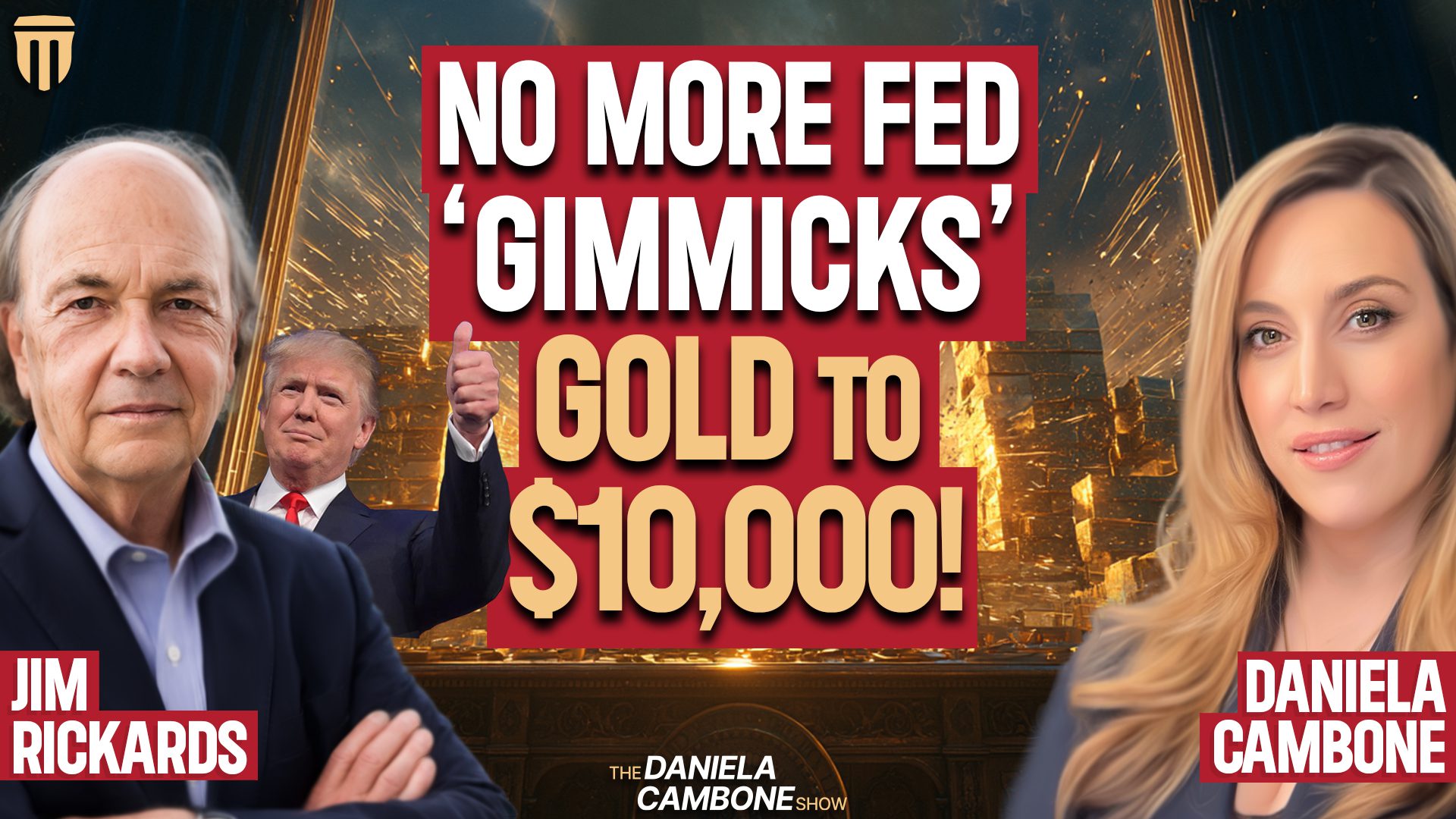
Gold to $10,000? Jim Rickards Says the Clock Is Already Ticking
What happens when a $10,000 gold forecast stops sounding like a fringe prediction—and the President of the United States amplifies the man making it?
Jim Rickards believes gold to $10,000 is no longer a distant, five-year scenario.
In his latest interview with Daniela Cambone, Rickards said the move could happen before the end of 2026. And if it takes until early or mid-2027?
In his view, that barely changes the thesis.
“Possibly before the end of the year,” Rickards said, while clarifying that his forecast is really about a sharp repricing over a relatively short period rather than an exact December 31 deadline.
That distinction matters.
Gold is already trading above $4,500 an ounce. Spot gold fell more than 3% following Federal Reserve Chairman Kevin Warsh’s August 28 Jackson Hole speech, dropping to roughly $4,567 per ounce, while silver fell to about $66.81.
For Rickards’ $10,000 target to materialize, gold would still need to more than double from current levels.
Extreme?
Perhaps.
But the backdrop is hardly normal.
The United States has just crossed $40 trillion in national debt. Inflation remains above the Federal Reserve’s target. Long-term borrowing costs are under pressure. Central banks continue accumulating gold. And geopolitical conflict is forcing investors to reconsider what “safe” money actually means.
That is the environment behind Rickards’ call.
Trump Amplified Rickards—And the Timing Is Hard to Ignore
Rickards told Daniela that President Donald Trump recently shared one of his videos on Truth Social.
According to Rickards, the presentation focused on what he calls a potential “midterm meltdown”—a convergence of political, financial and geopolitical turbulence heading into the November elections.
Rickards interpreted Trump’s decision to share the video as significant.
Whether the amplification represents agreement with every prediction is unknowable. But the larger point for investors is more important:
Political uncertainty is colliding with monetary uncertainty at a moment when confidence in traditional financial assets is already being tested.
And gold has historically been highly sensitive to exactly that combination.
The market is not waiting for a theoretical crisis to arrive.
Gold surged above $4,600 earlier this week as investors weighed fiscal concerns, dollar weakness and geopolitical tensions. Then Warsh’s hawkish Jackson Hole speech triggered a violent reversal.
That volatility itself tells a story.
Markets are attempting to price two competing forces at once:
- Higher interest rates, which can pressure non-yielding assets such as gold and silver.
- Persistent inflation and enormous fiscal deficits, which can undermine confidence in government debt and fiat currencies.
- Geopolitical risk, which historically increases demand for assets outside the conventional financial system.
- Central-bank diversification away from excessive dependence on dollar reserves.
- Growing questions over whether policymakers can fight inflation without making an already expensive federal debt burden even more difficult to finance.
That is not a calm monetary regime.
It is a tug-of-war.
Warsh Just Sent a Warning the Gold Market Couldn’t Ignore
Rickards’ conversation with Daniela came just as Fed Chairman Kevin Warsh delivered his first Jackson Hole keynote as chairman.
The speech was titled “In Our Time,” a reference Rickards connected to Ernest Hemingway’s famous short-story collection.
Rickards’ interpretation was that the most revealing part of the speech was what Warsh did not explicitly say.
His conclusion?
The Fed remains worried about inflation, and monetary policy may have to stay restrictive—or become more restrictive—to contain it.
Warsh’s actual remarks support the hawkish interpretation.
He called the Fed’s 2% PCE inflation objective a “firm, fixed target,” acknowledged that inflation has remained elevated for more than five years and said policymakers must be confident inflation is returning toward target “at sufficient speed.”
He also made clear that short-term interest rates should remain the Fed’s primary tool, while unconventional measures should be reserved largely for genuine crises.
In other words: investors hoping for another immediate flood of quantitative easing did not get the message they wanted.
Markets noticed.
Following the speech, traders pushed the implied probability of a September rate increase sharply higher, while gold sold off.
Interestingly, Rickards believes the Fed is more likely to wait until after the midterm elections before raising rates.
That is his interpretation—not a commitment Warsh made in the speech.
And this is where the gold story becomes more complicated.
Why Rickards Is Still Bullish on Gold Even If Rates Rise
Conventional wisdom says rising interest rates are bad for gold.
There is logic behind that.
Gold does not pay interest. When Treasury securities offer higher yields, investors can receive income from government bonds while gold continues sitting in a vault.
But Rickards argues the market is already discounting future tightening.
If investors expect higher rates tomorrow, they do not necessarily wait until tomorrow to sell gold.
They adjust today.
That may help explain why Rickards views short-term weakness as less important than the larger monetary trend.
More importantly, interest rates are only one variable affecting gold.
Fiscal deterioration is another.
And that picture is becoming increasingly difficult to ignore.
$40 Trillion in U.S. Debt Changes the Gold vs Dollar Equation
The United States officially crossed $40 trillion in total public debt in August 2026.
Treasury data showed the figure reaching approximately $40.047 trillion on August 18, including roughly $32.3 trillion held by the public and $7.8 trillion in intragovernmental holdings.
Think about that milestone.
The national debt stood around $20 trillion less than a decade ago.
Now it has doubled.
And the problem is no longer simply the size of the debt.
It is the cost of carrying it.
As rates rise, maturing low-rate Treasury securities must increasingly be refinanced at higher yields. That creates a painful feedback loop:
More debt → higher interest expense → larger financing requirements → more Treasury issuance → greater pressure on borrowing costs.
Reuters reported this month that investors are already demanding higher yields to absorb longer-duration government debt, even though Treasury demand remains solid and there is no evidence of a full-scale buyers’ strike.
This distinction matters.
The dollar does not have to “collapse” for gold to rise.
Treasuries do not have to default.
Confidence merely needs to deteriorate at the margin.
When governments must continually issue more currency-denominated debt simply to finance past obligations, investors have historically begun asking a basic question:
What should preserve purchasing power if the currency itself is being diluted?
That is where the gold vs dollar debate becomes increasingly relevant.
The $1 Trillion Gold Revaluation Idea—And the Catch
One of the most striking parts of Rickards’ interview involved an obscure line on the Federal Reserve’s balance sheet: the gold certificate account.
The mechanics date back to the Gold Reserve Act of 1934.
The Federal Reserve does not own America’s monetary gold. The Treasury does.
When the gold was transferred to the Treasury, gold certificates were issued to the Federal Reserve. Those certificates remain valued using the statutory gold price of just $42.2222 per fine troy ounce.
Meanwhile, Treasury reports holding approximately 261.499 million fine troy ounces of gold—roughly 8,133 metric tons. At the statutory price, that gold appears in official reserve reporting at only about $11 billion.
At a market price above $4,500?
Its theoretical market value is well over $1 trillion.
Rickards suggested that revaluing those gold certificates closer to market value could create roughly $1 trillion in additional Treasury financial capacity.
But there is an important legal distinction.
Under current U.S. law, outstanding gold certificates are explicitly tied to $42 2/9 per fine troy ounce.
So this is not simply a matter of the Treasury secretary calling the Fed chairman and ordering an accounting adjustment under the existing framework. Changing the valuation mechanism would require legal or policy action beyond an ordinary bookkeeping entry.
Still, the thought experiment exposes something extraordinary:
The U.S. government owns one of the largest gold reserves on Earth, yet officially carries that gold at a tiny fraction of its current market value.
Why does that matter?
Because even governments that issue fiat currency continue holding physical gold.
That should tell investors something.
Central Banks Aren’t Abandoning Gold—They’re Buying More
The gold bull market is not being driven solely by retail investors worried about inflation.
Central banks remain major buyers.
The World Gold Council reported that central banks purchased a net 289 tonnes of gold during the second quarter of 2026, up sharply from the first quarter. Poland and China were among the notable accumulators.
Over the previous four years, central banks accumulated roughly 1,000 tonnes annually on average, about double the pace of the preceding decade.
Why?
Reserve managers understand risks that ordinary investors are increasingly being forced to confront themselves.
Gold carries:
No issuing government.
No corporate counterparty.
No promise from a central bank to repay it later.
That does not make gold immune from price declines—as the post-Jackson Hole selloff made perfectly clear.
But physical gold exists outside the credit structure supporting stocks, bonds, bank deposits and sovereign debt.
That distinction becomes increasingly important when trust in the system itself becomes the variable investors are attempting to hedge.
Rickards Says He Holds at Least $1 Million in Physical Gold
Rickards also revealed that he personally owns at least $1 million worth of physical gold.
When social-media commenters questioned why the amount was “only” $1 million, Rickards clarified that he had deliberately said at least $1 million—not that $1 million represented his entire holdings.
The more interesting point is not the exact number.
It is the word physical.
Rickards is not merely making a bullish prediction about a ticker symbol.
His argument centers on gold as an asset held outside the conventional financial system.
That difference is central to the wealth-preservation discussion.
Gold and Silver as Wealth Preservation Assets
For investors approaching or already in retirement, the question is not simply whether gold reaches $10,000.
The more important question is:
What happens to the purchasing power of your savings if the forces pushing gold higher continue?
A $10,000 gold price would not necessarily mean gold suddenly became twice as useful.
It could mean the measuring stick—the dollar—lost purchasing power relative to scarce tangible assets.
That is why physical gold and silver have historically played a role in wealth preservation.
They are tangible assets with no corresponding issuer liability. They have survived currency resets, inflationary episodes, banking crises and major geopolitical disruptions.
Gold has traditionally served primarily as a monetary reserve and potential inflation hedge, while silver combines monetary demand with significant industrial demand.
Neither moves in a straight line.
Both can experience severe volatility.
But for investors evaluating gold vs dollar exposure, their purpose is different from chasing short-term returns.
The question is not merely:
“Will gold go up?”
It is:
“How much of my wealth should remain dependent on the continued purchasing power and stability of paper financial claims?”
That is a very different conversation.
$10,000 Gold Would Be a Warning, Not a Celebration
Rickards’ gold to $10,000 forecast is dramatic.
It is also far above most mainstream institutional forecasts.
For comparison, JPMorgan has projected gold around $6,300 by year-end 2026, substantially below Rickards’ target while still implying significant upside from current prices.
So $10,000 is not a consensus forecast.
And Rickards himself softened the calendar in his interview, saying the move could arrive before year-end or potentially in 2027.
But obsessing over the precise number risks missing the bigger story.
Gold is already above $4,500.
U.S. debt has crossed $40 trillion.
Inflation remains above the Fed’s target.
Central banks continue acquiring bullion.
The Fed is again confronting the uncomfortable tradeoff between restraining inflation and operating within an economy carrying historically enormous levels of debt.
And geopolitical instability continues making physical assets strategically relevant.
If gold eventually reaches $10,000, the headline may not be that gold became extraordinarily expensive.
The headline may be what happened to the dollar, debt markets and confidence in the financial system along the way.
For financially conservative investors, that is the risk worth examining before the next crisis—not after everyone agrees it has arrived.
About ITM Trading
ITM Trading has over 28 years of experience helping clients safeguard their wealth through personalized strategies built on physical gold and silver. Our team of experts delivers research-backed guidance tailored to today’s economic threats.
THINKING ABOUT PURCHASING GOLD & SILVER?
Get expert guidance from our team of analysts with 28+ years of experience.
👉 [SCHEDULE YOUR CALL HERE] or call 866-706-9061