Rand Paul Checks Fort Knox Gold, Dollar Is At “Death’s Door” – Gerald Celente
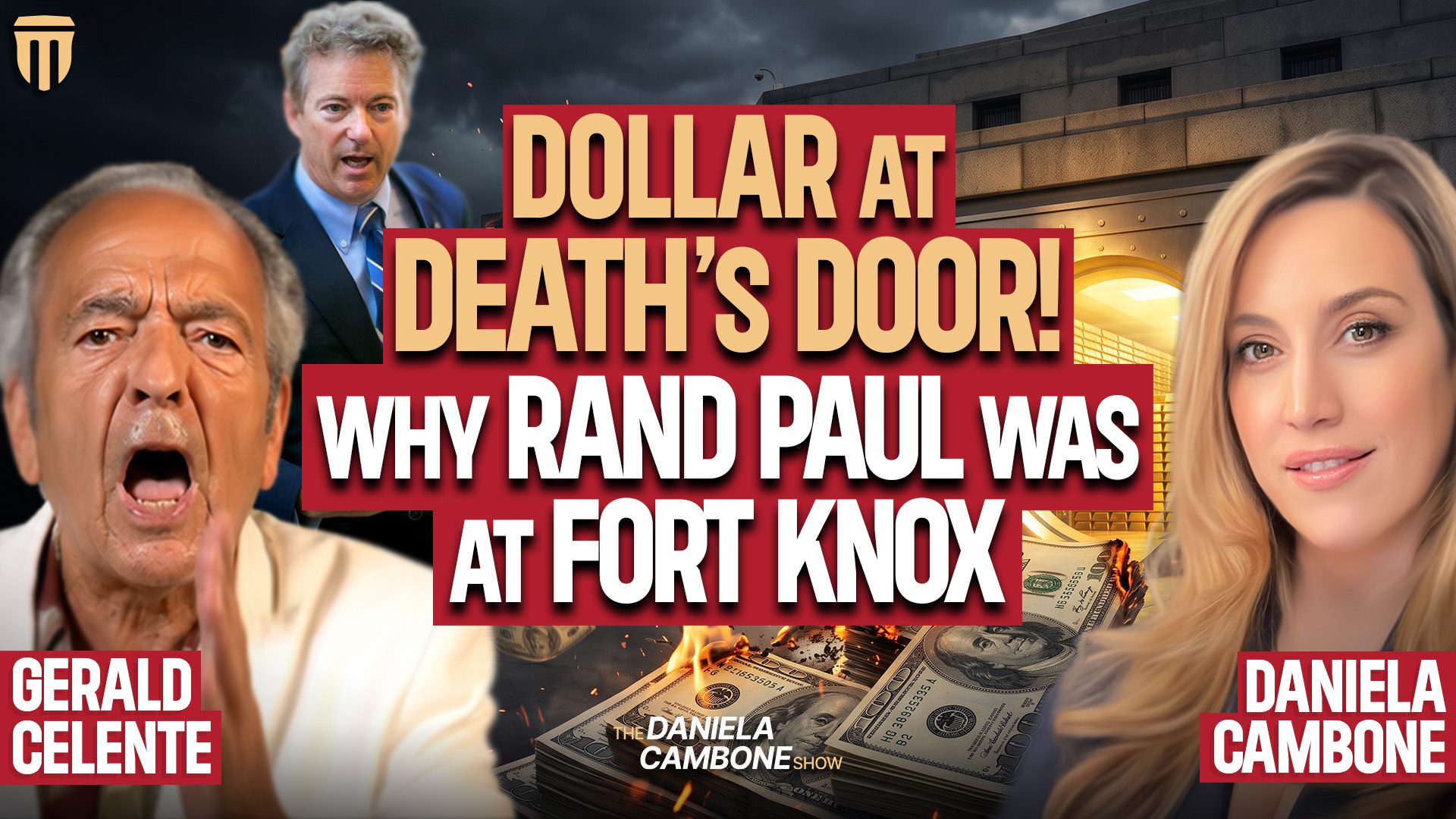
The gold is still in Fort Knox. But Gerald Celente says that may be the least important part of the story.
Sen. Rand Paul’s visit to Fort Knox gold reserves has reopened a much larger question: What does America’s massive gold stockpile mean when the dollar itself has lost most of its purchasing power since the U.S. broke its final link to gold in 1971?
Paul toured Fort Knox in August 2026 and said the gold was there. Treasury records show the depository officially holds approximately 147.3 million fine troy ounces of U.S. government gold.
But in Daniela Cambone’s latest interview with Trends Journal founder Gerald Celente, the conversation quickly moved beyond whether the bars exist.
Celente’s warning was far more severe: “The death of the dollar is on the doorstep.”
He argues that exploding debt, growing interest costs, geopolitical instability, potential rate cuts, central-bank gold buying, and a weakening faith in fiat currencies could push gold and silver into an entirely different monetary role. He even speculates that Washington could eventually revalue its gold holdings or reconsider gold’s place in the monetary system. That is Celente’s forecast—not an announced U.S. government policy.
And that distinction matters.
Because the verified numbers are alarming enough without speculation.
Fort Knox Gold Is There—But That’s Not the Real Story
For years, Fort Knox has attracted rumors about whether America’s gold was actually still inside the vaults.
Paul’s visit provides a new political spotlight on the issue. Yet Treasury’s own accounting already lists 147,341,858.382 fine troy ounces at Fort Knox, with additional U.S. gold stored at Denver and West Point.
Here is where things get more interesting.
Treasury continues to carry Fort Knox gold at a statutory accounting value of roughly $42.22 per ounce. At that price, the Fort Knox hoard appears on the books at only about $6.22 billion.
That accounting price bears little resemblance to gold’s market value.
And that gap is exactly what caught Celente’s attention.
During the interview, he floated the possibility that policymakers could eventually announce a dramatically higher official valuation for government gold and use that revaluation as part of a broader attempt to strengthen the federal balance sheet.
There is currently no verified evidence that the Treasury has announced such a plan.
And simply marking gold to a higher price would not make Treasury debt disappear. The national debt represents outstanding federal borrowing; changing the accounting value of an asset does not automatically cancel those liabilities. That said, a formal gold revaluation could have significant monetary and balance-sheet consequences depending on how policymakers structured it. This is an accounting inference based on Treasury’s treatment of debt and official gold holdings.
[Link to related guide or post: What Would a Gold Revaluation Mean for the U.S. Dollar?]
The Dollar Has Lost Nearly 88% of Its 1971 Purchasing Power
This may have been the most important part of Rand Paul’s Fort Knox message.
The debate is not simply about whether America owns gold.
It is about what happened to the dollar after gold stopped restraining the monetary system.
In August 1971, the Consumer Price Index stood at approximately 40.8. By June 2026, the comparable CPI index had risen to approximately 332.6.
That means consumer prices are more than eight times their August 1971 level.
Put differently, using CPI as the benchmark, the dollar has lost roughly 87.7% of its 1971 purchasing power.
A dollar that bought $1 worth of goods in August 1971 buys roughly 12 cents worth of the same CPI basket today.
That is not a prediction. It is the arithmetic of accumulated inflation.
And it helps explain why retirees often feel that official discussions about “moderating inflation” miss the bigger picture.
Lower inflation does not reverse previous price increases.
If prices rise 8%, then 4%, then 3%, prices are still rising from an already elevated base.
For Americans depending on pensions, Social Security, savings accounts, and fixed-income assets, dollar devaluation is cumulative.
Gold and silver enter the conversation precisely because they cannot be created with a keystroke by a central bank.
[Link to related post: How Inflation Erodes Retirement Purchasing Power]
Federal Debt Is Making the Dollar Debate Harder to Ignore
Celente repeatedly returned to one issue in his conversation with Daniela: debt.
And here, official numbers reinforce the concern.
The Congressional Budget Office estimated that the federal deficit reached approximately $1.8 trillion during the first 10 months of fiscal 2026. CBO also said net interest outlays increased by $117 billion, or 14%, compared with the same period a year earlier.
Earlier in 2026, CBO projected annual federal net interest costs of more than $1 trillion.
Meanwhile, Treasury said in August that it expected to borrow another $739 billion in privately held net marketable debt during the July–September quarter alone.
That creates a difficult monetary equation:
- Larger deficits require additional borrowing.
- More outstanding debt can increase future interest expense.
- Higher rates make refinancing existing debt more expensive.
- Lower rates can reduce some financing pressure but may also weaken confidence in the currency or reignite inflation concerns.
- Persistent fiscal deterioration can encourage investors and central banks to seek assets outside traditional fiat reserves.
Celente believes policymakers will eventually favor lower interest rates to support both financial markets and an increasingly debt-dependent economy. His next step is straightforward: lower rates, weaker dollar, higher gold.
That outcome is not guaranteed. Gold can fall even when rates decline, and currencies respond to many variables.
But the underlying debt pressure is very real.
Could America Return to a Gold Standard?
This is where Celente moves from economic analysis into a much more aggressive forecast.
He told Daniela that he believes the United States could ultimately “go back to the gold standard” and revalue gold at a much higher official price.
There is no official U.S. policy confirming that scenario.
But the idea deserves attention for one reason: gold is already becoming more important to governments and financial institutions around the world.
The World Gold Council reports that central banks accumulated an average of roughly 1,000 tonnes of gold annually during the past four years, approximately double the average pace of the preceding decade.
Its 2026 central-bank survey found:
- 89% of respondents expect global central-bank gold reserves to increase over the next 12 months.
- A record 45% expect their own institution’s gold reserves to rise.
- Only 1% expected their institution’s gold reserves to decline.
That does not mean the world is returning to a classical gold standard.
But it does tell us something important.
The institutions managing national reserves are not treating gold like a monetary relic.
They are accumulating it.
Central Banks Are Voting With Their Reserves
Mainstream monetary policy still revolves around fiat currencies, sovereign bonds, interest rates, and central-bank balance sheets.
Yet underneath that system, gold accumulation has accelerated.
Why?
Central banks commonly cite gold’s liquidity, security characteristics, diversification benefits, and lack of direct exposure to another country’s creditworthiness. The World Gold Council notes that central banks collectively hold roughly one-fifth of all gold mined throughout history.
This is where the gold vs dollar debate becomes much larger than the daily gold price.
A Treasury security is someone else’s liability.
A currency depends on the policies of its issuing government and central bank.
Physical gold is different.
It is an asset without a corresponding issuer liability.
For investors worried about currency debasement, sovereign debt, sanctions, banking instability, or geopolitical fragmentation, that distinction matters.
Silver plays a different but complementary role. It is both a monetary metal and an industrial commodity, which can make silver significantly more volatile than gold—but also sensitive to periods of strong investment demand.
Tokenized Gold: The Financial System Isn’t Abandoning Gold—It’s Digitizing It
One of the most revealing moments in the interview came when Celente pointed to developments in London.
The Financial Times reported in August that UK regulators are preparing a framework for tokenized gold as part of a broader effort to digitize financial markets and preserve London’s position in global bullion trading.
Think about the contradiction.
For decades, investors were told that gold represented the past.
Now some of the world’s largest financial institutions are exploring how to put ownership claims on gold onto digital infrastructure.
Technology may change the wrapper. It does not eliminate demand for the underlying asset.
But investors should understand the distinction between tokenized exposure and physical ownership.
A digital token backed by gold may involve:
- Custodial arrangements
- Counterparty exposure
- Redemption rules
- Technology infrastructure
- Regulatory jurisdiction
- Verification that physical metal actually backs the token
Physical gold held directly operates differently.
For investors focused primarily on wealth preservation rather than trading convenience, the difference between owning an asset and owning a digital claim on an asset should not be ignored.
What Happens to Gold and Silver If Wall Street Finally Cracks?
Celente’s second major warning involves financial markets.
He believes excessive investment in artificial intelligence, private equity stress, and concentrated equity ownership could produce what he calls “Dot Combust 2.0.” He specifically warned Daniela that a major equity-market decline could emerge after the summer and potentially accelerate demand for gold and silver.
Again, that is a forecast—not a certainty.
The timing of market crashes is notoriously difficult to predict.
But Celente’s larger point deserves consideration: Wall Street asset prices and the economic experience of ordinary households can diverge for a surprisingly long time.
Until they don’t.
A significant liquidity event can initially pressure almost every liquid asset as investors sell what they can to meet margin calls and redemptions. Gold and silver experienced this dynamic during previous crises.
But once emergency monetary responses arrive, precious metals can react very differently.
That is why gold should not be viewed simply as a one-day “crash trade.”
For conservative investors, the bigger question is whether their portfolio is prepared for currency risk, inflation risk, financial-system risk, and market risk before the crisis arrives.
Physical Gold & Silver: Tangible Assets in a Fiat World
The purpose of owning physical precious metals is not to predict the exact day the dollar fails, the stock market crashes, or Washington changes monetary policy.
It is preparation for outcomes that traditional financial assets may not handle well.
Gold and silver have characteristics that make them relevant to a wealth preservation strategy:
- Tangible assets: Physical metal exists outside a brokerage statement or bank database.
- No direct issuer risk: A gold coin does not depend on a corporation or government making an interest payment.
- Inflation hedge potential: Gold has historically been used as a store of value during periods of prolonged monetary instability, although its price can fluctuate significantly over shorter periods.
- Portfolio diversification: Gold can behave differently from stocks and bonds during periods of stress.
- Gold vs dollar exposure: Holding physical metal can reduce total dependence on dollar-denominated financial assets.
Silver offers many of the same tangible-asset characteristics, but with greater price volatility because industrial consumption plays a larger role in its market.
That is why physical gold and silver should be viewed strategically, not emotionally.
The objective is not to chase a price spike.
It is to determine how much of your wealth you want exposed exclusively to financial promises—and how much you want held in tangible assets outside that system.
Conclusion: Fort Knox Isn’t the Warning—The Dollar Is
Rand Paul went to Fort Knox and found the gold.
That should end one question.
It does not end the more important one.
Why does the United States still hold 147 million ounces of gold at Fort Knox if gold supposedly no longer matters to the monetary system?
Why are central banks aggressively accumulating gold?
Why are regulators exploring tokenized gold?
And why has the purchasing power of the dollar fallen nearly 88% since 1971 while federal deficits and interest costs continue climbing?
Celente believes these trends point toward something much larger: a declining dollar, greater monetary instability, higher gold and silver prices, and potentially an eventual reassessment of gold’s role in the financial system.
Whether his most dramatic forecasts materialize remains to be seen.
But investors do not need to believe the dollar dies tomorrow to recognize the risk of continuing dollar devaluation.
The question is not whether America still has gold.
The question is whether your retirement strategy is prepared for what happens if confidence in everything surrounding that gold keeps deteriorating.
About ITM Trading
ITM Trading has over 28 years of experience helping clients safeguard their wealth through personalized strategies built on physical gold and silver. Our team of experts delivers research-backed guidance tailored to today’s economic threats.
THINKING ABOUT PURCHASING GOLD & SILVER?
Get expert guidance from our team of analysts with 28+ years of experience.
👉 [SCHEDULE YOUR CALL HERE] or call 866-706-9061