Washington Quietly Puts Gold Back on Table , its Secret Plan
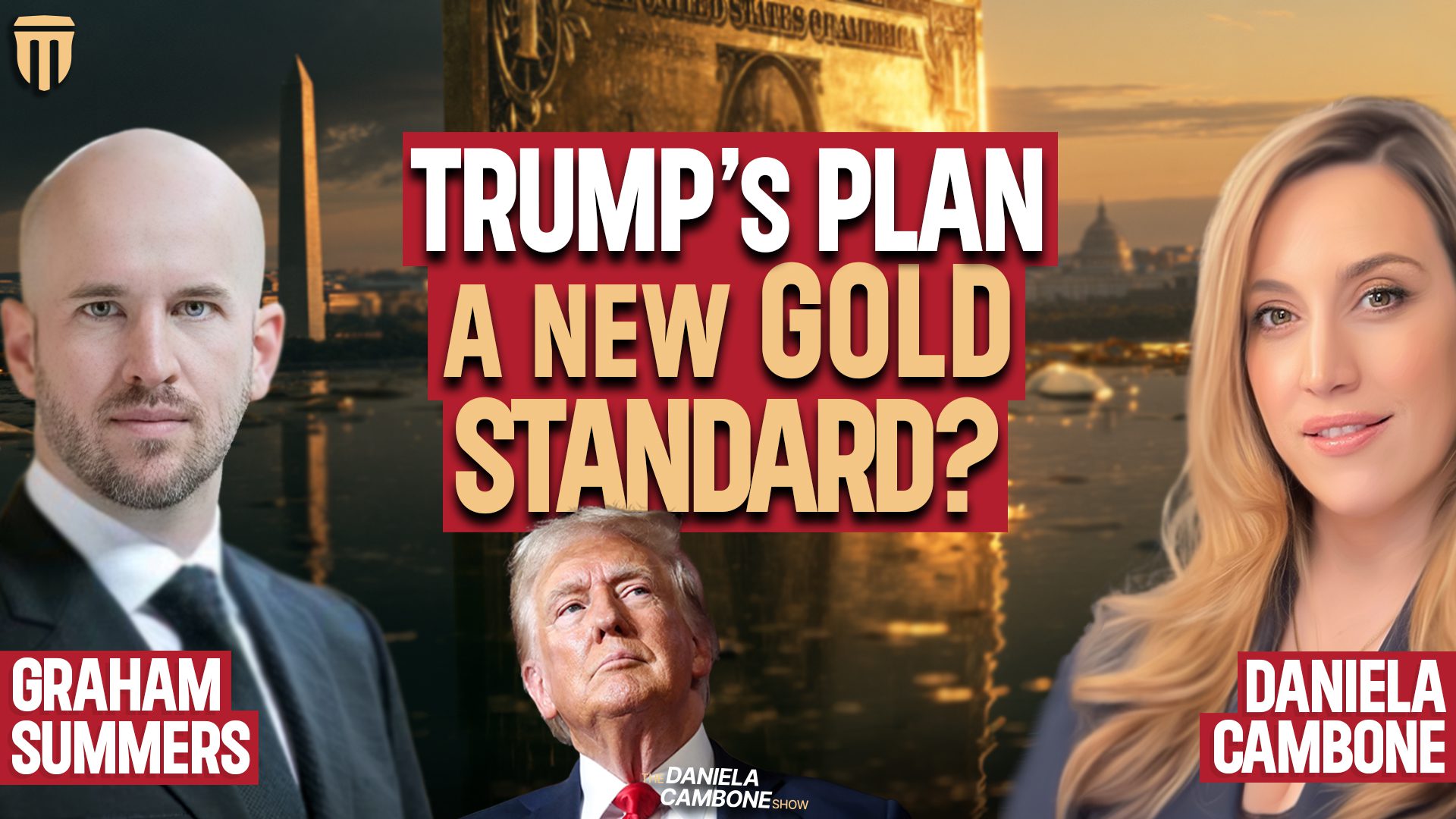
Washington spent decades treating gold like a monetary relic. Now Washington is talking about gold again—and the timing is difficult to dismiss.
In a matter of weeks, the White House accelerated its critical-minerals push, Senator Rand Paul visited the gold stored at Fort Knox, and senior policymakers put renewed attention on America’s strategic mineral reserves.
At the same time, gold has been trading around $4,400 an ounce, while central banks continue accumulating bullion at historically elevated levels.
None of this proves Washington has secretly decided to restore a gold-backed dollar.
But it does raise a much more important question:
Why is gold suddenly back in the conversation after Washington spent decades acting as though it no longer mattered?
That was the question Daniela Cambone put to Phoenix Capital Research founder Graham Summers—and his answer was simple: something has clearly changed.
Washington Is Talking About Gold Again
Gold has always occupied an awkward position in modern finance.
It sits outside the banking system. It cannot be created by a central bank. It carries no counterparty promise. And historically, it served as a restraint on governments’ ability to expand the supply of currency without limit.
That restraint changed dramatically in August 1971, when President Richard Nixon suspended the dollar’s convertibility into gold, effectively shutting the “gold window” and helping bring the Bretton Woods monetary system to an end.
For decades afterward, mainstream portfolio construction revolved overwhelmingly around stocks, bonds and dollar-denominated financial assets.
Gold never disappeared.
But politically, it largely disappeared from the conversation.
That is why today’s shift deserves attention.
Summers pointed to Treasury Secretary Scott Bessent publicly discussing America’s gold holdings and the country’s historical relationship with gold and silver.
Then came Senator Rand Paul.
Paul traveled to Fort Knox and said afterward that approximately 147 million ounces of gold were there. That figure aligns with the U.S. Mint’s official accounting: Fort Knox holds 147,341,858.382 fine troy ounces of gold.
The real story may not be whether the gold exists.
The bigger question is:
Why are senior officials suddenly making a point of reminding Americans that it does?
The Critical Minerals Race Has Become a National Security Strategy
The gold discussion is occurring alongside something potentially even bigger: Washington’s aggressive attempt to rebuild America’s domestic mineral supply chain.
On August 7, 2026, the White House announced more than $2 billion in new critical-mining and mining-related projects, along with more than $180 million aimed at mining education and workforce development.
This is not being framed merely as industrial policy.
It is being framed as national security.
A July 30 presidential determination warned that America’s inadequate supplies of critical minerals and materials create increasing risks to national defense and that dependence on foreign sources leaves the country vulnerable to serious supply disruptions.
The concern is straightforward.
Modern economies cannot build advanced weapons systems, data centers, electrical infrastructure, semiconductors, batteries and AI hardware without enormous quantities of physical resources.
You can write software in Silicon Valley.
You cannot code copper, uranium, silver or rare-earth minerals into existence.
And Washington increasingly appears to understand that distinction.
Silver Is Officially Critical—And That Matters
Silver now sits directly inside this national-security conversation.
The U.S. Geological Survey’s final 2025 List of Critical Minerals added 10 minerals, including copper, uranium—and silver.
That designation matters because silver is far more than a monetary metal.
Its conductivity and physical properties make it important across modern technology and electrical applications.
In the framework discussed by Summers, the battle over critical minerals increasingly intersects with the U.S.-China race for technological and AI dominance.
Think about what that means.
The same silver investors have historically owned as a store of value is increasingly connected to:
- Electrical infrastructure
- Advanced electronics
- Data-center expansion
- Defense technologies
- Energy systems
- Strategic domestic manufacturing
Silver now lives in two worlds at once: monetary uncertainty and industrial scarcity.
That combination is precisely why silver deserves attention when governments begin talking about securing strategic resources.
But Gold Is the Telltale Exception
Here is where the story gets more interesting.
Silver is formally listed as a critical mineral.
Gold is not.
That does not mean gold is unimportant.
The federal critical-minerals framework evaluates supply-chain vulnerability, including the risk created by dependence on foreign sources. The United States has substantial domestic gold production and is not dependent on geopolitical rivals for gold in the same way it is for certain other minerals.
So gold does not neatly fit the same supply-security test.
But that misses the monetary question.
Silver may be strategically critical because industry needs it. Gold may be strategically important for an entirely different reason: trust.
And trust is becoming one of the world’s scarcest financial assets.
Fort Knox Is About More Than 147 Million Ounces
Rand Paul’s Fort Knox visit immediately revived one of America’s favorite monetary debates: Is all the gold actually there?
Official records say yes.
The U.S. Mint currently reports roughly 147.3 million ounces at Fort Knox, representing a major portion of America’s government-owned gold stock.
But Paul used the visit to make a broader argument.
The important question, he suggested, is what has happened to the purchasing power of the dollar since the gold link disappeared.
That concern is not theoretical for retirees.
The Bureau of Labor Statistics reported that consumer prices were still rising 3.4% year over year in July 2026, with energy prices up 14.7% over the same period.
One year of inflation is uncomfortable.
Decades of compounded inflation can fundamentally alter retirement mathematics.
What once paid for groceries, insurance, housing or medical care requires progressively more dollars.
That is the hidden tax of currency debasement:
Your account balance can remain intact while your purchasing power quietly disappears.
Gold vs. Dollar: The 1971 Question Never Went Away
August 15, 1971 changed the monetary system.
Before Nixon closed the gold window, foreign monetary authorities operating under Bretton Woods could convert dollars into gold at an official rate.
Afterward, the dollar ultimately became a purely fiat reserve currency—its value no longer directly redeemable into a fixed quantity of gold.
That gave policymakers dramatically more monetary flexibility.
It also removed the old mechanical constraint.
Governments could run larger deficits.
Central banks could expand balance sheets.
Credit could grow far faster than the underlying supply of monetary gold.
And savers were left with a fundamental question:
What anchors the long-term value of currency when currency itself can be created in effectively unlimited quantities?
For more than five decades, the answer from policymakers has largely been credibility.
Today, that credibility is being tested by debt, deficits, inflation and geopolitical fragmentation.
And central banks themselves appear increasingly interested in an asset that requires no government’s promise.
Gold.
Central Banks Are Voting With Their Balance Sheets
This may be the most important part of the story.
Forget speeches.
Watch reserves.
The World Gold Council reported in its 2026 central-bank survey that central banks accumulated an average of roughly 1,000 metric tons of gold annually over the previous four years, roughly double the average pace of the preceding decade.
A record 45% of surveyed central banks said they expected their own gold holdings to increase over the following 12 months.
That should get every saver’s attention.
Central banks can create currency.
Yet many of them are choosing to accumulate an asset they cannot print.
That does not automatically mean the dollar is about to collapse.
It does mean reserve managers are increasingly valuing diversification, geopolitical resilience and assets without counterparty exposure.
When the institutions running the fiat system keep increasing their exposure to gold, individual investors should at least ask why.
Is Washington Preparing a Gold-Backed Dollar?
This is where speculation has to be separated from evidence.
There has been no public announcement that Washington intends to restore a gold standard or formally back the dollar with gold.
And rebuilding a modern monetary system around gold would involve enormous political, financial and operational questions.
But Summers’ argument is more subtle.
Washington does not need to announce a gold-backed dollar tomorrow for today’s signals to matter.
Look at the sequence:
- Washington is aggressively securing strategic minerals.
- Silver has officially become a U.S. critical mineral.
- Senior officials are publicly discussing America’s gold holdings.
- A sitting senator made a high-profile visit to Fort Knox.
- Central banks worldwide continue increasing their strategic interest in gold.
- Gold itself has moved back toward roughly $4,400 in mid-August.
Any one of those developments can be dismissed.
Taken together, they suggest gold is re-entering serious strategic conversations after decades on the sidelines.
That does not prove a secret monetary reset.
But waiting for an official press conference announcing that the monetary system has changed has never been a particularly effective risk-management strategy.
Markets usually move first.
The AI Arms Race Is Really a Natural-Resource Race
Summers made another point investors should not overlook.
Artificial intelligence looks digital.
Its infrastructure is anything but.
Every new data center requires massive physical systems:
- Power generation
- Transmission equipment
- Cooling infrastructure
- Copper wiring
- Specialized electronics
- Critical minerals
- Backup power
- Semiconductor supply chains
The AI race between the United States and China therefore cannot be separated from control over commodities and processing capacity.
Washington’s critical-minerals push recognizes this.
The White House has repeatedly described mineral supply chains as essential to defense, energy and economic security.
The uncomfortable reality is that America’s futuristic technological ambitions depend on some of the oldest businesses on Earth:
Mining. Refining. Smelting. Energy. Metals.
The digital economy still rests on physical foundations.
Gold & Silver: Tangible Assets in an Increasingly Intangible System
This is where the conversation becomes personal.
Most retirement wealth today exists as digital claims:
Bank balances.
Brokerage statements.
Bonds.
Stocks.
Pensions.
Money-market funds.
Those assets can play important roles in a diversified portfolio.
But they also exist within the financial system.
Physical gold and silver are different.
They are tangible assets that do not depend on a bank’s solvency, a corporation’s earnings, a government’s fiscal discipline or a central bank’s promise to preserve purchasing power.
That is why precious metals have historically been considered tools for wealth preservation, particularly during periods of monetary instability.
Gold can serve as an inflation hedge over long periods, although its price can be volatile over shorter periods and it does not move perfectly with inflation every year.
Silver adds another dimension because it combines monetary history with growing industrial importance.
The gold vs. dollar debate is therefore not really about predicting the exact date of a currency crisis.
It is about diversification.
It is about asking what portion of your wealth depends on someone else’s promise—and what portion exists outside that promise.
What Retirement Savers Should Be Watching Now
For financially conservative Americans, several signals deserve close attention.
First, watch government behavior instead of government rhetoric.
When Washington starts committing billions of dollars to mineral security, it is telling you resource scarcity has become strategic.
Second, watch central banks.
Their continued accumulation of physical gold says something about how the world’s most sophisticated reserve managers are thinking about monetary and geopolitical risk.
Third, watch purchasing power—not merely account balances.
A retirement portfolio that rises in nominal dollars can still lose ground if the cost of living rises faster.
And finally, watch gold and silver as insurance, not simply as trades.
The objective of physical precious metals is not necessarily to guess tomorrow’s price.
For many conservative investors, the objective is to preserve a portion of purchasing power through circumstances nobody can predict with precision.
Conclusion: Washington May Be Telling Us More Than It Realizes
There is no confirmed secret order to put America back on a gold standard.
There does not need to be one for this moment to matter.
Gold is back in Washington’s vocabulary. Silver is officially critical. Fort Knox is back in the headlines. Central banks are accumulating bullion. And the United States is treating control over physical resources as a matter of national security.
The financial establishment spent decades telling investors that the future was increasingly digital, increasingly financialized and increasingly sophisticated.
Washington’s latest actions point toward an older truth:
When national security, monetary credibility and geopolitical power are on the line, physical assets suddenly matter again.
The question is not whether every American should abandon conventional investments.
The question is whether your retirement strategy assumes today’s monetary system will operate exactly as it has in the past.
Because governments are already preparing for a world that may look very different.
Shouldn’t you?
About ITM Trading
ITM Trading has over 28 years of experience helping clients safeguard their wealth through personalized strategies built on physical gold and silver. Our team of experts delivers research-backed guidance tailored to today’s economic threats.
THINKING ABOUT PURCHASING GOLD & SILVER?
Get expert guidance from our team of analysts with 28+ years of experience.
👉 [SCHEDULE YOUR CALL HERE] or call 866-706-9061