Gold Becomes the “New Money”As Bonds Blow Up, China To Control Price – Piepenburg
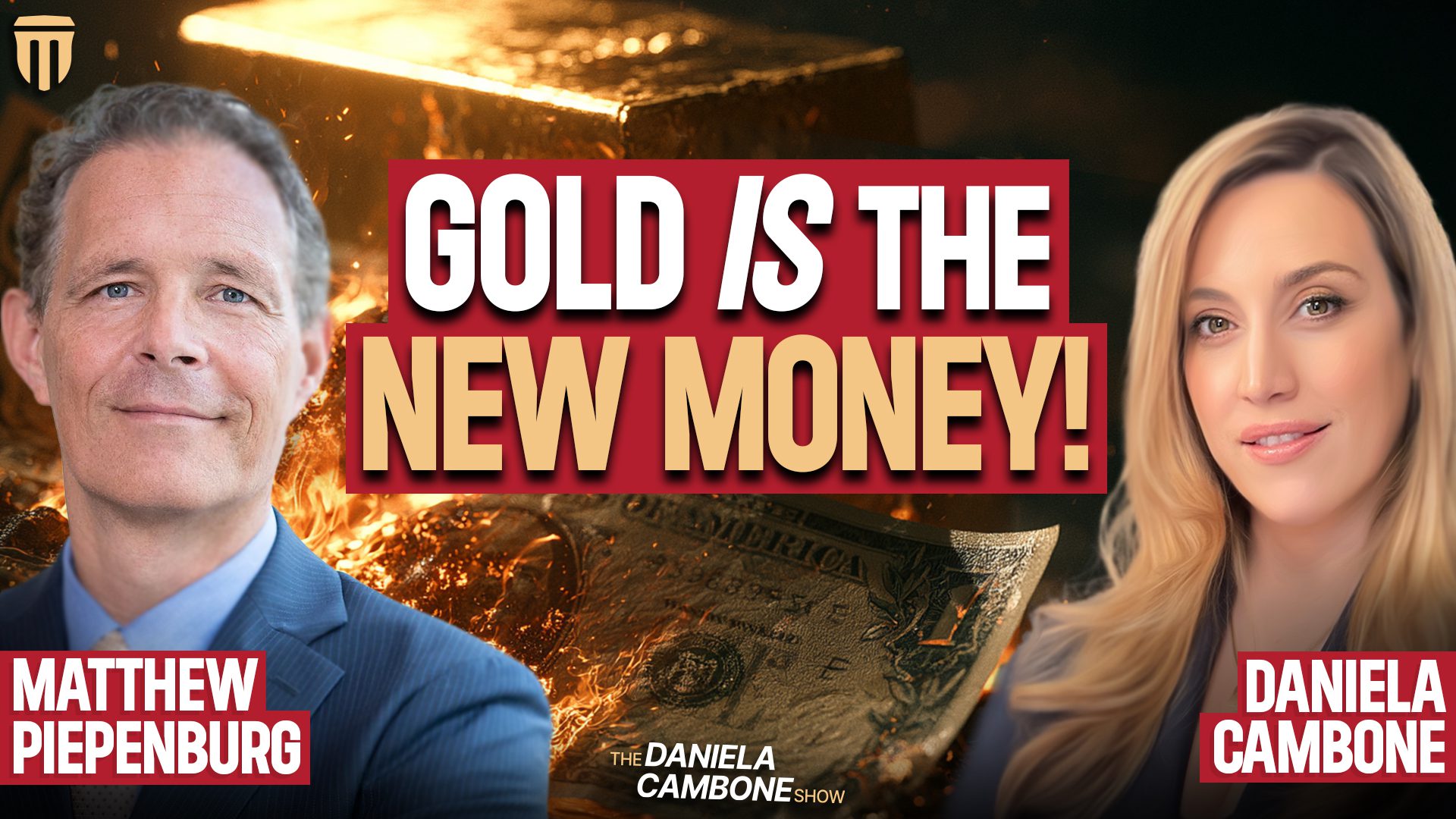
What if gold’s recent volatility isn’t evidence that the bull market is over—but cover for a much larger monetary shift already underway?
According to former hedge fund manager and Von Greyerz partner Matthew Piepenburg, gold as new money is no longer a fringe monetary argument. It is increasingly about collateral, trust, and what central banks choose to own as confidence in government debt and paper currencies deteriorates.
His message to Daniela Cambone is simple: stop looking at gold like a trader watching the next price candle and start watching where the largest pools of capital are moving.
Because while retail investors agonize over corrections, Piepenburg argues that central banks and China are playing a much longer game.
And the latest data make that argument harder to dismiss.
Gold as New Money: Watch What Central Banks Are Doing
For decades, gold was dismissed in much of the financial mainstream as a relic—an asset that produced no yield and belonged to another monetary era.
Central banks apparently didn’t get the memo.
The World Gold Council reported that central banks purchased 863 tonnes of gold in 2025. That was below the extraordinary 1,000-plus-tonne pace of the preceding three years, but still dramatically above the 2010–2021 annual average of 473 tonnes. (World Gold Council)
The trend has continued in 2026, though with important nuance. Following a subsequent revision to first-quarter estimates, central-bank net demand totaled 345 tonnes in the first half of 2026, the lowest first-half level since 2022. But Q2 alone saw purchases jump to 289 tonnes—a record for a second quarter. (World Gold Council)
More revealing may be what reserve managers themselves expect next.
A 2026 World Gold Council survey found:
- 89% of surveyed central-bank reserve managers expect global official gold holdings to rise over the next 12 months.
- A record 45% expect their own institution to increase its gold reserves.
- 83% expect gold to represent a larger share of global reserves five years from now.
- The World Gold Council noted that gold had recently overtaken U.S. government bonds as the top reserve asset. (World Gold Council)
That is the bigger story.
The institutions responsible for protecting national reserves are increasingly treating gold not as a speculative trade, but as strategic monetary insurance.
China Isn’t Waiting for the West to Fix Its Debt Problem
Piepenburg places China at the center of this monetary transition.
His argument isn’t that the dollar disappears tomorrow, or that Beijing announces a fully gold-backed yuan next week. It’s that China understands the direction of travel: rising sovereign debt, repeated currency debasement, geopolitical fragmentation, and declining confidence in Western financial infrastructure.
And Beijing has been accumulating accordingly.
By July 2026, the People’s Bank of China had reported 21 consecutive months of gold purchases, the longest streak on record. Its official holdings reached approximately 2,366 tonnes after adding another 20 tonnes in July. (World Gold Council)
China’s broader gold flows are equally striking.
According to World Gold Council data, China imported 764 tonnes of gold during the first half of 2026, up 138% year over year. Chinese gold ETFs also attracted RMB45 billion—roughly US$6.3 billion—in net inflows between January and July despite significant outflows during May and June. (World Gold Council)
Piepenburg’s point is not that every Chinese investor suddenly abandoned stocks for bullion.
It’s that China is methodically increasing its exposure to gold while simultaneously building infrastructure designed to give Asian markets a larger role in how gold is traded, settled, stored, and ultimately priced.
Is China Trying to Take Control of Gold Price Discovery?
This is where the story gets much bigger than central-bank buying.
Piepenburg argues that the next phase of the gold market could involve a gradual shift away from Western, derivatives-heavy price discovery toward markets with stronger connections to physical metal.
That shift is no longer theoretical.
On July 7, 2026, Hong Kong began trial operations of a new central gold clearing and settlement system. The infrastructure connects participants with designated vaults, facilitates deposits and withdrawals of physical gold, and includes a “Delivery Connect” program with the Shanghai Gold Exchange. Hong Kong also launched a new gold reference-price ticker aimed at increasing regional price discovery. (GovHK)
Hong Kong has separately outlined plans to expand gold storage capacity to more than 2,000 tonnes within three years, while strengthening connections between on-exchange, over-the-counter, storage, clearing, and physical-delivery markets. (GovHK)
Does this mean China can simply dictate tomorrow’s global gold price?
No.
But it does mean the assumption that London and New York will permanently dominate gold price discovery deserves more scrutiny.
Physical gold is moving east, Asian trading infrastructure is expanding, and China is building the plumbing required to have greater influence over the market.
That is a structural development—not another daily price headline.
The Bond Market Is Where the Real Danger Lives
For Piepenburg, gold is only half of the story.
The other half is bonds.
“The bond market is everything,” he told Cambone, arguing that rising government yields create a vicious cycle for heavily indebted governments. Higher yields mean higher refinancing costs. Higher financing costs increase fiscal pressure. And eventually, governments and central banks face stronger incentives to use financial repression, monetary expansion, or currency debasement to keep the system functioning.
That matters because sovereign bonds occupy the foundation of the modern financial system.
They are collateral for banks. They anchor discount rates. They influence mortgages, corporate borrowing, equity valuations, pensions, insurance portfolios, and currencies.
When government debt becomes unstable, the consequences rarely remain confined to the bond market.
Piepenburg also points to Japan’s carry trade as a major vulnerability. For decades, investors could borrow cheaply in yen and deploy that capital into U.S. Treasuries and risk assets. If that trade reverses, investors may be forced to unwind positions, repurchase yen, and sell other assets to raise liquidity.
That is why seemingly obscure movements in Japanese yields can suddenly matter to an American retiree holding a traditional stock-and-bond portfolio.
The financial system is interconnected precisely where most investors assume they are diversified.
The Dollar Doesn’t Have to Collapse for Gold to Win
One of Piepenburg’s more important distinctions is also one that gets lost in sensational headlines.
He is not arguing that the U.S. dollar disappears.
He is arguing that its purchasing power and monetary dominance can erode gradually.
Those are very different things.
A currency can remain the world’s dominant medium of exchange while still losing purchasing power over time. It can remain essential to global trade even as central banks diversify part of their reserves into assets carrying less counterparty or political risk.
And that helps explain why the gold story is bigger than predictions about a sudden “dollar collapse.”
You don’t need the dollar to go to zero for monetary debasement to matter.
You only need your dollars to buy progressively less.
For retirees and savers, that loss of purchasing power is not an abstract macroeconomic debate. It directly affects what a lifetime of savings can actually purchase.
Physical Gold and Silver: Tangible Assets in a Paper System
This is where physical gold and silver enter the wealth preservation conversation.
A Treasury bond is somebody else’s liability.
A bank deposit depends on a banking institution.
A stock depends on the earnings and solvency of a corporation.
A currency depends ultimately on confidence in the institution issuing it.
Physical gold carries no corresponding issuer liability.
That distinction is central to the case for gold as an inflation hedge, tangible asset, and long-term wealth preservation tool.
Silver can play a complementary role. Unlike gold, silver has substantial industrial demand and generally experiences greater price volatility. But physical silver also exists outside the purely digital architecture of modern finance and has served as monetary metal across centuries.
The relevant comparison isn’t simply gold vs dollar based on what happened this week.
It’s what each represents.
The dollar is a claim issued within a debt-based monetary system. Gold is a finite tangible asset whose ownership does not require another party to make good on a promise.
That doesn’t mean gold or silver rise every day. They don’t.
It doesn’t mean they eliminate investment risk.
They don’t.
It means investors concerned about inflation, monetary instability, sovereign debt, currency debasement, or financial-system counterparty risk have historically looked to physical gold and silver as assets held outside that chain of promises.
Ignore the Noise—Watch the Monetary Architecture
Gold can fall sharply.
It can frustrate investors for months or years. Traders can be forced out of positions. Mining shares can behave very differently from physical bullion. And no serious investor should confuse a long-term thesis with a guarantee of short-term price appreciation.
That is precisely Piepenburg’s distinction between investing and trading.
His argument is that today’s gold price matters less than the monetary architecture forming underneath it.
Central banks are still accumulating substantial quantities of gold. China continues increasing its reported reserves. Hong Kong and Shanghai are creating deeper physical-market infrastructure. And reserve managers are openly discussing a future in which gold occupies a larger share of the global reserve system.
Maybe the most important question isn’t whether gold has become expensive.
Maybe it’s why some of the world’s largest monetary institutions keep wanting more of it.
If the bond market becomes increasingly difficult to finance without further currency debasement, the answer may become clearer.
And by then, the shift from paper promises toward tangible assets may be much harder for investors to ignore.
About ITM Trading
ITM Trading has over 28 years of experience helping clients safeguard their wealth through personalized strategies built on physical gold and silver. Our team of experts delivers research-backed guidance tailored to today’s economic threats.
THINKING ABOUT PURCHASING GOLD & SILVER?
Get expert guidance from our team of analysts with 28+ years of experience.
👉 [SCHEDULE YOUR CALL HERE] or call 866-706-9061
The draft uses Daniela and Matthew Piepenburg’s transcript as the primary narrative source and follows the provided provocative, data-driven Zero Hedge-style framework.