$8,000 Gold Incoming: WEAKER Dollar ONLY Way America Survives Debt Cancer – Tavi Costa
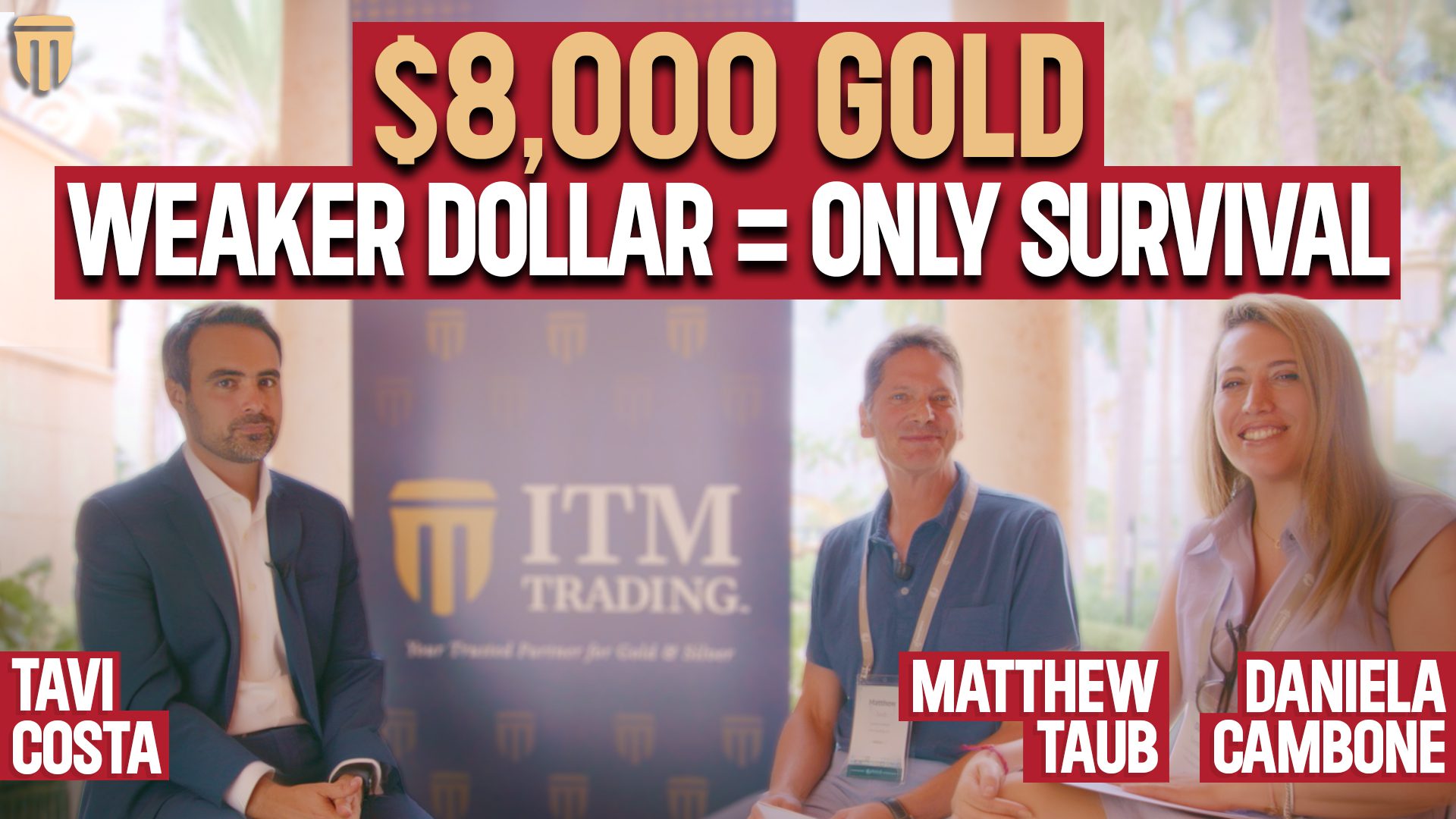
$8,000 Gold Incoming: WEAKER Dollar ONLY Way America Survives Debt Cancer – Tavi Costa
America’s Debt Problem Has Reached a Breaking Point
What if the biggest threat to your retirement isn’t inflation alone—but America’s own debt burden?
For decades, investors have been told that the United States can continue borrowing indefinitely because the dollar remains the world’s reserve currency. But according to macro investor Tavi Costa, that assumption is becoming increasingly dangerous. His argument is simple yet profound: if America wants the U.S. dollar to survive, it must first allow the dollar to weaken.
That idea sounds counterintuitive. Conventional wisdom says a strong dollar reflects economic strength. Costa argues the opposite. In today’s environment of record government debt, soaring interest costs, and persistent fiscal deficits, an excessively strong dollar could actually accelerate the financial pressures threatening the U.S. economy.
Speaking with Daniela Cambone and Matthew Taub at the Rick Rule Symposium, Costa outlined why he believes debt—not inflation—is becoming the defining economic story of the next decade. More importantly, he explained why this environment could become one of the most bullish periods for gold and silver investors in modern history.
America’s Debt Is Becoming More Expensive Every Year
The size of America’s debt is no longer the only concern.
The cost of carrying that debt is rapidly becoming the real crisis.
Costa points out that debt itself isn’t inherently dangerous. Households, businesses, and governments all borrow money. Problems begin when servicing that debt consumes an ever-growing share of income.
His concern centers on one critical metric:
- Interest expenses continue climbing.
- Government spending increasingly goes toward debt service instead of productive investment.
- Less capital remains for infrastructure, education, healthcare, or economic growth.
Costa compares the federal budget to a pie.
Every year, a larger slice must be devoted simply to paying interest.
That leaves progressively less available for investments that actually strengthen the economy.
He describes this growing interest burden as “a real cancer in the system.”
Unlike many economic cycles, this isn’t a temporary slowdown—it represents a structural problem that compounds over time.
Why a Strong Dollar Could Actually Hurt America
Most Americans instinctively view a stronger dollar as positive.
Cheaper imports.
Lower inflation.
Greater purchasing power.
But reserve currencies operate under a different set of rules.
Costa argues that America’s global role creates an entirely different challenge.
If interest rates remain elevated while the dollar stays exceptionally strong:
- Foreign borrowers struggle to service dollar-denominated debt.
- Global demand weakens.
- Export competitiveness declines.
- Treasury financing becomes increasingly difficult.
Instead, Costa believes policymakers eventually face an unavoidable decision:
Allow the dollar to weaken enough to ease debt pressures throughout the financial system.
A softer dollar would also make American exports more competitive while reducing the real burden of outstanding debt.
It would not solve America’s fiscal problems overnight.
But it could buy policymakers valuable time.
Lower Interest Rates May Become an Economic Necessity
Costa believes the Federal Reserve’s long-term options are becoming increasingly limited.
His reasoning isn’t based solely on inflation.
It’s based on mathematics.
Higher interest rates dramatically increase government financing costs.
As debt compounds into the tens of trillions of dollars, even relatively modest rate increases translate into hundreds of billions in additional annual interest expenses.
That creates a difficult policy dilemma.
Raise rates aggressively to fight inflation…
…or lower rates to prevent debt servicing costs from overwhelming the federal budget.
Costa believes the second outcome becomes increasingly likely over the next several years.
If rates eventually fall:
- Treasury yields decline.
- Debt servicing costs ease.
- Liquidity expands.
- Precious metals historically benefit.
For long-term investors, this policy shift could become one of the most important macroeconomic developments of the decade.
The Twin Deficit Is Becoming Impossible to Ignore
Costa also highlights another structural problem many investors overlook:
America is running both:
- A fiscal deficit
- A trade deficit
Economists often refer to this as the Twin Deficit Problem.
Normally, governments can address fiscal imbalances by cutting spending.
But Costa argues the U.S. economy has become heavily dependent on government expenditures.
Aggressive spending cuts could trigger far more than a recession.
They could create a severe economic contraction.
That leaves policymakers with very few politically acceptable solutions.
Costa believes weakening the dollar becomes one of the only remaining mechanisms capable of helping rebalance trade while simultaneously easing debt pressures.
This isn’t simply about currency markets.
It’s about preserving the functioning of the entire financial system.
Why Tavi Costa Believes Gold Could Reach $8,000
Perhaps Costa’s boldest prediction is his long-term $8,000 gold target.
While a weaker dollar certainly supports higher gold prices, he argues it is only one piece of a much larger puzzle.
The real catalyst, in his view, is the condition of the U.S. Treasury market.
Today, America’s official gold reserves represent only a tiny fraction of the nation’s outstanding debt. Costa contrasts this with earlier monetary systems, when gold backed a much larger percentage of government liabilities.
That raises an important question:
What happens if confidence in government debt continues to erode?
Costa believes policymakers may eventually have only two realistic options:
- Continue accumulating physical gold quietly over many years.
- Officially revalue the nation’s gold reserves at significantly higher prices.
Neither outcome would happen overnight.
In fact, Costa suggests governments would almost certainly purchase additional gold before publicly acknowledging such a strategy.
As he notes, no serious buyer announces major purchases before completing them.
For investors, this possibility reinforces an important reality:
Central banks continue treating gold as a strategic monetary asset—not simply another commodity.
Could America Eventually Revalue Its Gold?
One of the more fascinating parts of Costa’s thesis centers on the possibility of a future gold revaluation.
He explains that dramatically increasing the official price of gold could strengthen the government’s balance sheet without creating additional physical ounces.
While speculative, the concept isn’t without historical precedent.
The United States has altered the official price of gold before, most notably during the Great Depression when the Gold Reserve Act effectively raised gold’s value relative to the dollar.
Costa believes any future revaluation would likely require one condition first:
The United States would need confidence that it possesses sufficient gold reserves relative to competing nations.
Until then, he believes quietly accumulating additional gold would be the more logical path.
Whether or not this scenario unfolds exactly as envisioned, it underscores gold’s continuing importance within the global monetary system.
The Federal Reserve’s Credibility Challenge
Costa also questioned whether the Federal Reserve can realistically maintain its current inflation-fighting stance.
He outlined several possible policy paths:
- Continue raising interest rates aggressively.
- Raise the inflation target.
- Change the way inflation is measured.
Costa believes the third option may prove the most politically acceptable.
Adjusting inflation calculations could create room for lower interest rates while allowing policymakers to argue that inflation remains under control.
Whether that ultimately occurs remains uncertain.
However, the broader implication is clear:
Financial markets may increasingly depend on policy adjustments designed to reduce debt servicing costs rather than aggressively combat inflation.
Historically, environments featuring lower real interest rates have often provided strong support for gold and silver prices.
Why Gold and Silver Continue to Matter
Throughout history, periods of excessive debt accumulation have often been accompanied by currency debasement.
While every economic cycle differs, one lesson remains remarkably consistent:
Hard assets tend to outperform when confidence in fiat currencies weakens.
Physical gold and silver have historically served as:
- Stores of long-term value.
- Inflation hedges.
- Diversifiers during market volatility.
- Assets with no counterparty risk.
Unlike paper assets, physical precious metals are not dependent upon corporate earnings, bank solvency, or government promises.
As debt levels rise and monetary policy becomes increasingly accommodative, many investors continue viewing gold and silver as essential components of a diversified wealth preservation strategy.
Wealth Preservation in an Era of Rising Debt
If Costa’s outlook proves even partially correct, the next decade could look very different from the last.
Lower interest rates.
A weaker dollar.
Persistent fiscal deficits.
Growing government debt.
These are precisely the types of macroeconomic conditions that have historically benefited tangible assets.
For investors approaching retirement or seeking to preserve purchasing power across generations, physical gold and silver offer characteristics that many traditional financial assets simply cannot replicate.
Rather than attempting to predict exact market tops or bottoms, Costa encourages gradual accumulation over time.
His philosophy mirrors one embraced by many long-term precious metals investors:
Build positions consistently.
Remain patient.
Focus on preserving purchasing power instead of chasing speculative returns.
Conclusion
America’s debt burden is no longer a distant concern—it is becoming one of the defining economic challenges of our time.
According to Tavi Costa, the solution may not come through fiscal discipline alone. Instead, policymakers could increasingly rely on lower interest rates and a weaker dollar to reduce the growing weight of government debt.
If that path unfolds, the implications extend far beyond currency markets.
It could reshape the outlook for inflation, Treasury markets, global capital flows, and, perhaps most importantly, gold and silver.
Whether gold ultimately reaches $8,000 remains to be seen. But Costa’s broader message is clear: investors should pay close attention to the structural forces transforming the global financial system.
In periods of uncertainty, preserving purchasing power often becomes more important than maximizing returns.
For many investors, physical precious metals remain one of the few tangible assets designed for exactly that purpose.
About ITM Trading
ITM Trading has over 28 years of experience helping clients safeguard their wealth through personalized strategies built on physical gold and silver. Our team of experts delivers research-backed guidance tailored to today’s evolving economic threats.
THINKING ABOUT PURCHASING GOLD & SILVER?
Get expert guidance from our team of analysts with 28+ years of experience.
👉 SCHEDULE YOUR CALL HERE Or call 866-706-9061.