


Spain’s Border Crisis Escalates: Lacalle Issues Stark Warning to America
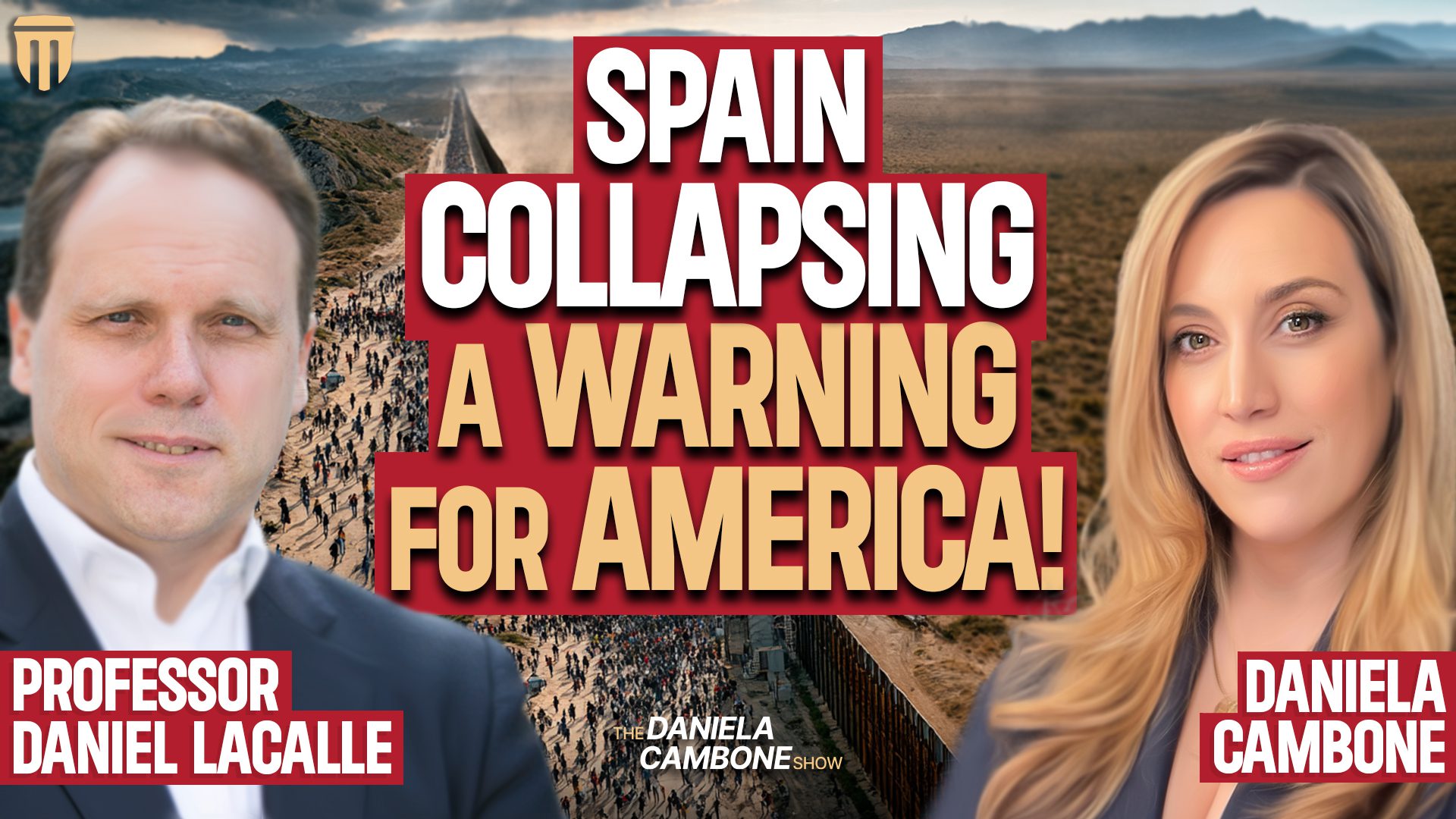
What happens when a government loses control of its border—and the economic consequences begin spreading far beyond the border itself?
The Spain border crisis has become a flashpoint in a much larger debate over migration, wages, government spending, public security, and the economic policies being pursued across Europe.
In a breaking interview with Daniela Cambone, economist and professor Daniel Lacalle argued that what is unfolding in Spain should serve as a warning to Americans.
His central argument is provocative: a country can report headline economic growth while its citizens experience stagnant productivity, pressure on real wages, worsening public finances, and declining confidence in the institutions meant to protect them.
And according to Lacalle, the United States should not assume it is immune.
[Link to related guide or post]
Spain Border Crisis: Why Ceuta Became the Flashpoint
Ceuta is a Spanish city located on the North African coast. With a population of roughly 84,000, it occupies an unusual geographic position: Spanish territory separated from mainland Spain by the Strait of Gibraltar.
According to the figures discussed in the interview, the city experienced an extraordinary influx of people within a matter of hours.
Lacalle characterized the episode not as an isolated accident, but as the culmination of years of migration and border policies that he believes created incentives for increasingly large inflows.
He pointed specifically to:
- Border enforcement he considers inadequate
- Regularization policies for undocumented migrants
- Government financial support
- Broader European migration policies
- Spain’s rapid population growth in recent years
Lacalle said Spain’s population has increased by more than 2 million people over approximately nine years.
His concern isn’t simply population growth.
It’s whether economic output, productivity, infrastructure, wages, housing, and government finances can absorb that growth without imposing increasingly visible costs on existing residents.
That distinction matters because a growing economy on paper doesn’t necessarily mean households are becoming wealthier.
The GDP Numbers May Not Tell the Whole Story
Governments love GDP growth.
It’s simple, measurable, and politically convenient.
But GDP can rise while GDP per capita, productivity, purchasing power, and household living standards tell a very different story.
That is at the heart of Lacalle’s criticism of Spain.
He argued that Spain has been able to report comparatively attractive headline GDP growth even as other indicators remain much less impressive.
Among the figures he cited:
- Approximately 3.7 million “real unemployed”
- Roughly 793,000 people he says are excluded from the official unemployment measure
- Official unemployment near 10%
- A figure he estimates is closer to 12.5% when those excluded workers are considered
- Roughly 86% of recent job creation, according to Lacalle’s cited period, associated with immigration
His question is straightforward.
If unemployment remains high, productivity is stagnant, and real wages are under pressure, what exactly does stronger headline GDP tell the average household?
That question extends far beyond Spain.
[Link to related guide or post]
Migration, Real Wages, and the Fiscal Pressure Nobody Wants to Discuss
Lacalle stressed an important distinction throughout the interview: his criticism is directed at illegal immigration and rapid regularization, not legal immigration.
He argued that uncontrolled migration can create three major economic and social pressures.
First, it can disadvantage immigrants attempting to enter legally and integrate through established processes.
Second, a sudden population shock can overwhelm local housing, healthcare, policing, transportation, and other essential services.
Third—and potentially most important over the long term—it can increase pressure on public finances while simultaneously weighing on wages in labor-intensive sectors.
Lacalle specifically identified industries such as:
- Tourism
- Agriculture
- Farming
- Hotels
- Service-sector employment
An expanding labor supply can help employers fill vacancies. But if labor supply grows faster than productive investment, critics argue the result can also be weaker wage bargaining power.
For retirees and conservative savers, this becomes part of a much bigger problem.
When governments face rising structural expenditures without equivalent improvements in productivity, they eventually have to find the money somewhere.
That can mean higher taxes, more borrowing, spending cuts—or monetary policies that reduce the purchasing power of existing currency over time.
Daniel Lacalle’s Warning to America
Daniela asked the question many Americans watching Europe are likely wondering:
Could something similar happen in the United States?
Lacalle’s answer was unequivocal: “Absolutely it can.”
He argued that border enforcement is one of the fundamental responsibilities of government, alongside public security and essential services.
More importantly, Lacalle warned Americans against viewing Europe’s experience as a uniquely European problem.
He pointed to the United States between 2021 and 2024, arguing that foreign workers represented a significant portion of employment growth during parts of that period while real net wage growth was weak.
His broader point was that uncontrolled migration isn’t simply a political or humanitarian debate.
It can become an economic issue involving:
- Labor supply
- Wage growth
- Housing
- Public services
- Government spending
- Social stability
- National security
And there is one major geographic difference.
Ceuta is separated from mainland Spain by water.
Once someone crosses the U.S. land border, Lacalle noted, that person is already inside the continental United States.
For America, the scale of the border makes enforcement an even larger logistical challenge.
The Bigger European Problem: Debt, Demographics, and Government Spending
The migration debate also intersects with Europe’s demographic crisis.
The standard argument is familiar: aging European countries need younger immigrants to expand their workforce and support increasingly expensive pension and welfare systems.
Lacalle challenges the premise.
He argues European governments simultaneously impose heavy tax burdens on younger and middle-class citizens—the very households that might otherwise have larger families—and then use declining birth rates as justification for aggressive migration policies.
Whether one agrees with that diagnosis or not, the underlying fiscal problem is difficult to ignore.
An aging population means fewer workers supporting more retirees.
Large welfare states require substantial tax revenue.
High sovereign debt leaves governments with less flexibility.
And weak productivity makes those obligations harder to finance through genuine economic growth.
That is where a demographic problem can become a currency problem.
And a currency problem is where owners of gold and silver tend to start paying attention.
Digital Euro and the Push for Greater Financial Control
The conversation then moved from Spain’s border to something seemingly unrelated: the digital euro.
But Lacalle sees a connection.
He pointed to two European initiatives:
- The European Central Bank’s proposed digital euro
- Europe’s effort to deepen its Savings and Investments Union
His concern is that policymakers increasingly want European savings directed toward European priorities rather than allowing capital to move freely toward assets and companies abroad.
Lacalle described the potential combination of a central bank digital currency and greater direction of private savings as a move toward increased financial control.
For Americans skeptical of CBDCs and government financial surveillance, Europe’s experiment deserves close attention.
A digital currency is not simply another version of electronic banking.
Depending on how it is ultimately designed, a CBDC can create a much more direct relationship between citizens, money, and central-bank infrastructure.
The question isn’t merely whether digital money is convenient. It’s how much control over money citizens are willing to place in centralized systems.
[Link to related guide or post]
Could Europe Be Heading Toward Another Debt Crisis?
The final part of Daniela’s conversation with Lacalle may have the greatest implications for global markets.
They discussed currency intervention involving the Japanese yen and the possibility of euros being sold as part of efforts to support the Japanese currency.
Lacalle interpreted this as a potential geopolitical and monetary warning to Europe.
Japan, he noted, has historically been an important buyer of European sovereign debt.
If major international holders were to reduce their exposure to euro-denominated sovereign bonds, European governments could face higher borrowing costs.
And that matters enormously when government debt is already elevated.
A heavily indebted government can tolerate low interest rates for a long time. What becomes dangerous is when investors demand substantially higher yields to keep financing it.
Rising yields mean:
- Higher government interest expense
- Greater refinancing pressure
- Less room for public spending
- Increased pressure for taxes or austerity
- Potential stress in banks holding sovereign bonds
Lacalle’s warning was stark: if large holders begin selling European sovereign debt, Europe could face another debt crisis.
Why Gold and Silver Matter When Trust Starts Breaking
Border policy, sovereign debt, CBDCs, demographic pressure, and weakening purchasing power may look like separate issues.
They share one important characteristic.
They all ultimately depend on confidence in government institutions and fiat currency systems.
Physical gold and silver operate outside that promise-based structure.
Gold does not require a government to balance its budget.
Silver does not depend on a central bank maintaining the purchasing power of its currency.
Physical precious metals do not depend on a corporation meeting its debt obligations.
That is why investors have historically considered precious metals as part of a wealth preservation strategy during periods of monetary and fiscal uncertainty.
The gold vs. dollar comparison is particularly relevant when governments respond to structural problems with more borrowing and monetary expansion.
Gold and silver are tangible assets rather than someone else’s liability.
That distinction becomes increasingly important when the risks investors are trying to hedge include:
- Currency devaluation
- Sovereign debt stress
- Persistent inflation
- Banking instability
- Capital controls or increased financial surveillance
- Loss of confidence in government institutions
Gold is often discussed as an inflation hedge, although its performance can vary significantly over shorter periods. Its deeper role in a diversified wealth strategy is monetary: physical gold has existed as a store of value across political regimes and currency systems for centuries.
Silver offers similar tangible characteristics while also having substantial industrial demand.
For financially conservative Americans, the objective isn’t necessarily predicting exactly which crisis happens next.
It’s reducing the consequences of being wrong if confidence in the financial system deteriorates faster than expected.
Spain May Be the Warning, Not the Exception
The images and accounts coming from Ceuta have pushed Spain’s border policies into the spotlight.
But Daniel Lacalle’s warning goes much further.
His argument is that governments cannot indefinitely use population growth and government spending to create attractive headline GDP figures while ignoring productivity, wages, unemployment, debt, and social strain.
And Americans should pay attention.
The United States faces its own combination of border disputes, enormous government debt, political division, currency concerns, and questions about the long-term purchasing power of the dollar.
Europe is simultaneously experimenting with a digital euro while confronting demographic and sovereign-debt pressures.
These risks don’t guarantee an imminent financial crisis.
But they do raise a more useful question for savers and retirees:
How much of your financial security depends on governments, currencies, and institutions continuing to operate exactly as expected?
Waiting until a crisis becomes obvious is rarely when protection is cheapest—or easiest to put in place.
For investors concerned about inflation, currency instability, government debt, or systemic financial risk, understanding how physical gold and silver may fit into a broader wealth preservation strategy is one way to prepare before the next shock arrives.
[Link to related guide or post]
About ITM Trading
ITM Trading has over 28 years of experience helping clients safeguard their wealth through personalized strategies built on physical gold and silver. Our team of experts delivers research-backed guidance tailored to today’s economic threats.
THINKING ABOUT PURCHASING GOLD & SILVER?
Get expert guidance from our team of analysts with 28+ years of experience.
👉 [SCHEDULE YOUR CALL HERE] or call 866-706-9061