Marc Faber: Debt Levels at Historic Extremes – “Be Prepared for Disaster”
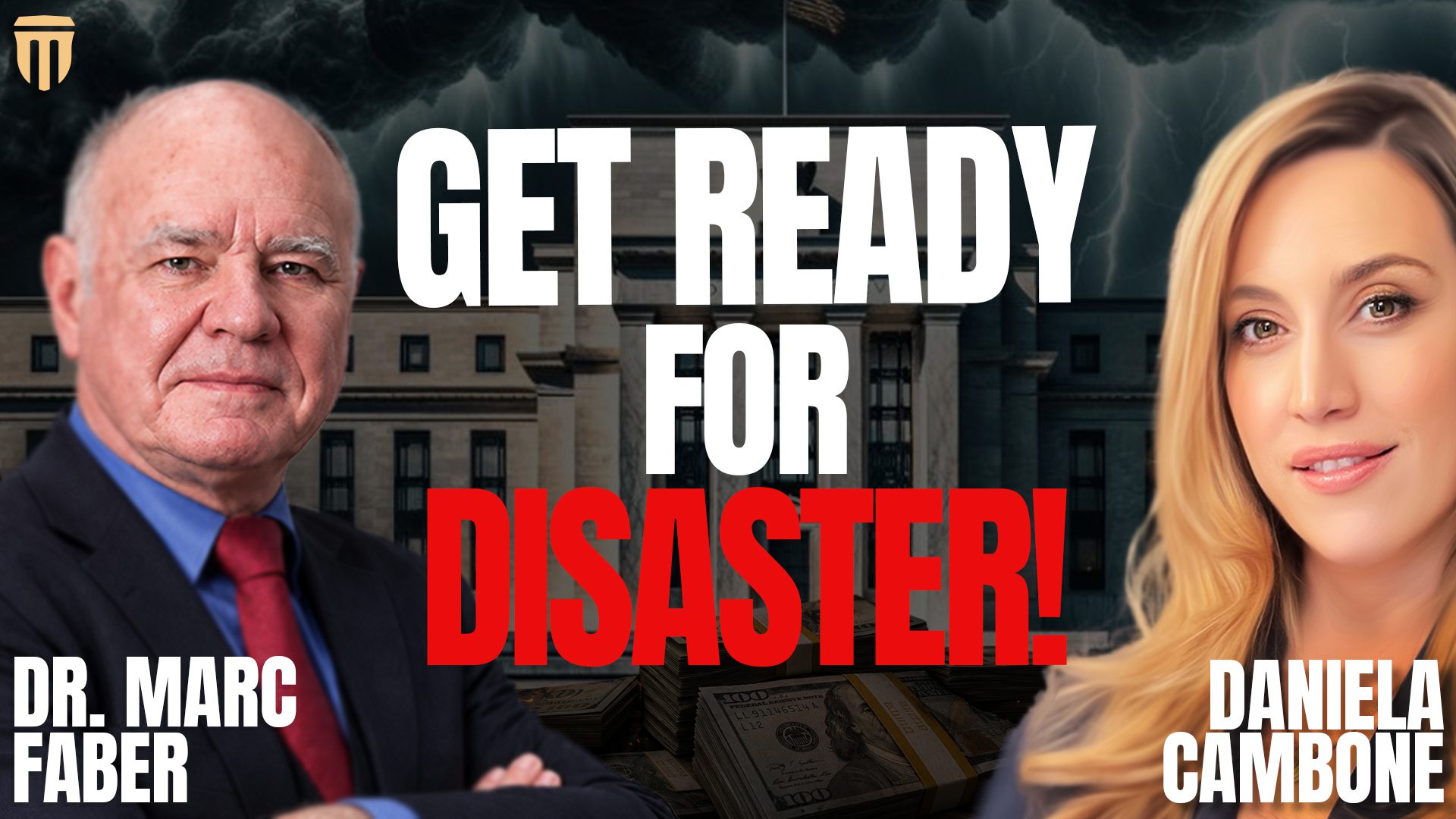
What happens when the world is drowning in debt, central banks can’t afford to raise interest rates, and investors are still betting that asset prices will keep climbing?
According to legendary investor Marc Faber, debt levels have reached dangerous extremes, leaving central banks facing a dilemma that could threaten financial markets, currencies, and retirement savings.
In a wide-ranging conversation with ITM Trading’s Daniela Cambone, Faber warned that the financial system has become increasingly vulnerable after decades of expanding credit, rising asset prices, and monetary intervention.
His concern isn’t simply that debt is too high. It’s that the traditional tools used to control inflation could now trigger the very financial crisis policymakers are trying to prevent.
And his warning is backed by troubling economic data.
According to the Congressional Budget Office, federal debt held by the public reached approximately 100% of U.S. GDP in fiscal year 2026, its highest level since 1946.
Meanwhile, the Federal Reserve Bank of New York reported that American household debt reached $19.1 trillion in the third quarter of 2026.
For Americans approaching retirement, the implications are significant: higher borrowing costs, persistent inflation, and asset-market volatility could all threaten the purchasing power of accumulated savings.
Faber’s message was simple:
“Be prepared for disaster.”
Historic Debt Levels Have Trapped the Federal Reserve
For decades, investors have operated under the assumption that central banks will intervene whenever financial markets experience serious trouble.
But Faber believes that assumption is becoming increasingly dangerous.
During his conversation with Cambone, he described the dilemma confronting monetary policymakers:
“If they tighten too much, there’s a debt crisis.”
But leaving monetary conditions too loose creates another potential problem: a loss of confidence in bonds and the currency.
This is the fundamental contradiction at the heart of today’s financial system.
- Raise interest rates: Governments, businesses, and households face higher borrowing and refinancing costs.
- Keep interest rates too low: Inflationary pressures can persist, undermining purchasing power.
- Expand the money supply: Liquidity support may temporarily stabilize markets but can create longer-term inflation and asset-pricing concerns.
- Allow financial markets to correct: Falling asset prices can damage household wealth and expose excessive leverage.
Faber argues that policymakers have allowed the financial system to become too dependent on easy monetary conditions.
The consequences could be especially serious because debt servicing costs continue to absorb resources that could otherwise support productive economic activity.
The CBO’s 2026 economic outlook projected that federal net interest costs would continue rising as a share of GDP over the coming decades.
The more debt a system carries, the more sensitive it becomes to higher interest rates.
And that sensitivity could become a defining feature of the next financial crisis.
The 40-Year Asset Boom May Be Reaching Its Limits
One of Faber’s most striking observations was that investors may be approaching the end of an extraordinary era.
He traced the beginning of the modern asset boom to the early 1980s, when bond yields began a long decline and stock markets entered a multidecade expansion.
For nearly 40 years, declining interest rates generally supported rising valuations across stocks, bonds, and real estate.
But that environment changed dramatically after 2020.
Faber pointed out that the 10-year U.S. Treasury yield fell to approximately 0.57% in August 2020 before entering a substantially higher interest-rate environment.
He believes the long-term trend of declining yields may have ended.
That could have enormous consequences for asset valuations.
Investors accustomed to falling interest rates can no longer safely assume the same conditions will continue indefinitely.
Faber also drew parallels to the early 1970s, when a relatively small group of popular companies dominated market performance.
Known as the “Nifty Fifty,” these stocks included once-powerful businesses such as Kodak, Polaroid, and Sears.
Many subsequently suffered severe declines, and several eventually lost their former dominance or disappeared.
He sees similarities in today’s highly concentrated equity markets, particularly the enthusiasm surrounding major technology companies and artificial intelligence.
Faber did not claim that every leading technology company would fail. Rather, he questioned whether investors were adequately pricing the risks of changing economic conditions and technological competition.
For retirees holding substantial investments in stocks, market concentration is a risk worth examining before a correction occurs.
Rising Interest Rates Could Trigger a Housing and Bond Market Shock
Faber also warned about the potential consequences of another significant increase in Treasury yields.
He offered a hypothetical scenario in which the 10-year U.S. Treasury yield rises from 5% to 6%.
Under that scenario, he suggested mortgage rates could approach 8%, placing additional pressure on an already strained housing market.
Higher mortgage rates can reduce affordability, discourage new buyers, and create downward pressure on property values.
Meanwhile, existing bondholders could suffer capital losses as yields rise.
The risks extend beyond Wall Street.
Households could face:
- Higher borrowing costs on variable-rate debt and new loans
- Reduced housing affordability
- Falling market values for existing fixed-rate bonds
- Greater financial pressure on highly leveraged businesses
- Increased volatility across retirement portfolios
Faber’s larger concern is that a heavily indebted economy has less flexibility to absorb these shocks.
The Federal Reserve Bank of New York’s third-quarter 2026 report showed household debt increasing by $334 billion in just three months.
That does not mean a widespread default crisis is inevitable. But it highlights how much household financial stability depends on employment, income growth, borrowing costs, and the ability to meet debt obligations.
A financial system can appear stable until refinancing becomes more expensive and weaker borrowers begin to struggle.
Inflation Is Quietly Redistributing Wealth
Perhaps Faber’s most important warning concerned the growing divide between asset owners and ordinary households.
He argued that monetary inflation has created an environment in which investors holding appreciating assets can benefit while workers and retirees struggle with higher living expenses.
He pointed to Germany’s historical hyperinflation as an example of how monetary disorder can radically redistribute wealth.
Drawing on economist Costantino Bresciani-Turroni’s work on German inflation, Faber explained that periods of severe inflation can enrich certain asset holders even as the purchasing power of ordinary households deteriorates.
His concern is that modern economies may be experiencing a less extreme version of the same dynamic.
Workers depend largely on wages. Retirees may rely on Social Security, pensions, and savings.
But asset owners can sometimes offset rising living costs through appreciation in stocks, real estate, or other investments.
Faber questioned whether official inflation measures fully capture the price pressures experienced by individual households.
The distinction matters.
A retiree’s personal inflation rate depends on the actual goods and services they purchase, particularly housing, healthcare, insurance, food, and utilities.
Even when income increases, purchasing power can decline if essential expenses rise faster.
The real danger isn’t simply losing dollars. It’s watching those dollars buy less every year.
And this is why understanding inflation protection becomes so important for long-term wealth preservation.
Could a U.S. Dollar Reset or Dual-Currency System Become a Reality?
Cambone pressed Faber on an even more unsettling possibility: Could the United States eventually experience some form of default or currency restructuring?
Faber discussed the historical use of dual-currency arrangements, in which different exchange rates or monetary units apply to different types of transactions.
He suggested a hypothetical system involving a financial dollar and a trading dollar.
Under such an arrangement, the purchasing power and value of different forms of currency could diverge.
Importantly, Faber presented this as a possibility, not as an announced or established U.S. policy.
He also acknowledged the historical difficulties associated with dual-currency systems.
Cambone raised the question of whether stablecoins or other digital financial instruments might become part of a future monetary restructuring.
Faber expressed skepticism toward cryptocurrencies and stablecoins, while acknowledging that younger generations often view digital assets differently.
His broader argument was about trust.
If confidence in paper currencies weakens, investors may increasingly question what constitutes a reliable long-term store of value.
That concern helps explain why Faber continues to hold physical gold despite his cautious near-term outlook for precious metals.
Why Marc Faber’s Largest Personal Holding Is Physical Gold
Despite warning that gold and other assets could experience further corrections, Faber made a revealing admission.
His largest personal holding is physical gold.
“I don’t even value it, I just keep it,” he told Cambone.
That distinction is important.
Faber isn’t necessarily holding gold because he expects an immediate surge in price.
He views it as a long-term store of wealth in a world where paper currencies may lose purchasing power.
Physical gold has several characteristics that distinguish it from conventional financial assets:
- Limited supply: Gold cannot be created through central-bank monetary policy.
- No issuer liability: Directly owned bullion is not dependent on a financial institution’s promise to repay.
- Global recognition: Gold has an established international market and a long monetary history.
- Tangible ownership: Physical bullion exists independently of digital payment systems.
- Long-term diversification: Gold can behave differently from traditional stocks and bonds, although those relationships vary over time.
Faber also emphasized the importance of where assets are held.
He advocated geographic diversification to reduce dependence on a single jurisdiction or custodian.
His warning was rooted partly in history.
In 1933, the United States imposed restrictions on private monetary gold ownership and required the delivery of certain gold holdings under federal rules. In 1934, the official gold price was increased from $20.67 to $35 per ounce.
That episode demonstrates that monetary rules can change dramatically during periods of crisis.
It does not establish that a similar restriction is imminent today, but it highlights why property rights, custody arrangements, and financial flexibility deserve consideration.
Gold vs. Silver: Which Has Greater Potential?
When an audience member asked Faber whether he preferred gold or silver, his answer was revealing.
He acknowledged owning more gold than silver, while suggesting that silver could potentially appreciate more than gold.
However, his relative-value preference at the time of the conversation was platinum, which he considered cheaper than both metals.
For investors considering physical precious metals, each metal has different characteristics.
Gold is widely held for monetary diversification, long-term wealth preservation, and its historical role as a store of value.
Silver combines monetary and industrial demand, creating opportunities for appreciation but also greater sensitivity to economic activity and potentially sharper price fluctuations.
Platinum is influenced by industrial demand, investment flows, and concentrated mine supply, making its price drivers different from those of gold and silver.
These differences matter because precious metals are not interchangeable.
Gold has traditionally been the primary monetary metal, while silver offers an additional form of tangible asset diversification.
Neither metal guarantees protection against losses, and both can experience significant short-term volatility.
Physical Gold and Silver: Wealth Preservation Beyond Paper Assets
Faber’s warning raises an important question for investors: What happens to a retirement strategy when traditional financial assets become increasingly dependent on monetary policy?
For many financially conservative Americans, physical gold and silver offer a way to diversify beyond stocks, bonds, and bank deposits.
The gold vs. dollar comparison is especially relevant.
The U.S. dollar is essential for everyday transactions, and cash remains important for liquidity and emergencies. But over long periods, inflation reduces the amount of goods and services a fixed number of dollars can purchase.
Physical gold is often considered an inflation hedge, although its effectiveness varies significantly across different periods.
Silver can also serve as a tangible asset, but its industrial exposure may amplify volatility during economic downturns.
A thoughtful wealth preservation strategy therefore considers more than the possibility of rising metal prices.
It examines:
- How much purchasing power a portfolio could lose under persistent inflation
- Whether retirement assets are overly concentrated in one market or institution
- How physical gold and silver might complement existing holdings
- The differences between direct bullion ownership and paper-based precious metals products
- Storage, insurance, liquidity, premiums, and the risks associated with physical ownership
The objective isn’t to predict the exact date of the next financial crisis. It’s to avoid becoming financially dependent on a single favorable economic outcome.
Marc Faber’s Final Warning: Prepare Before the Crisis
Faber repeatedly acknowledged that predicting financial markets is difficult.
He did not offer a precise timeline for a debt crisis, a currency collapse, or a stock market crash.
Instead, he emphasized diversification and preparedness.
His central concern is that decades of debt accumulation have left governments, central banks, and investors with fewer easy choices.
If interest rates rise sharply, debt servicing becomes more difficult.
If policymakers suppress rates too aggressively, inflation and currency risks can become more serious.
And if heavily valued assets begin correcting at the same time, retirement portfolios could face multiple pressures.
Faber believes the coming decade could bring significant changes in how wealth is created, preserved, and destroyed.
For Americans nearing or already in retirement, that uncertainty deserves attention.
The question isn’t whether Marc Faber can predict the next disaster. It’s whether your financial plan is prepared for circumstances that don’t unfold as expected.
Understanding the role of diversification, liquidity, and tangible assets such as physical gold and silver may be an important place to begin.
About ITM Trading
ITM Trading has over 28 years of experience helping clients safeguard their wealth through personalized strategies built on physical gold and silver. Our team of experts delivers research-backed guidance tailored to today’s economic threats.
THINKING ABOUT PURCHASING GOLD & SILVER?
Get expert guidance from our team of analysts with 28+ years of experience.
👉 [SCHEDULE YOUR CALL HERE] or call 866-706-9061