


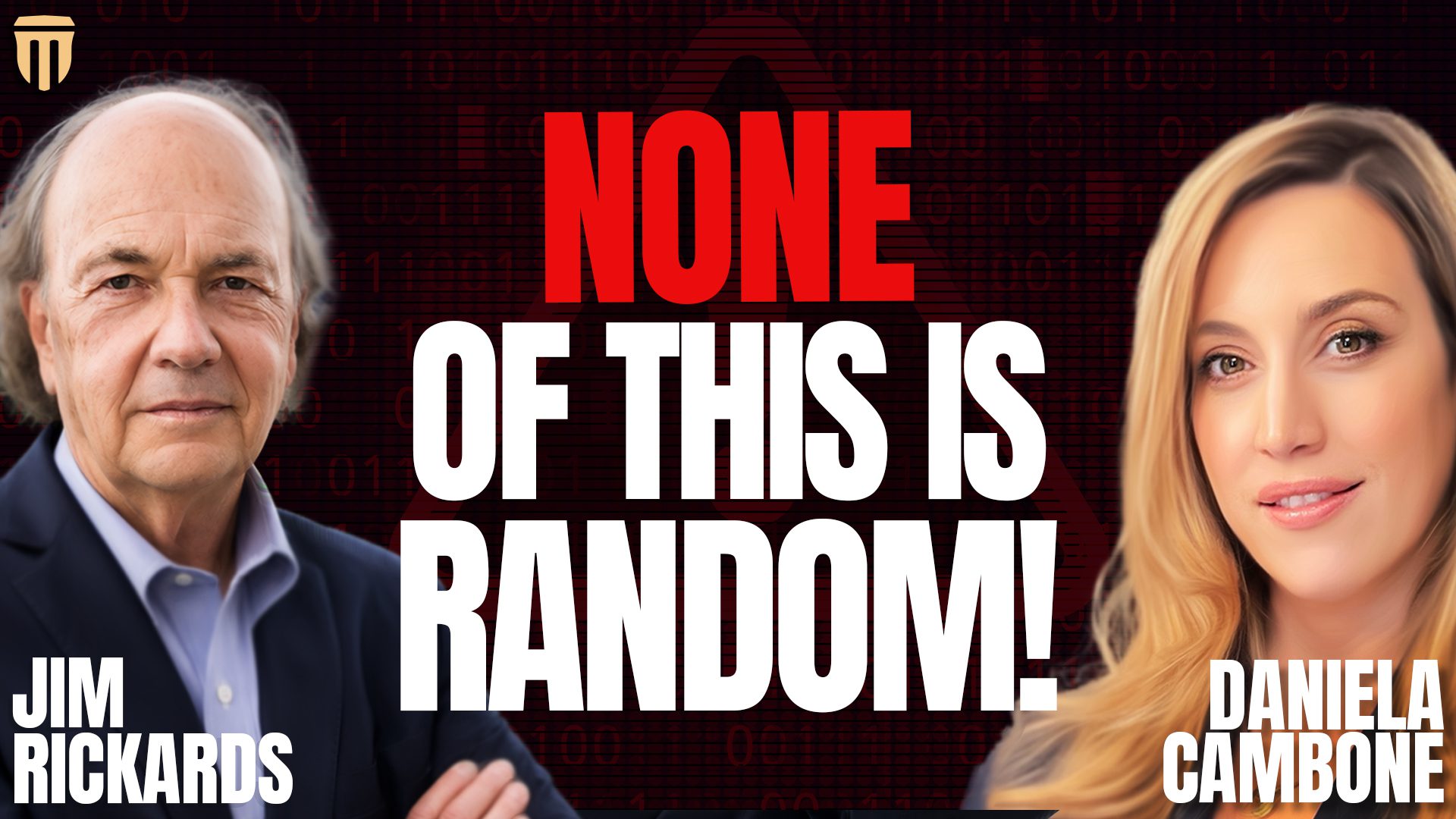
None of This Is Random: Jim Rickards on the ENEMY Behind 6 System Failures in 48 Hours
What happens when the systems Americans depend on to fly, communicate, and access their money begin breaking down within days of each other? And what if the next failure is even bigger?
That’s the alarming question behind Jim Rickards’ latest warning about a string of major system failures that disrupted airlines, banking services, and technology networks across the United States.
On November 12, 2026, Microsoft’s Outlook and Teams services experienced a widespread outage. The following day, the Federal Aviation Administration issued a rare nationwide ground stop. By November 16, JPMorgan Chase customers were reporting transaction problems, while United Airlines experienced another technology disruption.
Meanwhile, Nvidia was dealing with its own crisis after CEO Jensen Huang resigned amid reports involving a suspected Chinese spy, raising new questions about the security and leadership of America’s artificial intelligence industry.
For bestselling author and geopolitical strategist Jim Rickards, these events raise a disturbing possibility.
Speaking with Daniela Cambone, Rickards referenced a famous warning from Ian Fleming’s Goldfinger:
“Once is happenstance, twice is coincidence, third time enemy action.”
But what happens when multiple major systems fail within days?
Rickards believes two potential explanations deserve attention: the growing complexity of artificial intelligence interacting with aging infrastructure, or a possible coordinated Iranian cyberattack.
His second theory is particularly alarming. But it remains a theory, not an established explanation for the outages.
And for Americans concerned about retirement security, inflation, and protecting their savings, the larger question is unavoidable: How prepared are you for a world where digital financial systems cannot always be relied upon?
Six System Failures: What Happened to America’s Critical Infrastructure?
The recent disruptions exposed vulnerabilities across several important sectors of the economy.
Consider the sequence:
-
Microsoft: A widespread service outage disrupted Outlook, Teams, and other Microsoft 365 applications.
-
FAA: A communications malfunction prompted a nationwide ground stop lasting more than four hours.
-
JPMorgan Chase: A software problem delayed transactions and affected customers using banking services.
-
Zelle payments: Some transfers encountered delays associated with Chase’s processing problems, although Zelle’s network itself was not directly disrupted.
-
United Airlines: A separate technical outage interrupted flight departures.
-
Nvidia: Its CEO’s resignation amid a security-related controversy added to concerns about the stability of the AI sector, although this was a corporate crisis rather than a technical outage.
These incidents occurred over several days, not all within a literal 48-hour period. Companies and authorities have reported separate technical explanations, and no public evidence currently establishes a coordinated cyberattack connecting them.
Yet Rickards argues that the clustering of disruptions deserves scrutiny.
His concern is not simply that technology can fail. It is that modern society has become so dependent on interconnected systems that even isolated disruptions can produce widespread economic consequences.
A banking outage can delay payments. An aviation shutdown can strand travelers and disrupt commerce. An enterprise software failure can stop businesses from communicating.
When multiple essential services experience problems close together, operational resilience becomes a national economic issue.
And that leads to Rickards’ first explanation.
Is Artificial Intelligence Making Critical Infrastructure More Fragile?
Rickards believes the rapid adoption of artificial intelligence could be creating risks that businesses and governments do not fully understand.
His concern centers on interoperability: the ability of different technology systems to communicate and operate together.
America’s critical infrastructure includes legacy technology built decades before modern AI applications existed.
As organizations integrate newer systems into older environments, unexpected interactions can emerge.
Rickards explained that individual systems might function properly on their own but fail when required to communicate with one another.
The potential vulnerabilities include:
-
Legacy infrastructure that was not designed for modern workloads.
-
Complex software dependencies that make failures difficult to isolate.
-
Insufficient testing before deploying new technology.
-
Cascading disruptions that spread beyond the original malfunction.
This is a problem of complexity.
The more interconnected a system becomes, the more difficult it may be to identify every possible point of failure.
Importantly, the recent outages do not establish that AI caused them. Reported technical failures have included software defects, capacity problems, and communications equipment malfunctions.
But Rickards believes rapid AI deployment could make future disruptions more difficult to predict and contain.
The danger is not necessarily one malfunctioning computer. It’s the possibility that a small technical problem can spread through a network supporting millions of people.
Jim Rickards’ Cyberattack Theory: Could Iran Be Targeting American Systems?
Rickards’ second explanation is more controversial.
He suspects that the disruptions could be linked to Iranian cyber operations amid escalating military tensions between the United States and Iran.
“I want to be clear. This is my inference. No smoking guns,” Rickards told Daniela.
His argument centers on the possibility that cyber operations could be used as retaliation or deterrence during a military confrontation.
Rickards pointed to the concentration of U.S. military assets near Iran and argued that Tehran could seek to demonstrate its ability to disrupt American infrastructure without launching a conventional attack against the United States.
Potential targets in such a scenario could include:
-
Banking and electronic payments
-
Airlines and air traffic operations
-
Communications infrastructure
-
Electricity and energy networks
-
Other essential digital services
The strategic logic is straightforward: A country does not necessarily need to destroy physical infrastructure to cause economic damage if it can temporarily disable the technology controlling it.
Rickards described this possibility as a new dimension of modern warfare.
However, there is no verified public evidence tying Iran to the November outages. Organizations affected by the disruptions have described technical causes rather than confirmed hostile activity.
His assessment should therefore be understood as a geopolitical hypothesis, not proof of Iranian responsibility.
What makes the discussion relevant is the broader vulnerability it highlights.
In a digitally dependent economy, cyber warfare can threaten the same systems households use to earn income, purchase necessities, and access savings.
And unlike traditional military conflict, the immediate economic consequences could extend far beyond the battlefield.
Iran, Oil, and Inflation: The Economic Threat Americans Cannot Ignore
Cybersecurity was only part of Rickards’ warning.
He also argued that the conflict involving Iran could create another serious problem for American households: a prolonged energy shock that feeds directly into inflation.
The Strait of Hormuz is one of the world’s most important energy transportation routes. Disruptions there can affect global oil shipments, transportation costs, and the prices consumers pay for essential goods.
But Rickards emphasized an important distinction between crude oil and the products Americans actually use.
Crude oil must be refined into gasoline, diesel, and jet fuel before it can power cars, trucks, and airplanes.
Even when crude oil remains available globally, refinery constraints and transportation disruptions can push finished fuel prices higher.
The consequences can spread throughout the economy:
-
Gasoline: Higher prices reduce household purchasing power.
-
Diesel: Rising freight costs can increase grocery and merchandise prices.
-
Jet fuel: Airlines face higher operating costs that can affect ticket prices.
-
Manufacturing: Businesses encounter more expensive transportation and production inputs.
-
Retirement savings: Persistent inflation can weaken the purchasing power of fixed-income investments.
Rickards also raised concerns about America’s depleted Strategic Petroleum Reserve.
According to the U.S. Energy Information Administration, the reserve held approximately 279.5 million barrels as of November 6, 2026, down from 410.4 million barrels a year earlier.That is a reduction of approximately 32% in one year.
For Rickards, depleted reserves present an additional vulnerability if energy markets experience further disruptions.
And the implications extend directly to the dollar.
Inflation does not have to destroy the financial system to damage retirement security. It only has to steadily erode what accumulated savings can purchase.
This is one reason physical gold and silver remain central to the broader conversation about wealth preservation.
Why Jim Rickards Believes Gold Could Reach $10,000
Despite recent declines in precious metals prices, Rickards remains bullish on the long-term outlook for physical gold.
During the interview, Daniela asked him about gold trading below $4,000 per ounce.
Rickards pointed to a price target he had previously identified: approximately $3,800.
His analysis centered on the scale of gold’s earlier rally and the potential for a substantial correction before another upward move.
Using an approximate starting price of $1,600 and a peak near $5,400, Rickards described $3,800 as a significant retracement level.
He also referenced commodities investor Jim Rogers, who has warned that dramatic drawdowns are a normal feature of commodity markets.
But Rickards does not believe a major decline necessarily signals the end of gold’s bull market.
Instead, he maintains his longer-term projection of $10,000 gold.
“I’m standing by my $10,000 projection.”
That forecast is Rickards’ opinion, not a guaranteed price target. Gold remains volatile, and further declines are possible. On November 18, Reuters reported renewed weakness in gold as the dollar strengthened and expectations for higher interest rates weighed on prices.
Unlike currencies, gold cannot be created through central bank monetary policy.
Unlike digital deposits, physical gold held directly is not dependent on a bank’s payment network to exist.
That distinction becomes particularly important when investors are concerned about financial-system resilience.
Physical Gold vs. the Dollar: What Happens When Trust Breaks Down?
The debate over gold vs. dollar holdings ultimately comes down to purchasing power, liquidity, and counterparty risk.
A bank balance represents a claim on a financial institution. Its usefulness for day-to-day transactions depends on functioning payment systems and access channels.
Physical gold, by contrast, is a tangible asset that can be held outside the banking system.
This gives gold several characteristics that may be attractive during periods of uncertainty:
-
Wealth preservation: Gold has historically served as a long-term store of value across different monetary systems.
-
Tangible ownership: Properly secured physical gold does not depend on a brokerage account or electronic payment network for ownership.
-
Inflation hedge: Gold can help diversify exposure to currency depreciation over long periods, although it does not consistently offset inflation in every year.
-
Financial diversification: Gold’s performance can differ from stocks, bonds, and cash.
Gold also has limitations. Its price can decline sharply, it generates no interest or dividends, and physical ownership involves premiums, storage, insurance, and selling costs.
Still, Rickards believes holding physical gold is fundamentally different from relying entirely on financial assets maintained within electronic systems.
The central question isn’t whether gold eliminates risk. It’s whether concentrating nearly all wealth inside the same financial infrastructure creates risks of its own.
Why Jim Rickards Recommends Physical Silver for Emergency Preparedness
One of the most practical moments in Daniela’s interview came when Rickards moved beyond gold and discussed physical silver.
While he views gold primarily as a store of substantial wealth, he believes silver coins may offer additional flexibility in an emergency.
His preference? American Silver Eagle coins.
His argument is based on practicality. A one-ounce gold coin may represent thousands of dollars in value, making it inconvenient for small purchases.
Individual silver coins, by comparison, contain considerably less value per piece.
In Rickards’ view, this difference could matter if electronic payments became temporarily unavailable.
He described physical silver as an additional preparedness asset alongside ordinary emergency supplies.
However, precious metals are not guaranteed to be accepted by merchants during an emergency. American Silver Eagles are legal-tender coins, but their statutory face value differs from their bullion value, and spending or selling them may involve substantial friction.
For immediate household needs, accessible cash and essential supplies are generally more practical than assuming local merchants will accept bullion.
Silver can also experience significant price volatility and typically carries higher percentage premiums than larger gold bullion products.
Nevertheless, Rickards’ broader point remains relevant: physical gold and silver offer a form of ownership outside purely digital financial accounts.
Financial System Failures: How Can Americans Prepare?
When Daniela asked Rickards how Americans should respond to the possibility of more disruptions, his answer centered on preparation rather than panic.
He recommended maintaining basic emergency supplies and exploring alternative communications systems that do not rely entirely on local ground infrastructure.
Among the measures discussed were:
-
Water and food: Maintain an emergency supply appropriate for your household.
-
Backup lighting: Keep flashlights, batteries, and other essential equipment available.
-
Emergency communications: Consider battery-powered or hand-crank radios.
-
Alternative connectivity: Satellite communications may provide redundancy when conventional networks fail, although service still depends on equipment, power, satellite availability, and network operations.
-
Accessible funds: Maintain some cash for short-term expenses if card terminals or digital payment systems are unavailable.
-
Physical assets: Evaluate whether gold and silver fit into a broader financial resilience strategy.
-
Community preparedness: Build relationships and establish plans for communicating with family and neighbors.
Rickards personally discussed owning satellite communications equipment and maintaining an independent radio setup.
His message was not that every household needs an elaborate emergency command center.
It was that dependence on a single system can create avoidable vulnerabilities.
Preparation means identifying what you rely on most—and considering what happens if that service disappears temporarily.
For retirees and Americans nearing retirement, that principle also applies to financial planning.
A retirement strategy should account not only for investment returns but also for liquidity, inflation, access to funds, and the possibility of unexpected disruptions.
Gold and Silver Wealth Preservation in an Increasingly Uncertain World
The recent technology failures have not established that the United States is facing a coordinated cyber campaign.
But they have provided a reminder of how quickly essential services can become unavailable.
Whether the underlying risk is aging infrastructure, software complexity, cyber threats, or geopolitical conflict, Americans face a growing need to think carefully about financial resilience.
Physical gold and silver have a particular role in that discussion because they are tangible assets that do not require continuous access to a banking app, electronic brokerage platform, or payment processor to be owned.
They cannot prevent inflation, stop cyberattacks, or guarantee financial security.
But they may provide an additional form of diversification within a thoughtfully constructed wealth preservation plan.
For those concerned about dollar devaluation, retirement purchasing power, and the reliability of financial institutions, evaluating physical precious metals before a disruption may be more practical than making hurried decisions during one.
Conclusion: The Next System Failure May Not Come With a Warning
Jim Rickards believes the convergence of technology disruptions, military tensions, and increasingly complex infrastructure should be taken seriously.
His theory that Iranian cyber operations may be responsible remains unproven.
But the underlying vulnerabilities deserve attention regardless of who—or what—caused the recent disruptions.
The November outages demonstrated that aviation, banking, and communications services can experience substantial problems with little advance notice.
Meanwhile, geopolitical uncertainty, energy pressures, and inflation continue to complicate the financial outlook for American households.
The lesson isn’t to assume every breakdown is an attack. It’s to recognize that even systems considered reliable can fail.
For those who have spent decades building retirement savings, protecting accumulated purchasing power deserves as much consideration as growing it.
That means asking difficult questions about financial concentration, access to liquidity, and the role that physical gold and silver could play in a broader preparedness strategy.
Because when the next disruption occurs, the most important question may not be what caused it.
It may be how well you prepared before it happened.
About ITM Trading
ITM Trading has over 28 years of experience helping clients safeguard their wealth through personalized strategies built on physical gold and silver. Our team of experts delivers research-backed guidance tailored to today’s economic threats.
THINKING ABOUT PURCHASING GOLD & SILVER?
Get expert guidance from our team of analysts with 28+ years of experience.
[SCHEDULE YOUR CALL HERE] or call 866-706-9061