

Frank Giustra: Reckoning Upon Us as Global Debt Surpasses $365 TRILLION – Empire’s DEAD
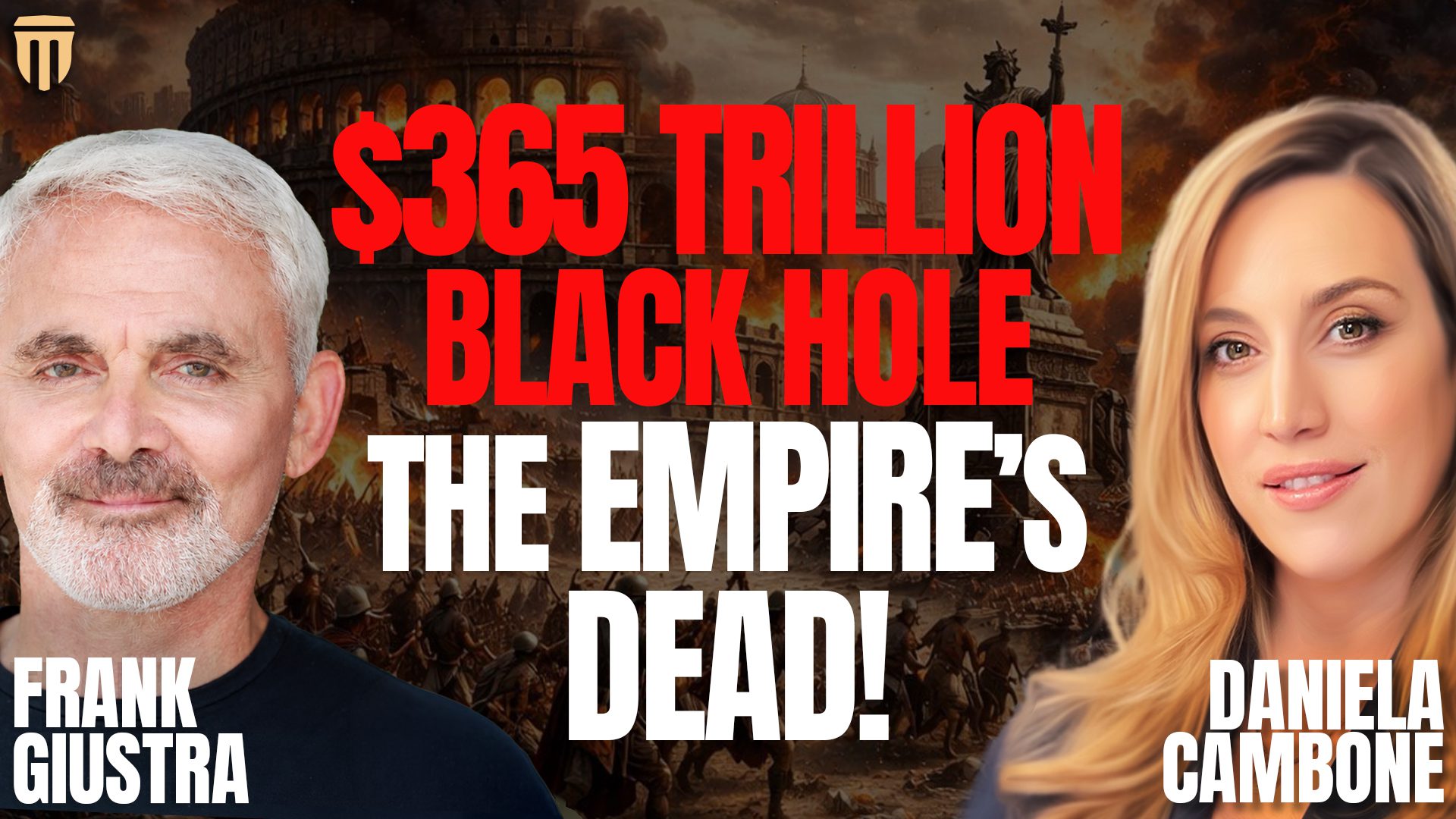
What happens when the world owes more than $365 trillion—and the countries responsible for that debt can no longer afford to sustain it?
The global debt crisis is reaching unprecedented levels, and billionaire investor Frank Giustra believes the financial system is approaching a historic reckoning. With government deficits expanding, interest costs consuming national budgets, and confidence in the U.S. dollar facing mounting challenges, Giustra warns that the warning signs resemble those that preceded the decline of some of history’s most powerful empires.
In an exclusive interview with ITM Trading’s Daniela Cambone, Giustra argues that the world is no longer experiencing an ordinary economic cycle. Instead, he believes we are witnessing a structural breakdown of the financial and geopolitical order that has dominated for decades.
And his warning is stark: The debt problem may already be beyond conventional solutions.
Global Debt Surpasses $365 Trillion: The Reckoning Giustra Sees Coming
According to the Institute of International Finance (IIF), global debt surpassed $365 trillion in the first half of 2026, adding more than $10 trillion in just six months.
That figure includes debt owed by governments, households, financial institutions, and corporations.
The concern isn’t simply how much the world owes. It’s whether borrowers can continue servicing and refinancing those obligations without triggering economic instability.
During the interview, Giustra estimates that global debt has already reached approximately $370 trillion, emphasizing the extraordinary pace of accumulation.
He describes the situation as increasingly unsustainable, warning that the system could eventually face a severe deflationary collapse or an inflationary crisis.
While neither outcome is inevitable, the underlying pressures are substantial:
- Exploding interest expenses: More government revenue is being directed toward servicing existing debt.
- Persistent fiscal deficits: Governments continue borrowing to finance spending beyond their revenues.
- Refinancing pressure: Maturing debt may need to be replaced with new debt at higher interest rates.
- Currency depreciation risks: Policymakers may face pressure to tolerate higher inflation to reduce the real burden of debt.
Giustra’s central argument is that the world’s financial vulnerabilities are interconnected—and excessive debt sits at the foundation.
Is America Repeating the Fall of the Roman Empire?
One of the most striking moments of Daniela Cambone’s interview takes place against the backdrop of Rome, where Giustra draws parallels between the Roman Empire’s decline and the pressures facing the United States today.
He identifies four major forces that contributed to Rome’s deterioration:
- Military overextension and the growing costs of maintaining an empire.
- Excessive debt and currency debasement, weakening monetary confidence.
- Declining trade, undermining economic prosperity.
- Political corruption, eroding institutions and public trust.
Giustra argues that several of these same pressures are visible in modern America.
The historical comparison is particularly relevant when examining currency debasement.
As Roman authorities reduced the precious-metal content of certain coins, the empire’s monetary system experienced periods of severe instability.
Modern fiat currencies operate differently, but the underlying concern remains: What happens when confidence in a currency deteriorates faster than governments can restore it?
The United States benefits from issuing the world’s dominant reserve currency, but Giustra questions whether that privilege can indefinitely protect an increasingly indebted economy.
Rome’s decline unfolded over centuries, and history does not establish that the United States faces the same outcome. Nevertheless, Giustra believes the parallels deserve serious attention.
The U.S. Debt Crisis: When Interest Payments Become a National Burden
The United States is already experiencing the consequences of rising borrowing costs.
Net interest payments on the federal debt reached approximately $1.05 trillion in fiscal year 2026, compared with roughly $970 billion in fiscal year 2025.
That means more than $1 trillion annually is being spent on interest rather than directly financing public programs or investments.
Giustra argues that meaningful fiscal reform presents an enormous political challenge.
Substantial spending reductions, tax increases, or a combination of both could help address deficits. But each choice carries economic and political consequences.
The danger is a reinforcing debt cycle:
More borrowing creates higher interest expenses. Higher interest expenses increase pressure on deficits. Larger deficits can require still more borrowing.
This does not guarantee a sovereign debt crisis. However, it leaves policymakers with less flexibility when the next recession, financial shock, or geopolitical emergency occurs.
For households approaching retirement, that distinction matters.
Government debt pressures can influence interest rates, inflation expectations, economic growth, and ultimately the purchasing power of savings accumulated over decades.
The Petrodollar System and the Growing Challenge to U.S. Dollar Dominance
Giustra also warns that America’s financial influence is closely connected to the dollar’s central role in international trade.
For decades, the petrodollar system has helped reinforce demand for U.S. dollars through global oil transactions.
Countries conducting trade in dollars often maintain dollar reserves and participate in dollar-based financial markets.
That provides the United States with significant advantages, including access to deep global capital markets.
But Giustra believes that system is gradually being challenged.
He points to countries developing alternatives to dollar-based trade and settlement, including efforts among BRICS members to expand financial relationships outside traditional Western infrastructure.
He describes initiatives involving:
- Bilateral currency arrangements and currency swaps.
- Alternative cross-border settlement mechanisms.
- Financial institutions operating alongside established Western-led institutions.
- Greater interest in gold as an international reserve asset.
Importantly, Giustra does not expect a unified BRICS currency to emerge in the immediate future.
His argument is more gradual: The dollar does not need to disappear for its international dominance to weaken.
If more countries conduct trade in local currencies, the structural demand supporting dollar-based transactions could change over time.
That would not automatically cause a U.S. dollar collapse. But it could complicate America’s ability to finance persistent deficits on favorable terms.
Gold, Central Banks, and the Return of Monetary Competition
For Giustra, one of the most important developments is the growing role of gold in the international monetary system.
He believes central banks and governments increasingly recognize the strategic importance of holding assets that are not liabilities of another country.
Unlike government bonds, physical gold does not depend on an issuer’s promise to repay principal and interest.
That distinction becomes especially significant when countries are concerned about sanctions, currency exposure, or counterparty risk.
Giustra expects gold to play a larger role in settling international trade imbalances, particularly among countries seeking to reduce reliance on the dollar.
His position is not that the world will immediately return to a traditional gold standard.
Rather, he anticipates a gradual monetary restructuring in which gold becomes more important alongside national currencies.
This represents a critical distinction between gold vs. dollar exposure.
The dollar is an essential medium of exchange and the foundation of many financial contracts. Gold, by contrast, is a scarce monetary asset that cannot be created through conventional central-bank policy.
Neither is risk-free, but they respond to different economic pressures.
Why Physical Gold and Silver Matter for Wealth Preservation
Giustra’s broader warning raises a practical question: What can individuals do if debt, inflation, and monetary instability continue to intensify?
His answer centers on protecting personal wealth rather than assuming policymakers will eliminate systemic risks.
He emphasizes ownership of scarce, tangible assets in an environment where he expects inflationary pressures to remain persistent.
For investors evaluating gold and silver wealth preservation, several characteristics are worth understanding.
- Physical gold: Historically used as a store of value across monetary systems and financial crises.
- Physical silver: A tangible precious metal with both monetary history and significant industrial demand.
- Limited supply: Neither metal can be created through central-bank money printing.
- Portfolio diversification: Precious metals may respond differently from stocks, bonds, and cash during periods of financial stress.
Gold has historically served as a long-term inflation hedge in some environments, although it does not reliably offset inflation over every shorter period.
Silver may provide additional exposure to precious metals, but its industrial sensitivity and greater price volatility can produce substantial fluctuations.
Physical precious metals also involve storage, insurance, transaction spreads, and liquidity considerations.
The case for tangible assets is therefore not that gold and silver guarantee protection from losses.
It is that holding assets outside the conventional debt-based financial system may provide a different form of diversification when confidence in monetary institutions comes under pressure.
The Financial Reckoning: What Happens Next?
Toward the end of the interview, Daniela asks Giustra what ordinary people should understand about the extraordinary economic changes unfolding around them.
His response is among the most sobering moments of the discussion.
He believes the debt and deficit problems have advanced so far that the existing system may eventually require a fundamental restructuring.
Giustra does not claim to know precisely when that reckoning will arrive or whether it will take the form of a depression, a major inflationary shock, or another kind of monetary disruption.
But he believes preparation is more realistic than waiting for an easy political solution.
The lesson is not that every financial collapse prediction will come true. It’s that systemic risks become more consequential when households have little margin for error.
For Americans who have spent decades saving for retirement, continued scrutiny of purchasing power, financial concentration, debt exposure, and long-term asset protection is increasingly important.
The global debt crisis is no longer a distant theoretical concern. Its effects are already visible in government financing costs and the difficult choices confronting policymakers.
Whether the coming years bring a gradual adjustment or a more disruptive financial reckoning remains uncertain.
What is clear is that understanding those risks—and examining the potential role of physical gold and silver before a crisis develops—can be an important part of a thoughtful wealth preservation strategy.
About ITM Trading
ITM Trading has over 28 years of experience helping clients safeguard their wealth through personalized strategies built on physical gold and silver. Our team of experts delivers research-backed guidance tailored to today’s economic threats.
THINKING ABOUT PURCHASING GOLD & SILVER?
Get expert guidance from our team of analysts with 28+ years of experience.
👉 [SCHEDULE YOUR CALL HERE] or call 866-706-9061