

The Biggest Energy Shock of Our Lifetime. You Don’t Own Enough Gold- Chris Martenson
The market can debate narratives. Physics doesn’t negotiate.
The energy shock now hitting the global economy is no longer a theoretical risk buried inside an analyst report. It is showing up in tanker traffic, freight rates, diesel prices, strategic reserves—and potentially your cost of living.
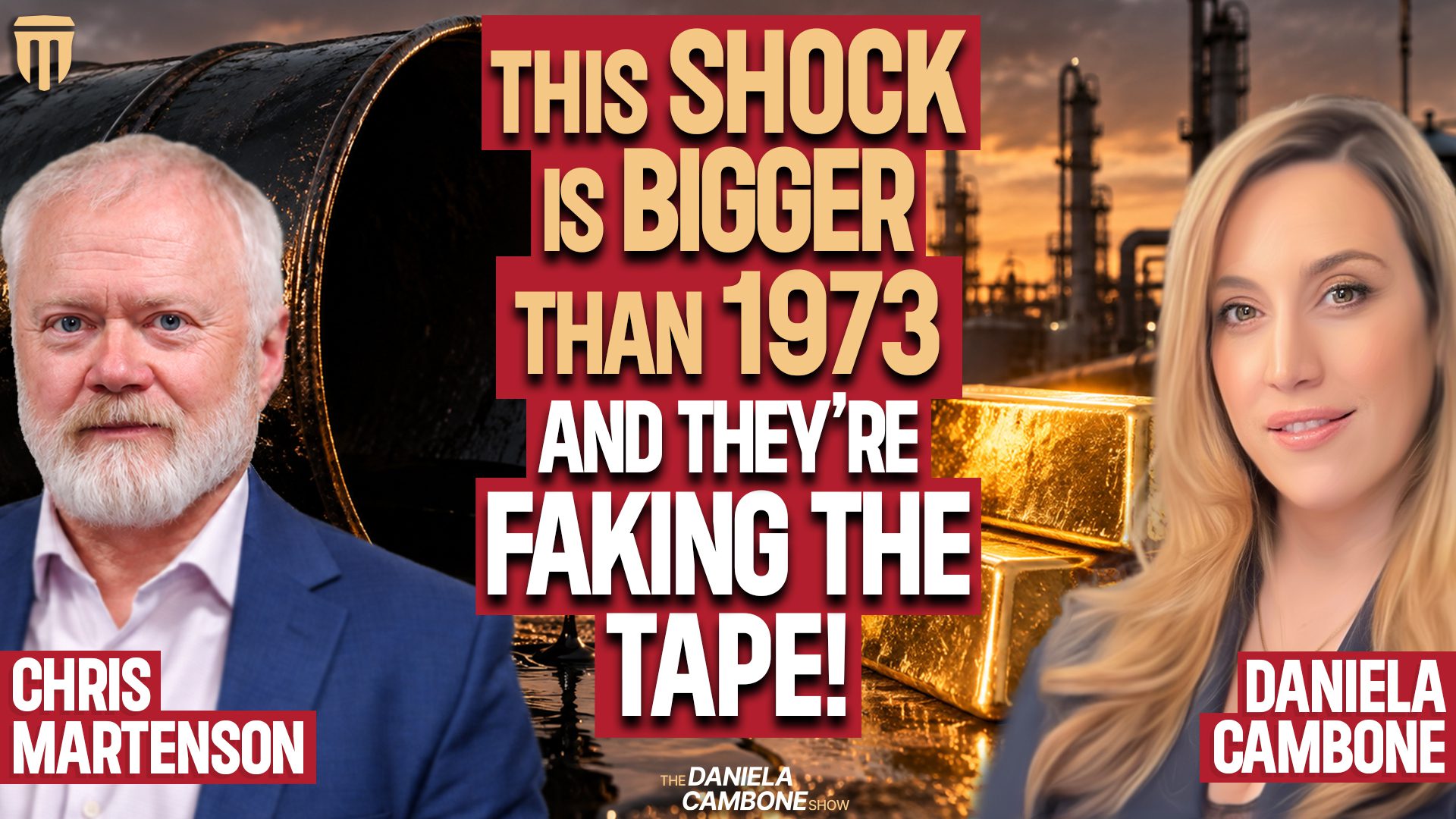
That is the warning Dr. Chris Martenson, founder of Peak Prosperity, delivered in his conversation with Daniela Cambone.
His central argument is simple: governments can create currency. Central banks can change interest rates. Financial markets can reprice assets in seconds.
But nobody can print a barrel of oil, manufacture diesel with monetary policy, or replace a damaged pipeline with a press conference.
And when energy becomes scarce or difficult to transport, the effects do not stop at the gas pump. They move through trucking, farming, aviation, mining, manufacturing, food, construction and eventually nearly everything households buy.
That is why Martenson calls the current situation the biggest energy shock of our lifetime—and why he believes the implications reach far beyond oil and directly into the case for owning gold.
The Energy Shock Is Hitting the World’s Most Important Chokepoints
The Strait of Hormuz is not some obscure line on a geopolitical map.
It is one of the arteries of the global economy.
Before the current conflict, the strait handled roughly one-fifth of global oil and gas flows. By September, vessel traffic had collapsed dramatically. Reuters reported that only 17 commodity vessels crossed the strait over one recent weekend, compared with a pre-war average of roughly 125 vessels per day. (Reuters)
And Hormuz is not the only problem.
Saudi Arabia’s East-West Pipeline—designed specifically to move crude toward the Red Sea and bypass Hormuz—was itself hit in September. The pipeline had been transporting roughly 4 million to 5 million barrels per day, equivalent to approximately 4%–5% of global oil supply. (Reuters)
Meanwhile, shipping through the Bab el-Mandeb route has also faced disruption.
The backup routes now need backup routes.
That matters because an oil supply problem is bad enough. An oil transportation problem layered on top of it can become even more dangerous.
The market has responded with increasingly elaborate workarounds, including ship-to-ship transfers near Oman. But those workarounds are expensive. Reuters reported that crude transferred through these emergency logistics networks reached roughly 2.5 million barrels per day in September, while freight costs for some shipments climbed above $30 per barrel. (Reuters)
This is the point Martenson keeps returning to:
Energy is physical.
A futures contract can trade lower.
A politician can announce another initiative.
A central bank can change the federal funds rate.
None of those actions physically moves crude through a damaged pipeline or safely guides an oil tanker through a war zone.
Diesel Is Where the Energy Crisis Reaches Your Kitchen Table
Crude oil gets the headlines.
Diesel is where the problem enters the real economy.
As of September 21, the national average retail price for U.S. diesel had climbed to $6.529 per gallon, according to the Energy Information Administration. That was up from $5.257 just six weeks earlier. (U.S. Energy Information Administration)
Why should retirees and investors care about diesel if they do not drive a diesel vehicle?
Because diesel moves the economy.
It powers or supports:
- Heavy-duty trucks carrying groceries and consumer goods
- Agricultural machinery planting and harvesting crops
- Mining equipment extracting raw materials
- Construction equipment
- Freight and logistics networks
- Industrial machinery and backup generation
A sustained increase in diesel costs therefore does not stay isolated at the fuel station.
Businesses eventually have to absorb those costs, cut elsewhere or pass some of them through to customers.
That is why Martenson describes elevated diesel prices as inherently inflationary. The precise pass-through varies by industry and economic conditions, but the basic mechanism is difficult to escape: energy is an input into almost everything.
Reuters recently described U.S. diesel prices above $6 per gallon as a major economic problem stemming from constrained refining capacity and disruptions to global fuel supplies. (Reuters)
For households already concerned about purchasing power, this is the part of the energy shock that matters most.
You do not have to buy crude oil to pay for expensive crude oil.
You pay for it when food travels farther.
You pay for it when a contractor runs equipment.
You pay for it when manufacturers ship finished products.
You pay for it when airlines face higher fuel and logistics expenses.
The energy system quietly sits beneath almost every price in the economy.
America Is an Energy Powerhouse—But It Still Depends on Imported Crude
One of Martenson’s most important points concerns the phrase “energy independence.”
The United States is unquestionably an enormous energy producer. In fact, America exported more total energy than it imported in 2025. (U.S. Energy Information Administration)
But that does not mean the country is self-sufficient in every form of energy.
The U.S. remained a net importer of crude oil by roughly 2.2 million barrels per day in 2025, according to EIA data. (U.S. Energy Information Administration)
Canada remains particularly important.
U.S. crude imports from Canada averaged approximately 3.9 million barrels per day in 2025, supported by an enormous network of pipelines feeding American refineries. (U.S. Energy Information Administration)
That distinction matters.
The United States can simultaneously be:
A net exporter of total energy and a net importer of the specific crude oil grades its refinery system needs.
Those two facts are not contradictory.
They simply reveal how interconnected the energy system really is.
Martenson’s broader point is that modern economies depend not merely on producing “energy” in aggregate, but on having the correct fuel, in the correct location, moving through the correct infrastructure at the correct time.
Break enough links in that chain and national production statistics suddenly become much less comforting.
The Strategic Petroleum Reserve Is Buying Time—But Time Is Not Oil
Strategic reserves exist precisely for moments of disruption.
But reserves are inventories, not production.
Once released, they must eventually be replaced—or the buffer becomes progressively smaller.
The U.S. Strategic Petroleum Reserve stood at roughly 285 million barrels in mid-September, according to EIA data. One year earlier it held about 406 million barrels, meaning the reserve was nearly 30% lower year over year. (U.S. Energy Information Administration)
Reuters reported September 21 that SPR inventories had fallen to their lowest level since 1982 amid emergency releases intended to stabilize supply. (Reuters)
That is where Martenson sees a dangerous tradeoff.
Using strategic inventories can cushion the immediate blow.
But if the underlying disruption continues, drawing down emergency reserves does not solve the physical supply problem—it postpones the moment when the market must confront it.
A reserve can bridge a temporary interruption.
It cannot permanently substitute for millions of barrels per day of disrupted production or transportation.
Oil Futures Say One Thing. The Physical Market Is Sending Another Message.
Here is where the situation gets especially strange.
On September 22, Brent crude futures dropped below $98 per barrel as traders reacted to the possibility of improving Middle East supply and a potential reopening of Hormuz. (MarketWatch)
Yet at the same time, emergency tanker logistics have been adding more than $30 per barrel in transportation costs on some routes. (Reuters)
That disconnect is important.
A quoted futures price is not necessarily the complete cost of delivering the right barrel to the right refinery at the right time.
Martenson goes further. In the interview, he raises the possibility that official intervention has influenced oil and gold markets. But he explicitly describes this as his own theory and acknowledges that he cannot prove it.
That distinction matters.
There is clear evidence of extraordinary physical-market stress.
There is not sufficient evidence from the interview to state as fact that governments are secretly suppressing gold or oil prices.
What can be observed is arguably more interesting anyway:
The physical cost of moving energy has become dramatically more expensive even while headline crude futures remain far below the levels some feared earlier in the crisis.
That should be a reminder that price signals can become messy during extreme disruptions.
The Energy Shock Is Colliding With the Bond Market
Energy inflation would be difficult enough in isolation.
It is not happening in isolation.
The U.S. Treasury market is already dealing with elevated long-term borrowing costs. On September 22, the benchmark 10-year Treasury yield stood at 4.96%, while the 20-year and 30-year yields were both above 5.2%. (U.S. Department of the Treasury)
The Federal Reserve, meanwhile, recently raised its policy rate as officials continued focusing on persistent inflation pressures, including those stemming partly from higher energy costs. (Reuters)
That creates an uncomfortable policy problem.
If energy inflation stays elevated, policymakers may have reason to keep monetary conditions tighter.
But higher rates also increase borrowing costs across mortgages, corporate debt and government finance.
Martenson frames the long-term dilemma more dramatically: eventually, monetary authorities could face increasing tension between supporting bond markets and protecting the purchasing power of the currency.
That outcome is not predetermined.
But investors should understand the mechanism.
The Fed can create additional dollar liquidity.
It cannot create additional diesel.
If monetary support eventually increases while physical energy remains constrained, the financial system may receive more nominal purchasing power without receiving more physical supply.
That is exactly the kind of environment in which investors historically begin thinking differently about hard assets.
Central Banks Are Still Accumulating Gold
This is where Martenson’s energy thesis intersects with gold.
While investors argue about whether gold is expensive, global central banks continue treating it as a strategic reserve asset.
Central banks purchased 863 tonnes of gold in 2025, according to the World Gold Council. That was below the extraordinary 1,000-plus-tonne buying pace of the preceding three years, but still far above the 2010–2021 annual average of 473 tonnes. (World Gold Council)
Buying accelerated again in the second quarter of 2026.
Central banks purchased an estimated 289 tonnes during Q2, a fivefold increase from the revised first-quarter figure. (World Gold Council)
China has been especially notable.
The People’s Bank of China reported adding 20.2 tonnes in August alone, its largest monthly increase since October 2023. Its officially reported holdings reached approximately 2,387 tonnes, marking 22 consecutive months of additions. (World Gold Council)
China’s broader gold imports have also surged. World Gold Council data showed 764 tonnes of net imports during the first half of 2026, up 138% from a year earlier. By August, Chinese customs figures showed imports had already surpassed 1,000 tonnes for the year. (World Gold Council)
This does not prove any particular prediction about the dollar.
But it does demonstrate something important:
Some of the institutions responsible for managing national reserves continue increasing their exposure to an asset that cannot be printed, defaulted on or digitally created.
There is another revealing development.
The Dutch central bank recently transferred approximately 86 tonnes of gold from New York and Ottawa to London, saying the move was intended to improve liquidity and tradability while strengthening preparedness for severe crises. It was not a repatriation to the Netherlands, but it does highlight the growing attention central banks are paying not only to how much gold they own, but where it is held and how quickly it can be mobilized. (World Gold Council)
Custody matters.
Liquidity matters.
And during a crisis, physical access matters.
Gold and Silver: Tangible Assets in a World of Monetary Promises
Martenson’s conclusion is deliberately provocative:
“However much gold you own, you don’t have enough.”
The appropriate amount of gold or silver will obviously differ from one household to another. Age, income needs, liquidity requirements, existing assets and risk tolerance all matter.
But the underlying argument deserves attention.
Physical gold occupies a fundamentally different position from most financial assets.
A bond depends on an issuer.
A bank deposit depends on a bank and its supporting financial infrastructure.
A stock represents a claim on a business.
Physical gold held directly is a tangible asset with no issuer and no counterparty liability attached to the metal itself.
That distinction can matter during periods of monetary stress.
Gold is often discussed as an inflation hedge, although it does not track consumer prices perfectly over short periods. Its more durable appeal is its history as a store of value when confidence in currencies, sovereign debt or financial institutions is under pressure.
That is the deeper gold vs dollar argument.
The dollar is monetary infrastructure.
Gold is an asset outside that infrastructure.
Silver can play a complementary role in wealth preservation, but investors should understand that silver behaves differently. Its large industrial-demand component can create significantly greater volatility than gold.
That makes physical gold and silver related—but not interchangeable—tangible assets.
Neither metal produces income.
Neither prevents an energy crisis.
Neither guarantees gains.
But unlike currency, neither can be created through monetary policy.
And unlike a barrel of diesel, gold does not disappear when consumed.
The Real Warning: You Cannot Print Your Way Around Physics
There are many moving pieces in this crisis.
Hormuz.
Red Sea shipping.
Damaged pipelines.
Diesel above $6 per gallon.
Falling strategic oil reserves.
Elevated Treasury yields.
Persistent inflation.
Central banks accumulating gold.
Individually, each could be dismissed as another volatile headline.
Together, they tell a much bigger story.
The financial economy ultimately rests on the physical economy.
Factories need energy.
Trucks need fuel.
Food needs transportation.
Mines need equipment.
Aircraft need jet fuel.
Data centers need electricity.
Money may determine who gets access to those resources—but money cannot manufacture the resources themselves.
That is the distinction Martenson believes markets have underestimated.
And if the energy shock continues, investors may discover that the greatest risk is not simply paying more at the pump.
It is what happens when an energy shortage collides with an already heavily indebted monetary system.
Gold and silver should not be viewed as magic solutions to that problem.
They are something simpler.
Physical assets that exist outside the promises and liabilities of the financial system.
For investors concerned about inflation, currency purchasing power and systemic risk, this may be the time to review what portion of their wealth is dependent entirely on financial promises—and what portion exists in tangible form.
About ITM Trading
ITM Trading has over 28 years of experience helping clients safeguard their wealth through personalized strategies built on physical gold and silver. Our team of experts delivers research-backed guidance tailored to today’s economic threats.
THINKING ABOUT PURCHASING GOLD & SILVER?
Get expert guidance from our team of analysts with 28+ years of experience.
👉 [SCHEDULE YOUR CALL HERE] or call 866-706-9061