

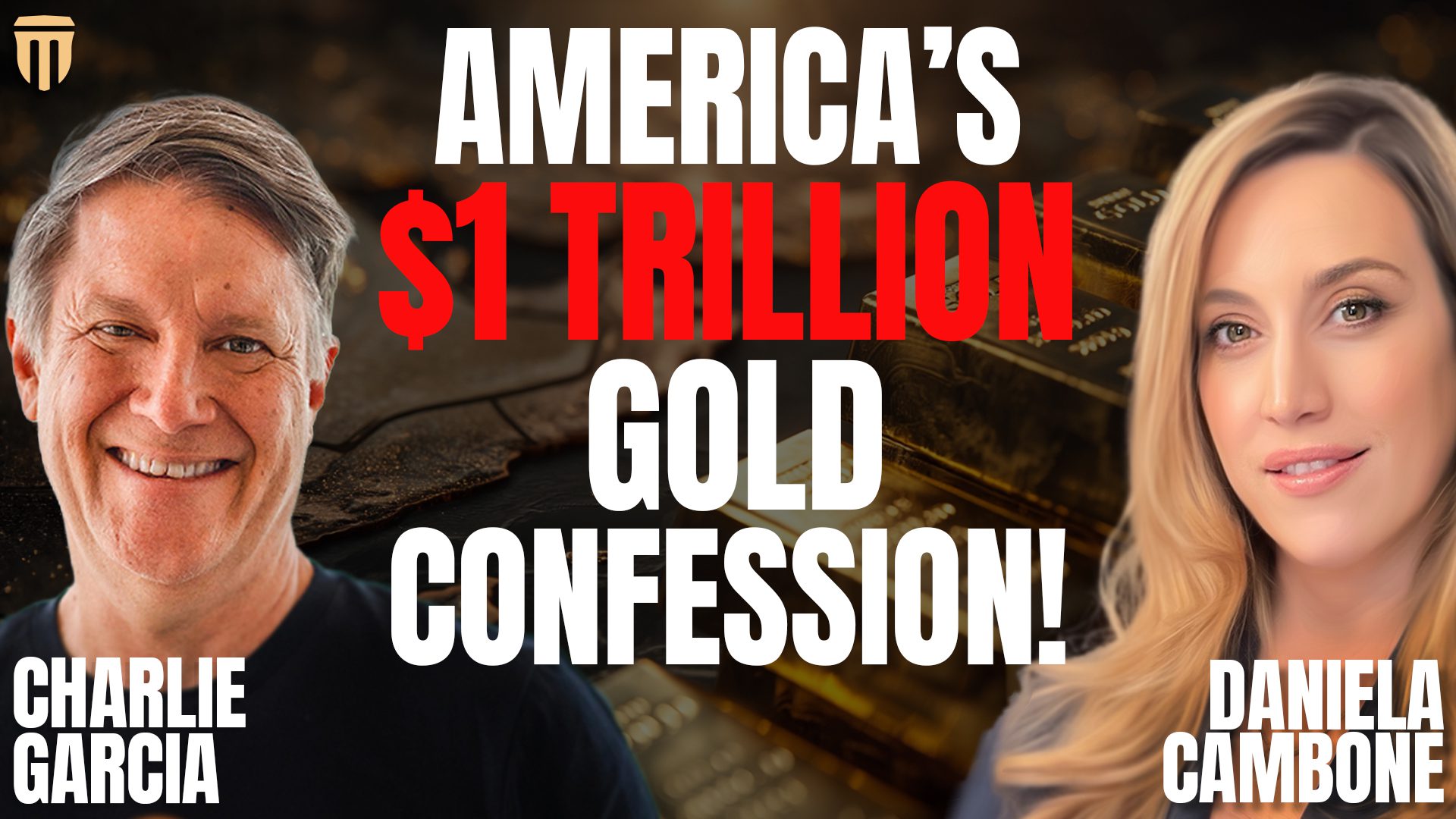
America’s $1 Trillion Gold Confession. China Preps a Siege – Charlie Garcia
What happens when the U.S. government starts looking at gold not as a relic—but as a potential trillion-dollar financial weapon?
That is the question at the center of Daniela Cambone’s conversation with Charlie Garcia, founder of R360 and author of Capital Mischief.
Garcia argues that two developments investors should be watching are deeply connected: China’s aggressive accumulation of gold and growing discussion around revaluing U.S. gold reserves from their statutory book value to something closer to the market price.
His interpretation is provocative.
China may not simply be diversifying its reserves. It may be preparing for a world in which access to dollars, global trade routes, and Western financial infrastructure can no longer be taken for granted.
And Washington may be rediscovering something it has officially valued at just $42.22 an ounce for decades:
Gold is still monetary power.
The $1 Trillion Question Hidden Inside U.S. Gold Reserves
The United States holds approximately 261.5 million fine troy ounces of gold.
Yet for official accounting purposes, that gold is carried at a statutory value of only $42.22 per fine troy ounce—leaving an enormous gap between its official book value and its market value.
That discrepancy is central to Garcia’s argument.
He points to discussion around potentially revaluing America’s gold reserves closer to prevailing market prices. At sufficiently high gold prices, the accounting gain could approach $1 trillion.
Why does that matter?
Because a revaluation could potentially create additional financial capacity without the government first selling the underlying gold.
But the symbolism could be even more important than the accounting.
If Washington were to recognize a dramatically higher value for its own gold, it would force markets to confront an uncomfortable question: Why has an asset officially treated like a monetary antique suddenly become strategically important again?
For retirement savers, the issue goes well beyond an accounting adjustment.
It raises questions about confidence in sovereign debt, the dollar, and the monetary system itself.
China’s Gold Buying May Be About More Than Diversification
China has been accumulating gold aggressively, and Garcia believes the conventional explanation—reserve diversification—doesn’t capture the full story.
His description is far more consequential: “siege-proofing.”
In other words, China could be building a financial reserve capable of functioning in a scenario where geopolitical conflict disrupts access to dollars or Western-controlled financial networks.
Gold is particularly useful in such an environment because it is:
- No one else’s liability.
- Not dependent on another government’s promise to pay.
- Globally recognized.
- Physically transferable.
- Outside the conventional credit system when held directly.
That distinction became increasingly important after Western governments demonstrated their willingness to freeze sovereign financial assets following Russia’s invasion of Ukraine.
For governments watching from Beijing and elsewhere, the lesson was difficult to miss: foreign reserves are only as politically neutral as the infrastructure holding them.
Gold operates differently.
Garcia also raises the possibility of China eventually pursuing a stronger link between gold and its currency. That remains speculative, and the transcript does not establish that Beijing has committed to such a policy.
But China’s appetite for bullion deserves attention regardless.
A country does not need to announce a gold-backed currency for gold accumulation to alter its strategic financial position.
America’s Debt Problem Is Becoming an Arithmetic Problem
Behind the gold discussion sits a much larger concern: federal debt.
Garcia’s thesis is straightforward. As older, cheaper government debt matures and must be refinanced at higher rates, interest expense can consume a growing share of federal resources.
That creates an increasingly difficult policy trap.
Raise rates aggressively, and government financing costs can increase.
Cut rates too quickly, and policymakers risk renewed inflation or currency weakness.
Expand the money supply to ease financial stress, and confidence in the dollar’s purchasing power can suffer.
There is no painless door out of a heavily indebted system.
That is why Garcia views gold and silver primarily through the lens of monetary debasement rather than short-term price speculation.
His argument isn’t simply that inflation could rise next month.
It is that governments carrying enormous debt loads have historically faced powerful incentives to reduce the real burden of those debts over time.
For someone approaching or already in retirement, that matters because the real question isn’t merely how many dollars you have.
It’s what those dollars will still buy.
The Strait of Hormuz Could Be the Risk Gold Investors Are Missing
Garcia’s second warning moves from monetary policy to geopolitics.
His focus: the Strait of Hormuz.
The narrow waterway is one of the world’s most strategically important energy corridors. A serious disruption could affect global oil and fuel supplies, potentially transmitting higher transportation and production costs throughout the economy.
Garcia argues investors should pay particular attention to diesel.
Why?
Because diesel powers much of the physical economy: trucks, agricultural machinery, construction equipment, freight, and other critical infrastructure.
Higher diesel costs don’t remain isolated at the pump.
They can work their way through supply chains and ultimately into the price consumers pay for food, manufactured goods, construction, and transportation.
That creates another potential headache for policymakers.
If geopolitical disruption drives energy inflation while the economy weakens, the Federal Reserve could face competing pressures: support growth or contain inflation.
For investors, that is precisely the kind of environment in which traditional stock-and-bond assumptions can become less reliable.
Stocks Can Look Calm While Credit Markets Flash Warnings
One of Garcia’s more important observations is the possibility of divergence between equity and credit markets.
Stock indexes can remain elevated even while stress develops beneath the surface.
Garcia points to consumer borrowing pressure, household interest costs, refinancing activity, small-business stress, and weakness outside the largest technology-related companies as reasons to question the headline narrative of a uniformly strong economy.
His broader point is worth understanding:
Markets rarely deteriorate everywhere at exactly the same time.
Financial stress often emerges unevenly.
Credit can weaken before equities.
Consumers can struggle while headline indexes rise.
Highly capitalized technology companies can prosper while smaller businesses face deteriorating financing conditions.
That can produce a deeply misleading picture for investors who rely only on the S&P 500 as their economic dashboard.
Gold and Silver Don’t Require Someone Else to Keep a Promise
This is where physical precious metals become particularly relevant.
A Treasury bond represents a government obligation.
A bank deposit represents a bank liability.
A corporate bond depends on a company meeting its obligations.
Even cash depends on the long-term purchasing power of the currency.
Physical gold and silver are different because they do not simultaneously represent someone else’s debt.
That characteristic has helped make precious metals stores of wealth across monetary regimes, political upheavals, banking crises, and currency resets.
For investors concerned about wealth preservation, the argument isn’t that gold and silver will rise every day—or outperform every other asset in every environment.
They won’t.
The argument is diversification against a different category of risk.
Gold vs. Dollar: What Are You Actually Protecting?
The gold vs dollar question becomes especially important when governments are heavily indebted.
Dollars offer liquidity and are essential for everyday expenses.
Gold offers something different: scarcity outside the fiat monetary system.
Silver adds another dimension because it combines monetary history with significant industrial demand.
That can make physical precious metals relevant as:
- A potential inflation hedge over longer periods.
- Tangible assets held outside purely digital financial claims.
- A form of portfolio diversification.
- A potential tool for wealth preservation during monetary instability.
- Assets without traditional counterparty risk when owned outright.
This doesn’t mean abandoning cash, stocks, bonds, or other productive assets.
It means recognizing that different assets protect against different risks.
And if the risk you’re worried about is monetary debasement, sovereign debt stress, geopolitical fragmentation, or declining confidence in fiat currencies, physical gold and silver occupy a fundamentally different position than conventional paper assets.
The Bigger Signal: Governments Are Rediscovering Gold
For decades, investors were told gold was an outdated monetary relic.
Yet central banks continue to own it.
China continues to accumulate it.
And discussion of America’s enormous gold holdings is resurfacing as policymakers confront an increasingly difficult fiscal environment.
That doesn’t prove an imminent monetary reset.
It doesn’t prove China will launch a gold-backed currency.
And it certainly doesn’t mean every alarming scenario will materialize.
But it does raise a question financially conservative Americans should consider:
If the world’s governments still treat gold as a strategic reserve asset when financial pressure rises, should individual investors dismiss it as an artifact of the past?
Garcia’s warning ultimately isn’t about predicting one specific crisis.
It’s about preparation for a system carrying multiple vulnerabilities at once: enormous sovereign debt, refinancing pressure, geopolitical conflict, energy chokepoints, currency competition, and increasingly strained consumers.
The danger may not come from one catalyst.
It may come when several of them collide.
For investors focused on protecting decades of accumulated wealth, the next step isn’t panic or trying to predict the exact date of a crisis.
It’s understanding what you own, what risks those assets depend upon, and whether part of your wealth should exist outside a financial system increasingly dependent on debt, policy intervention, and confidence.
About ITM Trading
ITM Trading has over 28 years of experience helping clients safeguard their wealth through personalized strategies built on physical gold and silver. Our team of experts delivers research-backed guidance tailored to today’s economic threats.
THINKING ABOUT PURCHASING GOLD & SILVER?
Get expert guidance from our team of analysts with 28+ years of experience.
👉 [SCHEDULE YOUR CALL HERE] or call 866-706-9061