


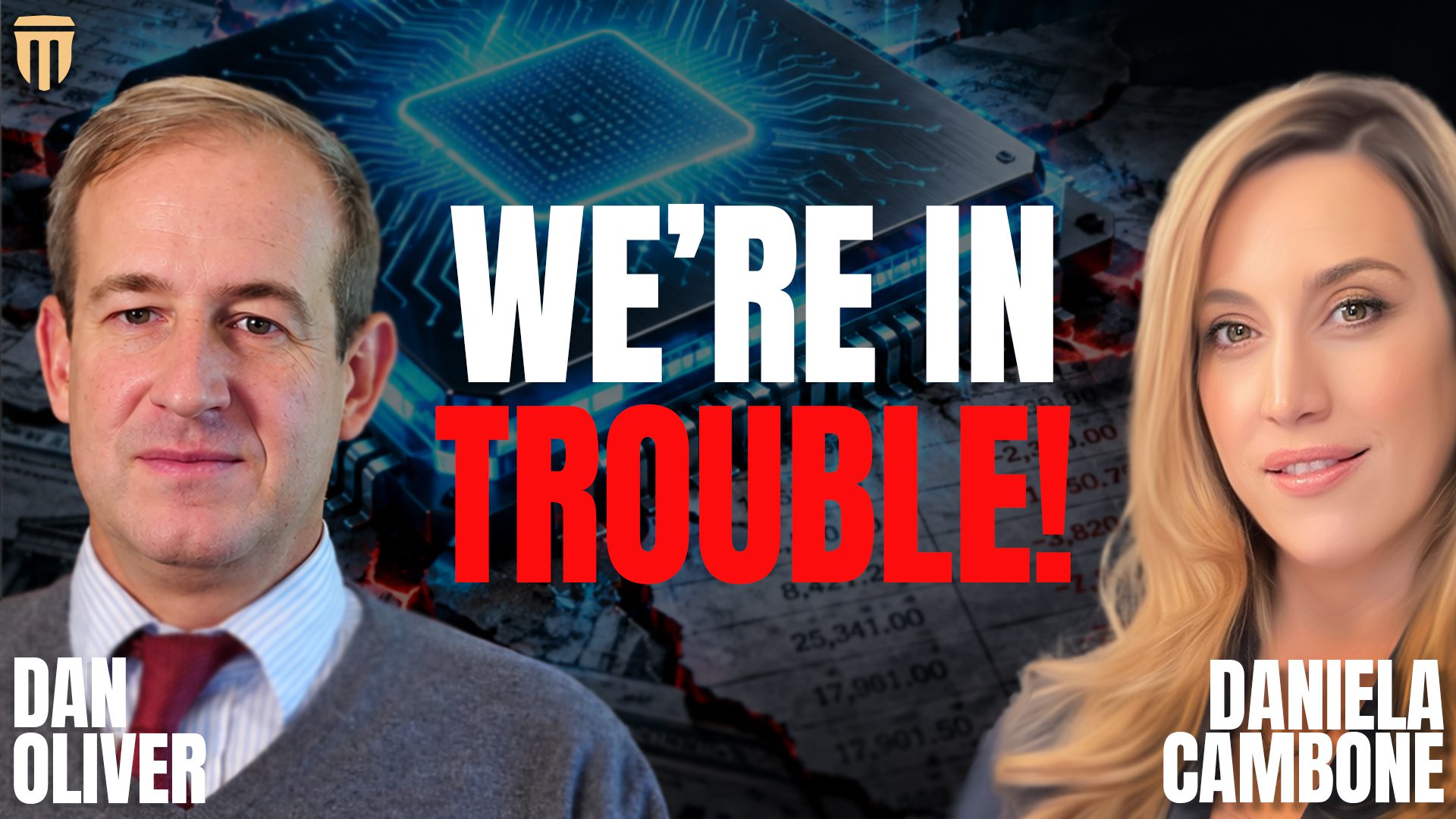
Bigger Than AIG: The AI Debt Secretly Buried in Your Insurance – Dan Oliver
The AI Boom May Not Be a Stock Bubble. It May Be a Credit Bubble.
What if the greatest risk from the artificial intelligence boom isn’t buried in your tech portfolio—but inside the financial institutions Americans depend on for long-term security?
The AI debt boom has become enormous. Data centers, chips, power infrastructure, and long-term computing contracts require staggering amounts of capital, and increasingly, that capital is being raised through debt markets.
Morgan Stanley has estimated the AI infrastructure sector could require roughly $1.5 trillion in funding by 2028. In October 2026 alone, reports emerged that SpaceX was seeking approximately $40 billion in financing to acquire Nvidia chips, including $30 billion of investment-grade debt.
That is precisely where Myrmikan Capital founder Dan Oliver believes investors are looking in the wrong direction.
“The AI boom is not a stock story,” Daniela Cambone said at the start of their conversation. “It’s a debt story.”
Oliver’s argument is more unsettling than the familiar “AI stocks are overvalued” debate.
AI could transform the economy.
AI companies could become enormously valuable.
AI technology could be every bit as revolutionary as its supporters claim.
And the people financing today’s infrastructure boom could still lose enormous amounts of money.
That has happened before.
AI Debt Is Following a Very Old Bubble Playbook
Oliver sees today’s AI infrastructure boom as another chapter in a financial pattern stretching back centuries.
The technology changes.
The credit cycle does not.
He points to several historical examples:
- Canals in the 1800s
- Railroads in the 19th century
- Real estate booms
- Telecommunications infrastructure in the late 1990s
- The dot-com era
- Today’s AI data-center buildout
The recurring sequence is straightforward.
Cheap capital encourages investment.
Investment becomes overinvestment.
Overinvestment creates excess capacity.
Excess capacity pressures prices.
Cash flows fail to meet optimistic projections.
Then the debt comes due.
“AI can change the world and still not pay for itself” is the central tension behind Oliver’s thesis.
The telecom boom provides an especially useful comparison.
The internet was real. Broadband was transformative. Demand eventually became massive.
But that did not mean every company financing fiber-optic networks at peak valuations earned an attractive return.
Oliver argues AI investors face the same distinction:
A revolutionary technology is not automatically a profitable investment at any price.
The crucial question is not whether AI works.
It is whether AI produces enough cash flow, soon enough, to service the extraordinary amount of capital being committed today.
The Scale of AI Financing Is Becoming Difficult to Ignore
That question is growing more important as AI financing expands beyond the cash-rich technology giants.
Credit markets are increasingly being asked to finance chips, data centers, energy infrastructure, and other components of the AI buildout.
In October 2026, Reuters reported that Nvidia’s effort to establish AI computing equipment as a financeable asset class was encountering skepticism among lenders.
Why?
Because lenders must determine what expensive GPUs will actually be worth years from now.
While Nvidia has argued that its processors can remain economically useful for much longer periods, lenders have generally been more conservative, using shorter depreciation assumptions and seeking additional guarantees, contractual revenues, or customer commitments before providing financing.
That disagreement matters.
If a lender finances a conventional building, pipeline, or aircraft, there is a long history for estimating residual value.
The financial history of billion-dollar clusters of rapidly evolving AI processors is considerably shorter.
What happens if today’s cutting-edge hardware becomes economically obsolete faster than lenders modeled?
The loan remains.
The collateral value may not.
And that is when a technology story becomes a credit story.
How Private Credit Connects AI Debt to Insurance Companies
This is where Oliver’s argument becomes especially important for retirees and conservative savers.
He says he initially struggled to understand where much of the credit driving the AI expansion was originating because traditional banks did not appear to be financing the entire boom.
His answer: private credit and the insurance industry.
There is substantial evidence supporting the broader connection between private credit, private equity, and insurers.
The National Association of Insurance Commissioners, or NAIC, says the private-credit market reached an estimated $1.8 trillion in 2023, citing IMF data, and notes that life insurers are major participants because long-duration private-credit investments can match the long-duration liabilities created by insurance policies.
Private credit can also offer higher yields than comparable publicly traded debt.
But that yield comes with tradeoffs.
The NAIC specifically identifies:
- Less liquidity than public debt
- Less transparent pricing
- Infrequent valuations
- The possibility of increasingly complex or “esoteric” transactions
- Potential deterioration in credit quality as the market evolves
That doesn’t mean private credit is inherently dangerous.
It does mean investors should understand what the higher yield is compensating them for.
There is no financial law that allows an investor to permanently earn materially higher returns without accepting some additional risk.
Private Equity Has Moved Deeper Into Life Insurance
The relationship gets even more complicated when private-equity firms become involved.
Following the ultra-low interest-rate environment after the 2008 financial crisis, insurers faced enormous pressure to earn sufficient returns on assets backing long-term obligations.
Traditional government bonds offered increasingly unattractive yields.
Alternative assets became more appealing.
And private-equity firms saw an opportunity.
The NAIC says private equity’s presence in insurance has expanded in two directions:
- Insurance companies increasingly invested in private equity and alternative assets seeking higher returns.
- Private-equity firms increasingly invested directly in insurance businesses, including acquiring insurers outright.
At year-end 2024, the NAIC had identified 137 private-equity-owned U.S. insurers, rising to 139 by June 2025.
Why are life and annuity businesses particularly attractive?
They generate large pools of long-duration capital.
That capital needs to be invested.
Asset managers can earn fees managing it.
Oliver argues this structure creates a potential incentive problem when affiliated investment managers create private-credit products and insurers provide the capital buying them.
That does not demonstrate that AI credit sitting on insurance balance sheets will fail.
But it raises a question worth asking:
Who ultimately carries the risk when increasingly complex private assets are financed with money supporting long-term insurance obligations?
Could This Become Bigger Than AIG?
The comparison to AIG is intentionally provocative.
But it is not arbitrary.
AIG entered the 2008 crisis with approximately $1 trillion in reported assets. Its financial-products operation had written credit-default swaps guaranteeing enormous amounts of debt, including mortgage-related securities.
When those securities deteriorated and counterparties demanded additional collateral, AIG could not meet the calls without government assistance.
Federal authorities ultimately intervened because they concluded that a disorderly AIG failure could inflict catastrophic damage on the financial system.
Treasury records show $67.8 billion was ultimately disbursed through its AIG investment program, while the Federal Reserve also provided extraordinary assistance. The government eventually recovered its broader investment, but the intervention demonstrated something investors should remember:
An insurance company can become systemically important when its investment exposures are deeply intertwined with the rest of the financial system.
Oliver sees an uncomfortable parallel.
AIG was not simply an “insurance company problem.”
Its balance sheet connected it to banks, securities markets, mortgage credit, and counterparties throughout the financial system.
His concern is that today’s private-credit architecture could create another network of interconnected risks—only this time involving AI infrastructure.
That is a hypothesis, not a documented repeat of 2008.
But the underlying lesson from AIG is difficult to dismiss:
Complex credit risk can appear contained until liquidity disappears.
The Critical Difference Between AI Debt and Mortgage Debt
There is another wrinkle.
Oliver argues an AI crisis could actually be harder for policymakers to address directly than the mortgage crisis.
In 2008, the Federal Reserve created emergency facilities and supplied liquidity throughout the financial system as mortgage-related markets froze.
But ultimately, mortgage assets were linked to homes producing a recognizable economic service.
AI infrastructure creates a different problem.
Suppose enormous quantities of debt finance data centers designed around assumptions about future AI demand.
Then suppose:
- AI computing prices collapse.
- Capacity exceeds demand.
- Chip values depreciate faster than expected.
- Customers renegotiate contracts.
- AI companies fail to generate anticipated cash flow.
The data center still exists.
The chips still exist.
But the cash flow originally expected to service the debt might not.
Printing money cannot manufacture profitable AI demand.
That is why Oliver doubts the Federal Reserve could simply purchase troubled AI credit and restore its economics.
Instead, he believes the intervention could arrive indirectly—through liquidity facilities or broader financial rescues after insurance or credit-market stress begins spreading.
Again, that remains Oliver’s forecast.
But history suggests policymakers respond aggressively when credit-market failures threaten the broader financial system.
The Insurance Risk Most People Never Investigate
Most people understand that banks invest deposited money.
Far fewer investigate what sits behind a life insurance company or annuity provider.
Oliver points to a simple behavioral reality:
Most policyholders do not read hundreds of pages of insurance-company financial disclosures.
The assumption is that the institution is regulated, therefore everything must be safe.
Yet insurance companies are investment institutions as much as they are insurance providers.
They collect premiums.
They invest those premiums.
The investment portfolio helps fund obligations that may stretch decades into the future.
If insurers reach further into private markets searching for yield, understanding those assets becomes increasingly important.
The NAIC itself says regulators are monitoring insurers’ growing private-credit exposure to ensure risks are appropriately managed and companies remain capable of meeting policyholder obligations.
That’s not evidence of an impending insurance crisis.
It is evidence that regulators recognize private credit as an area requiring attention.
The Real Danger: The First Failure Rarely Looks Systemic
Financial crises rarely begin with the institution everyone is watching.
Before 2008 became “the global financial crisis,” seemingly isolated problems appeared across mortgage lenders, investment funds, and smaller institutions.
The familiar language followed:
Contained.
Manageable.
No contagion.
Then the connections became visible.
Oliver believes something similar could happen in insurance.
A relatively small insurer experiences problems.
Markets dismiss it.
Another follows.
Questions emerge about asset valuations.
Policyholders begin asking what their own insurer owns.
Liquidity becomes more valuable.
Then supposedly long-term investments suddenly need to be sold.
That is when a solvency problem can become a liquidity problem—and a liquidity problem can become a systemic one.
This is the scenario Oliver is watching.
Not Nvidia dropping 20%.
Not one AI startup failing.
The danger would be credit losses traveling from AI infrastructure into private-credit portfolios and then into institutions assumed to be conservative and stable.
AI Can Succeed While AI Investors Fail
This is perhaps the most important distinction in the entire discussion.
The bearish credit argument does not require AI to fail.
Think about the railroad boom.
Railroads changed civilization.
Investors still lost fortunes.
Think about telecommunications.
Fiber-optic infrastructure became essential to the modern economy.
Many companies financing the original buildout were devastated.
Think about the internet.
The internet became more transformative than even many 1999 bulls imagined.
But countless dot-com shareholders were wiped out.
Amazon survived and became a giant.
Hundreds of competitors disappeared.
Oliver believes AI could follow that same pattern.
The technology wins.
Society benefits.
Early capital gets destroyed.
Then stronger investors purchase distressed infrastructure at radically lower prices.
That is how credit cycles frequently redistribute wealth.
Why an AI Bailout Could Matter for Gold
This brings us to the monetary endgame.
Oliver’s bullish case for gold is not based on AI itself.
It is based on what he expects policymakers to do if excessive AI debt produces systemic financial stress.
His reasoning is straightforward:
When financial institutions become threatened by widespread credit losses, central banks historically respond by expanding liquidity.
The Federal Reserve did so aggressively after the 2008 crisis.
It did so again during the 2020 pandemic shock.
Oliver expects future monetary intervention to weaken the purchasing power of currency relative to scarce monetary assets.
That is why he views a future AI-credit crisis as potentially bullish for gold.
But there is an important nuance.
Gold does not necessarily rise in a straight line during a liquidity crisis.
Oliver points to 2008, when gold initially suffered as investors sold liquid assets during the panic.
Once aggressive monetary intervention arrived, the dynamics changed.
His distinction is useful:
- Short term: Gold can respond to liquidity.
- Long term: Gold can respond to concerns about currency solvency and monetary expansion.
That distinction is especially relevant for investors who confuse a temporary decline in the gold price with a change in the monetary thesis.
Gold and Silver: Tangible Assets Outside the Credit Chain
The AI-credit debate exposes a larger issue that has nothing to do with whether a particular technology company succeeds.
Modern finance is built largely on promises.
A bond is someone’s promise to repay.
An insurance policy is an institution’s promise to perform.
A bank deposit is a bank liability.
A private-credit instrument is a contractual claim on future cash flow.
Physical gold and silver are different.
When directly owned, they do not depend upon a technology company generating enough revenue to refinance its debt.
They do not require an insurance company to correctly value private credit.
They do not require a borrower to remain solvent.
And they do not depend on a central bank maintaining the purchasing power of fiat currency.
That is why generations of investors have viewed precious metals as tools for wealth preservation, particularly during periods of monetary instability.
For financially conservative investors, the relevant comparison is not merely gold vs. dollar on today’s price chart.
It is the structural difference between:
A tangible asset with no counterparty liability
and
a financial claim dependent on somebody else’s balance sheet.
Gold has historically been treated as a monetary reserve asset, while silver combines monetary characteristics with significant industrial demand.
Neither eliminates investment risk. Prices fluctuate, sometimes sharply.
But physical precious metals occupy a fundamentally different place in a portfolio from leveraged credit instruments.
That is what makes gold and silver potentially useful as an inflation hedge and diversification tool when confidence in financial claims deteriorates.
The Dollar Could Face a Different Kind of Bailout Cycle
Oliver also raises another issue: whether future Federal Reserve money creation could create more domestic inflation than previous rounds.
His argument is connected to changes in the international dollar system.
The U.S. dollar’s reserve-currency status allows dollars to circulate throughout global trade and finance.
Oliver argues that as portions of the world seek alternatives to dollar-based settlement and reserve holdings, future monetary expansion may be absorbed by a smaller international dollar system.
If so, he believes more of the inflationary consequences could remain inside the United States.
That outcome is uncertain.
Dollar dominance remains substantial, and debates about “de-dollarization” often become exaggerated.
But the underlying question deserves attention:
What happens if the next financial rescue requires enormous monetary intervention at the same time foreign demand for dollar assets is changing?
For retirement savers, that question matters far more than whether the Nasdaq has another strong quarter.
The Warning Hidden Behind the AI Headlines
Wall Street continues focusing on the most exciting portion of the AI story:
Faster chips.
Bigger models.
Higher productivity.
Trillion-dollar valuations.
But credit cycles are rarely destroyed by technological disappointment alone.
They are destroyed by the gap between expectations and cash flow.
AI could be one of the most important technologies ever created and still produce the classic ingredients of a financial bubble:
- Cheap or abundant financing
- Enormous capital expenditures
- Optimistic long-term revenue assumptions
- Increasing leverage
- Complex structured credit
- Investors reaching for higher yields
- Assets whose future value is difficult to estimate
When those ingredients combine, the relevant question isn’t simply whether AI keeps growing.
It is:
Who financed the growth, what return were they promised, and who absorbs the loss if those returns never arrive?
That is the question behind Dan Oliver’s warning.
And it may be considerably more important than whether the next AI earnings report beats expectations.
Conclusion: Follow the Debt, Not the Hype
The most dangerous bubbles are often built around something genuinely transformative.
Railroads were transformative.
Electricity was transformative.
Telecommunications were transformative.
The internet was transformative.
And AI may prove equally revolutionary.
But revolutionary technology does not repeal the mathematics of debt.
If trillions of dollars of infrastructure are eventually built around revenue assumptions that fail to materialize, somebody must absorb the losses.
Dan Oliver believes those losses could travel through private credit and insurance balance sheets before eventually forcing policymakers to intervene.
Whether his full scenario materializes remains uncertain.
What is already clear is that private credit is growing, insurers are meaningful participants, AI infrastructure requires extraordinary amounts of capital, and increasingly creative financing structures are being developed to fund it.
For investors approaching or already in retirement, this is the moment to understand where your wealth sits in the financial system, which promises it depends upon, and how much protection you have from the next credit cycle.
Because if another rescue becomes necessary, history suggests the bailout itself may only be the beginning.
The longer-term cost can arrive through currency dilution, inflation, and declining purchasing power.
That is precisely why tangible assets such as physical gold and silver continue to play a role in wealth-preservation strategies designed for risks the mainstream portfolio may not anticipate.
About ITM Trading
ITM Trading has over 28 years of experience helping clients safeguard their wealth through personalized strategies built on physical gold and silver. Our team of experts delivers research-backed guidance tailored to today’s economic threats.
THINKING ABOUT PURCHASING GOLD & SILVER?
Get expert guidance from our team of analysts with 28+ years of experience.
👉 [SCHEDULE YOUR CALL HERE] or call 866-706-9061