Fed Chair Warsh Called In This Gold Manager (Here’s What He Wanted) – Axel Merk Exclusive
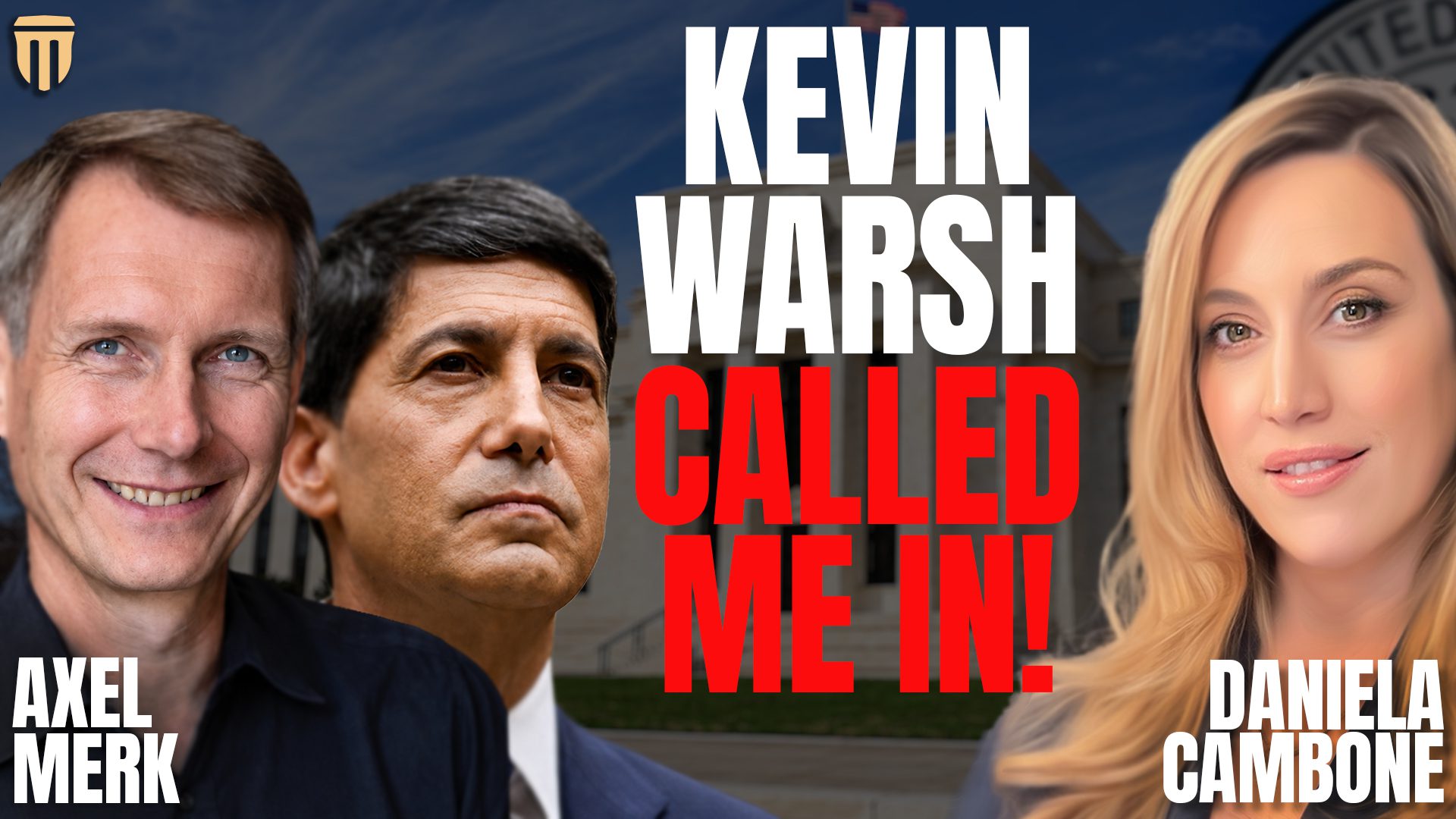
The Fed Chair Called In a Gold Manager.
Why would Federal Reserve Chair Kevin Warsh sit down privately with one of the precious metals industry’s best-known money managers?
That question immediately caught the attention of the Kevin Warsh gold crowd.
Axel Merk has spent years criticizing Federal Reserve policy. His firm manages billions of dollars in precious metals, and Merk himself has long argued that unsustainable fiscal policy strengthens the case for owning gold.
So when Warsh invited him in for a private discussion, the obvious assumption was that gold somehow entered the conversation.
It didn’t.
According to Merk, the two never discussed gold at all.
What they did discuss may be even more important.
The meeting focused on monetary policy, the Federal Reserve’s expanding role in financial markets, its enormous balance sheet, and whether America’s central bank can finally stop trying to micromanage the economy.
That matters because Warsh appears determined to reconsider some of the very policies that transformed the Fed after 2008.
And if he succeeds, the implications could reach far beyond interest rates.
They could affect:
- Treasury yields
- Asset prices
- Bank liquidity
- Inflation expectations
- The U.S. dollar
- And ultimately, gold and silver
Why Kevin Warsh Wanted to Hear From Axel Merk
Merk told Daniela Cambone that his relationship with Federal Reserve officials did not begin yesterday.
He has spent years studying monetary policy and interacting with people inside the central banking world.
His former economics professor, William Poole, previously served as president of the Federal Reserve Bank of St. Louis and later worked as a senior economic adviser to Merk.
Merk also attended monetary policy conferences and became familiar with Warsh over time.
But there is an important twist.
Merk has hardly been a cheerleader for the Fed.
He openly criticized the Bernanke Fed, the Yellen Fed, and the Powell Fed.
That may be precisely why his perspective mattered.
Merk believes Warsh wanted input from people outside the Federal Reserve’s traditional institutional bubble.
As Merk put it, one of the Fed’s long-standing weaknesses has been its tendency to operate inside an “echo chamber.”
Warsh appears interested in hearing perspectives that challenge the prevailing consensus.
That alone represents a meaningful shift.
For decades, monetary policy has increasingly become dominated by models, forecasts, committee communication strategies, and massive interventions in financial markets.
Warsh may be asking a more uncomfortable question:
What if the Fed itself has become part of the distortion?
Kevin Warsh Could Be Trying to Shrink the Fed’s Footprint
Merk said something surprisingly simple about Warsh’s potential legacy.
Even if Warsh accomplished nothing except stopping the Fed from continuously expanding its influence over markets, Merk would consider that a success.
That tells you how dramatic the post-2008 transformation has been.
The Federal Reserve moved far beyond adjusting short-term interest rates.
It began:
- Purchasing enormous quantities of securities
- Buying mortgage-backed securities
- Paying interest on bank reserves
- Using forward guidance to steer investor expectations
- Expanding its balance sheet during repeated crises
- Taking an increasingly active role in asset markets
To many investors, these measures have become normal.
Merk argues they are anything but.
His concern is that the more aggressively the Federal Reserve controls financial conditions, the less genuine information markets can provide.
When the central bank is constantly signaling where rates are headed and intervening in bond markets, price discovery becomes distorted.
And when price discovery weakens, investors may no longer know whether asset prices reflect genuine economic fundamentals or central bank policy.
That is a dangerous distinction.
The Real Battle May Be the Federal Reserve Balance Sheet
One of the most important issues Merk highlighted was the Fed’s balance sheet.
Warsh, in Merk’s assessment, is not comfortable with the massive balance sheet the Federal Reserve accumulated through years of quantitative easing.
The challenge is unwinding it.
Before the 2008 financial crisis, the Fed used a much different operating framework.
The New York Fed regularly intervened in short-term money markets to keep interest rates near the central bank’s target.
After 2008, the system changed dramatically.
The Fed began paying interest on reserve balances and operating with far more liquidity in the banking system.
That system may be easier to administer.
But Merk believes it comes with costs.
A huge central bank balance sheet can distort asset prices and hide stress that markets would otherwise reveal.
There is also a political problem.
Paying interest on enormous bank reserve balances means billions of dollars can flow directly to financial institutions.
That is difficult to explain to Americans who feel the system already favors Wall Street.
Merk believes Warsh faces major institutional resistance if he tries to reverse that framework.
And that resistance could become one of the biggest battles of his tenure.
Quantitative Easing May Face a Much Higher Bar Under Warsh
Investors have become accustomed to one recurring pattern.
A crisis erupts.
Markets fall.
Liquidity disappears.
And eventually, the Federal Reserve arrives.
Rate cuts.
Emergency lending.
Asset purchases.
Quantitative easing.
Repeat.
Merk believes Warsh is deeply uncomfortable with that cycle.
Warsh resigned from the Federal Reserve after the 2008 crisis in part because he believed emergency policies were not being withdrawn quickly enough.
According to Merk, Warsh accepts that extraordinary intervention may occasionally be necessary during genuine emergencies.
But that does not mean emergency measures should become permanent features of monetary policy.
That distinction is crucial.
Merk characterized Warsh as someone for whom the bar for another major QE campaign would likely be extremely high.
In other words, investors accustomed to the “Fed put” may eventually discover that the rules are changing.
That could have major consequences for risk assets.
The Fed Has Quietly Crossed Into Fiscal Policy
One of Merk’s sharpest criticisms involves mortgage-backed securities.
Most investors barely question the fact that the Federal Reserve accumulated enormous holdings of agency mortgage-backed securities after 2008.
Merk does.
Why?
Because once the Fed begins favoring a specific sector of the economy, it is no longer simply managing money and credit.
It is effectively allocating credit.
And that begins to resemble fiscal policy.
By purchasing mortgage-backed securities, the Federal Reserve directs support toward housing finance.
Merk argues that once the central bank enters that territory, political pressure becomes almost inevitable.
Why?
Because elected lawmakers traditionally make decisions about which sectors should receive government support.
When the Fed performs a similar function, monetary and fiscal policy begin to blur together.
That creates a dangerous feedback loop.
Politicians demand more from the Fed.
Markets expect more from the Fed.
Investors become conditioned to intervention.
And suddenly the supposedly independent central bank becomes responsible for everything from employment to mortgage rates to financial market stability.
Warsh appears interested in pushing the Fed back toward a narrower mandate.
Why Higher Treasury Yields Could Become Washington’s Wake-Up Call
The conversation eventually turned to the bond market.
Merk did not sugarcoat the fiscal situation.
He described U.S. fiscal policy as unsustainable.
The basic problem is simple.
When government debt rises while borrowing costs remain elevated, interest expenses become increasingly difficult to contain.
Eventually, the bond market begins demanding a higher price for financing government deficits.
Politicians may ignore economists.
They may ignore budget watchdogs.
They may ignore warnings about debt.
But they have a much harder time ignoring the Treasury market.
Merk believes market pressure may eventually force Washington to confront fiscal reality.
The problem?
There is very little evidence that policymakers are eager to make the necessary adjustments.
That is one reason Merk continues to own gold.
As he put it, he intends to hold gold until “fiscal sanity” breaks out in Washington.
Judging by current incentives, he does not appear to expect that day anytime soon.
There May Never Be a Dramatic “Reset”
There is another important point for investors who expect the monetary system to suddenly collapse and be replaced overnight.
Merk is skeptical.
Countries can run deeply flawed monetary systems for an extraordinarily long time.
Governments can:
- Refinance debt
- Extend maturities
- Change regulations
- Restructure financial systems
- Debase currencies gradually
- Introduce new interventions
- Kick the can farther down the road
That does not mean there are no consequences.
There are.
Purchasing power can erode.
Asset inequality can worsen.
Political instability can rise.
Confidence in institutions can deteriorate.
But there may never be one cinematic moment when the entire system formally “resets.”
There is usually a tomorrow.
That may actually make wealth preservation more complicated.
Instead of preparing only for sudden collapse, investors must also prepare for the slower danger of monetary erosion.
Why Gold Can Rise Even With High Real Interest Rates
Conventional wisdom says high real interest rates should hurt gold.
After all, gold does not generate interest.
When inflation-adjusted bond yields rise, interest-bearing assets theoretically become more attractive.
But the current environment is more complicated.
Merk noted that longer-term real rates remain relatively high.
Yet interest in gold has remained substantial.
Why?
Because investors are not buying gold for only one reason.
The gold market includes several distinct groups:
- Central banks diversifying reserves
- Long-term investors concerned about currency debasement
- Portfolio managers seeking diversification
- Speculators chasing momentum
- Precious metals investors worried about fiscal deficits
Those groups behave differently.
Speculators can disappear quickly.
Long-term holders may barely change their positions.
Central banks can continue diversifying regardless of short-term price fluctuations.
This helps explain why gold can remain structurally supported even while traditional valuation models suggest it should struggle.
The Gold Buyer Has Changed
Merk identified another major shift.
Speculators returned to the gold market as momentum accelerated.
But speculative money is fickle.
The same traders chasing gold today may be chasing technology stocks, cryptocurrency, or another momentum trade tomorrow.
That makes speculative demand unstable.
Long-term demand is different.
Merk described investors who have remained committed to gold because they see it as insurance against:
- Fiscal instability
- Currency debasement
- Excessive monetary intervention
- Financial market distortion
- Loss of institutional credibility
Central banks also belong in a separate category.
They have their own incentive to diversify reserve assets.
That does not mean they will abandon the dollar.
But gold remains one of the few reserve assets without a corresponding counterparty liability.
For governments concerned about geopolitical or financial-system risk, that characteristic matters.
Gold Miners May Finally Be Competing With the AI Trade
One of the most interesting arguments in Merk’s interview had little to do with the Fed.
It involved artificial intelligence.
During the long technology boom, software companies enjoyed a powerful advantage.
They often had relatively low capital requirements and extremely high margins.
Gold mining looked unattractive by comparison.
Mining requires enormous upfront investment.
Projects can take years.
Operating conditions are difficult.
Permitting is complicated.
Costs fluctuate.
But the investment landscape is changing.
AI infrastructure also requires huge amounts of capital.
Data centers, semiconductors, power infrastructure, cooling, and transmission all demand massive investment.
That changes the relative comparison.
Suddenly, capital-intensive businesses are competing against other capital-intensive businesses.
And when gold prices remain elevated, mining margins can become extremely attractive.
Merk said he has already noticed broader institutional interest appearing in the mining sector.
That does not guarantee higher mining share prices.
But it could represent an important shift in investor perception.
Gold miners may no longer look like the only capital-intensive industry in a market obsessed with asset-light technology.
Why Oil and Gold Can Move in Opposite Directions
One of the most useful parts of Merk’s discussion involved the relationship between oil shocks and gold.
Many investors assume geopolitical crises automatically push gold higher.
History is more complicated.
Merk argues that the crucial variable is not necessarily the shock itself.
It is the policy response.
Consider an oil shock.
Higher oil prices can raise headline inflation.
But expensive energy also slows economic activity.
Consumers spend more on gasoline and energy bills.
Businesses face higher transportation and production costs.
Growth can weaken.
That can create disinflationary or even deflationary pressure elsewhere in the economy.
Gold does not automatically benefit.
What mattered during previous inflationary episodes was often what governments and central banks did afterward.
If policymakers respond with aggressive money creation, subsidies, deficit spending, price controls, or other interventions, the monetary consequences can become far more supportive for gold.
That distinction matters.
The crisis itself is not necessarily bullish for gold. The policy response can be.
Tariffs Could Be Affecting Treasury Yields in Ways Few Investors Notice
Merk also raised an underappreciated connection between trade policy and the bond market.
Tariffs are usually discussed in terms of consumer prices and global trade.
But there is also a capital-flow dimension.
Foreign countries that accumulate dollars through trade often recycle those dollars into U.S. financial assets, including Treasury securities.
If trade flows change, those financial flows can change too.
Fewer foreign dollars available to purchase Treasuries could contribute to upward pressure on long-term yields.
This does not mean tariffs alone determine Treasury rates.
Far from it.
Federal deficits, inflation expectations, monetary policy, economic growth, and investor demand all matter.
But Merk’s point is that trade policy and bond-market dynamics cannot be viewed in isolation.
The global monetary system is interconnected.
And when one flow changes, another usually moves with it.
Judy Shelton, Sound Money, and the Gold Question
Daniela also asked Merk about Judy Shelton’s role at the Treasury and her history of advocating sound-money ideas.
Shelton has previously discussed mechanisms that could reconnect government debt instruments with gold.
Merk welcomed her participation in policy discussions.
But he was skeptical that Treasury would suddenly embrace a gold-linked bond.
The reason is institutional.
Treasury securities occupy a unique position in the global financial system.
Creating a government instrument explicitly tied to gold could implicitly raise uncomfortable questions about the purchasing-power stability of conventional Treasuries.
That alone could generate resistance.
Still, Merk believes having Shelton inside the conversation matters.
Even if sweeping monetary reform never happens, introducing different ideas can influence policy at the margin.
And sometimes, bending policy slightly in a better direction is the only realistic victory available.
Gold and Silver as Wealth Preservation Assets
This is where the conversation becomes relevant for ordinary investors.
The United States does not need to return to an official gold standard for individuals to create their own form of monetary diversification.
Physical gold and silver remain tangible assets outside the traditional banking system.
They do not depend on the solvency of a corporation.
They are not created by central banks.
And they cannot be expanded electronically with a keystroke.
That does not mean gold or silver rise every day.
They do not.
Both can experience significant volatility.
But their historical role in wealth preservation is precisely why investors continue turning to precious metals when confidence in fiscal or monetary policy weakens.
The gold vs dollar debate is ultimately a debate about monetary discipline.
The dollar is a liability issued within the financial system.
Gold is an asset without a corresponding issuer.
Silver shares many of those monetary characteristics while also carrying substantial industrial demand.
For investors worried about persistent deficits, currency erosion, or another cycle of monetary intervention, physical precious metals can serve as a long-term inflation hedge and portfolio diversifier.
The key is not speculation.
It is resilience.
Merk made that point clearly.
Investors should not own more gold than they can financially or psychologically tolerate.
If normal price volatility keeps you awake at night, the position may simply be too large.
But for investors who can hold through volatility, gold can serve a very different purpose from stocks, bonds, or cash.
The Bigger Story Is Bigger Than Gold
Axel Merk’s meeting with Kevin Warsh was intriguing precisely because the obvious story turned out to be wrong.
They did not sit down to discuss some secret government gold plan.
They discussed the machinery of monetary policy.
That may ultimately matter more.
Warsh appears interested in a Federal Reserve that:
- Intervenes less
- Distorts markets less
- Relies less on forward guidance
- Shrinks its policy footprint
- Separates monetary policy from fiscal policy
- Treats quantitative easing as an emergency measure rather than a routine tool
- Allows markets to send clearer signals
Whether he can accomplish those goals is another question.
Institutions resist change.
Markets have spent nearly two decades adjusting to aggressive central bank support.
Politicians have grown accustomed to enormous deficits.
And investors have been trained to expect intervention whenever financial conditions deteriorate.
Undoing that system will not be easy.
But the fact that the conversation is happening at all should get investors’ attention.
Because if policymakers truly reduce monetary intervention while fiscal deficits remain unresolved, markets may eventually be forced to price risks that central banks have spent years suppressing.
And that is precisely the kind of environment in which understanding the role of gold and silver becomes increasingly important.
Conclusion
The most revealing part of Axel Merk’s meeting with Kevin Warsh may be what they didn’t discuss.
Gold never came up.
Instead, they discussed something deeper: whether the Federal Reserve itself needs to change.
Warsh appears determined to challenge parts of the post-2008 central banking framework, from quantitative easing and balance-sheet expansion to forward guidance and market intervention.
But even a more disciplined Federal Reserve cannot solve Washington’s fiscal problem.
That remains in the hands of Congress and the administration.
And until America’s debt trajectory becomes sustainable, investors will continue asking the same question:
How much confidence should you place in financial assets dependent on monetary and fiscal institutions that have repeatedly chosen short-term relief over long-term discipline?
For many financially conservative investors, physical gold and silver remain one answer.
Not because collapse is guaranteed.
Not because a monetary reset is inevitable.
But because diversification matters most before confidence becomes a scarce asset.
About ITM Trading
ITM Trading has over 28 years of experience helping clients safeguard their wealth through personalized strategies built on physical gold and silver. Our team of experts delivers research-backed guidance tailored to today’s economic threats.
THINKING ABOUT PURCHASING GOLD & SILVER?
Get expert guidance from our team of analysts with 28+ years of experience.
👉 [SCHEDULE YOUR CALL HERE] or call 866-706-9061