

Why Gold Falls First | Doug Casey: That’s When the Bigger Crisis Starts
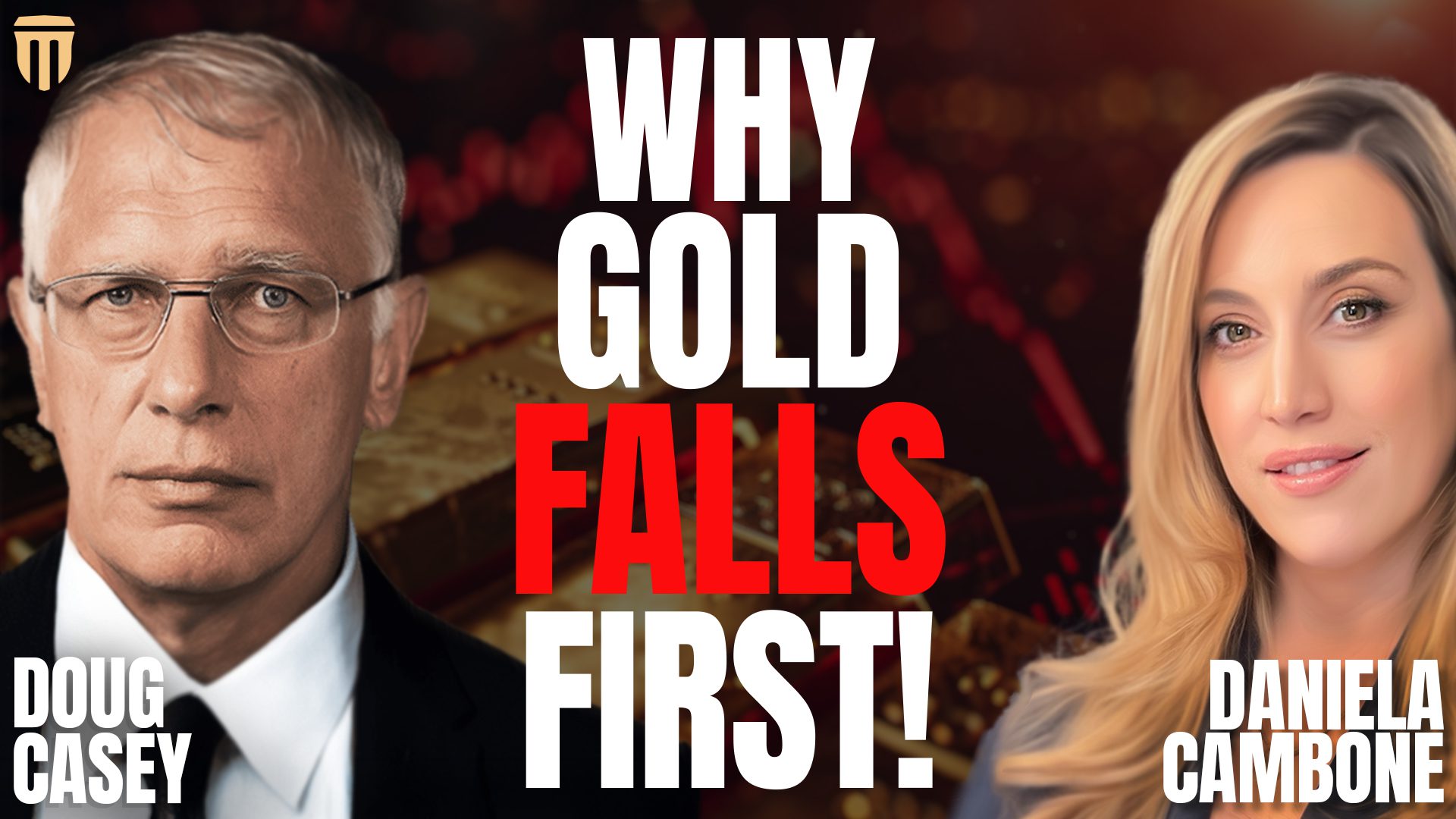
Gold Is Falling. So Is the Crisis Over?
Gold falling while debt risks get worse may look like a contradiction. It isn’t necessarily one.
That is the central message from veteran crisis investor Doug Casey, who has owned gold since the early 1970s and says a gold price correction should not be confused with the disappearance of the monetary problems that drove investors toward the metal in the first place.
Gold has gone through a sharp period of weakness in 2026. According to the World Gold Council, the international gold price fell about 8% during the first half of the year, its first negative first half since 2021.
But while prices corrected, something important did not stop.
Central banks kept buying.
And the debt problem kept growing.
That is the disconnect investors should be watching.
The screen price of gold can fall long before the underlying monetary risks disappear.
Why Doug Casey Doesn’t Treat Gold Like a Trade
Casey says he began buying gold after reading Harry Browne’s How You Can Profit from the Coming Monetary Crisis around 1970.
His philosophy since then has been remarkably simple:
Gold is savings.
Not a stock.
Not a business.
Not something that produces cash flow.
And, in his view, not something that should be judged primarily by what it did this week.
Casey told Daniela Cambone:
Gold is “the only financial asset that’s not simultaneously somebody else’s liability.”
That distinction gets to the core of why physical gold occupies a different place in a portfolio than conventional financial assets.
A bank deposit is a liability of a bank.
A bond is a liability of an issuer.
A Treasury security is an obligation of the U.S. government.
A share of stock represents ownership in a corporation whose value depends on its business and capital structure.
Physical gold held outright has no issuer promising to pay you back.
That does not mean gold cannot lose value, sometimes sharply. It means the nature of the risk is different.
And in a world increasingly defined by leverage, debt and counterparty exposure, that difference matters.
The Gold Price Correction Is Happening While Debt Keeps Climbing
Here is where the story gets uncomfortable.
Gold weakened.
But America’s fiscal position did not suddenly improve.
The Congressional Budget Office estimated that the U.S. federal government accumulated a $2.0 trillion deficit during the first 11 months of fiscal year 2026.
Casey argues that investors underestimate the significance of persistent trillion-dollar deficits because numbers this large have become normalized.
But deficits eventually become debt.
Debt requires servicing.
And higher interest rates make that servicing more expensive.
Meanwhile, the pressure does not stop at Washington.
The Federal Reserve Bank of New York reported that total U.S. household debt stood at approximately $18.8 trillion in the second quarter of 2026. That included:
- $13.1 trillion in mortgage balances
- $1.71 trillion in auto loans
- $1.65 trillion in student loans
- $1.26 trillion in credit-card balances
And financing conditions remain punishing for many households.
Freddie Mac reported that the average U.S. 30-year fixed mortgage rate reached 7.03% on September 24, 2026.
That combination—heavy public debt, heavy household debt and expensive financing—is exactly the kind of environment in which seemingly isolated credit problems can spread.
Casey’s warning is that the danger is not merely inflation.
It is what happens if defaults begin occurring faster than policymakers can contain them.
The Bigger Risk: Inflation or a Credit Collapse?
Most discussions about gold eventually come back to inflation.
Casey sees the situation as more complicated.
He describes policymakers as being caught between two dangerous outcomes:
Inflation: Governments and central banks respond to financial stress with additional liquidity or monetary expansion.
Deflationary credit stress: Borrowers default, collateral falls in value, lending contracts and liabilities disappear through bankruptcy or restructuring.
The uncomfortable possibility is that investors could experience elements of both.
An economy can have weak credit conditions in one sector while prices remain elevated elsewhere.
Asset prices can plunge even as living costs remain stubborn.
And gold itself can sell off during the initial phase of a liquidity event.
That last point is critical.
During severe market stress, investors often sell what they can—not necessarily what they want to sell.
Liquid assets can therefore get hit first as investors raise cash, meet redemptions or cover leveraged positions.
A falling gold price by itself does not prove that systemic risk has vanished.
Sometimes it can simply mean markets are scrambling for liquidity.
Even the IMF Is Warning About the Debt “Staircase”
The debt warning is no longer coming exclusively from contrarian investors.
IMF Managing Director Kristalina Georgieva said in September 2026 that worldwide public debt was approaching 100% of global GDP and had exceeded its post-World War II highs.
She compared the trajectory to a staircase: economic shocks push debt sharply higher, but governments make little progress bringing it back down afterward.
Think about what that means.
First came the debt.
Then came another crisis.
Then more borrowing.
Then another crisis.
Then still more borrowing.
The emergency measures disappear. The debt rarely does.
That is precisely the long-term monetary problem gold investors are watching.
Governments do not need to formally declare a debt crisis for the consequences to begin appearing in currencies, interest rates, taxes, financial repression or purchasing power.
If Gold Is Struggling, Why Are Central Banks Still Buying?
This may be the most revealing piece of the puzzle.
Private investors frequently focus on short-term performance.
Central banks are playing a very different game.
World Gold Council data show that global central banks purchased a net 289 tonnes of gold in the second quarter of 2026, a fivefold increase from the revised first-quarter level.
China has been particularly notable.
The People’s Bank of China added approximately 20 tonnes in July alone, bringing its reported official holdings to around 2,366 tonnes and extending its buying streak to 21 consecutive months.
And this is not merely about China.
In the World Gold Council’s 2026 survey of reserve managers:
- 89% expected global central-bank gold reserves to increase during the following 12 months.
- A record 45% expected their own institutions to increase gold holdings.
- 83% believed gold would represent a larger share of global reserves five years from now.
Over the previous four years, central banks accumulated roughly 1,000 tonnes annually on average, approximately double the average pace of the preceding decade.
So ask the obvious question:
If gold’s monetary role is supposedly obsolete, why are institutions responsible for managing national reserves accumulating so much of it?
Their stated motivations include reserve diversification, liquidity, risk management and gold’s lack of credit risk.
That does not guarantee higher gold prices.
But it tells investors something important about how monetary authorities themselves view the asset.
Gold at $4,000 Is Not Gold at $40
Casey also makes a point gold investors may not necessarily want to hear.
Gold is not as cheap relative to the world as it was when he began buying near $40 an ounce.
That matters.
He argues that gold today should therefore be viewed differently from gold in the early 1970s.
For Casey, the metal is principally a savings vehicle today—not necessarily the extraordinary speculation it once was.
That is an important distinction.
A person buying physical gold for wealth preservation is asking a different question from a trader trying to predict next month’s price.
The trader asks:
“Will gold go up?”
The saver asks:
“What do I want to own if confidence in financial promises deteriorates?”
Those are not the same question.
Casey Says Silver May Offer More Speculative Upside
Casey also highlighted another precious metal during the interview:
silver.
He said he currently views silver as potentially a more attractive speculation than gold.
The reason is not that silver replaces gold’s monetary function.
Silver behaves differently.
It has both monetary history and substantial industrial demand, and its smaller market can make price movements considerably more volatile.
That cuts both ways.
Silver can produce outsized upside during precious-metals bull markets.
It can also fall harder.
For retirement-minded investors, the distinction between wealth-preservation assets and speculative positions matters.
Physical gold may serve one purpose.
Physical silver may serve another.
Mining equities—a specialty Casey also discusses—bring an entirely different level of operating, financing and market risk.
They should not be treated as interchangeable simply because all three involve precious metals.
Gold vs. Dollar: Why Tangible Assets Still Matter
The real question behind the gold vs dollar debate is not whether the dollar disappears tomorrow.
That is the wrong framework.
The question is what happens to purchasing power over long periods when governments repeatedly run deficits, accumulate debt and rely on a financial system built around expanding credit.
This is where tangible assets enter the conversation.
Physical gold and silver do not depend on an earnings forecast, bond covenant or bank balance sheet to exist.
They cannot default.
They cannot be printed by a central bank.
And when held directly, they are not somebody else’s promise to repay.
That is why gold has historically been used as an inflation hedge and monetary reserve, even though it can be volatile over shorter periods and does not perfectly track inflation month to month.
For financially conservative investors, the purpose of owning physical precious metals is therefore less about calling the next price move and more about diversification against risks that conventional financial assets may share.
Wealth preservation is not the same thing as price speculation.
A temporary gold correction does not erase that distinction.
The Signal Isn’t the Daily Gold Price
Markets have trained investors to obsess over screens.
Green means the thesis is working.
Red means something must be wrong.
But systemic financial risks do not operate on a daily chart.
The U.S. deficit is still enormous.
Household debt remains near record nominal levels.
Mortgage rates are around 7%.
Worldwide public debt is approaching the size of annual global economic output.
And central banks continue accumulating gold even after one of the strongest multi-year moves in the metal’s modern history.
That doesn’t mean gold rises in a straight line.
It means a falling gold price and a growing debt problem can exist at the same time.
Casey’s broader message is to look beyond the quotation on the screen and examine the structure beneath it.
Debt.
Credit.
Counterparty exposure.
Currency risk.
And the financial assets you would want to own if confidence in those structures were suddenly tested.
A correction can feel frightening.
But for long-term savers, the bigger question isn’t simply why gold fell.
It’s whether the reasons for owning it disappeared when it did.
About ITM Trading
ITM Trading has over 28 years of experience helping clients safeguard their wealth through personalized strategies built on physical gold and silver. Our team of experts delivers research-backed guidance tailored to today’s economic threats.
THINKING ABOUT PURCHASING GOLD & SILVER?
Get expert guidance from our team of analysts with 28+ years of experience.
👉 [SCHEDULE YOUR CALL HERE] or call 866-706-9061