

93T Bond Fraud Will Crash Financial System: “We’re Dancing on a Razor Blade” – Mitch Vexler
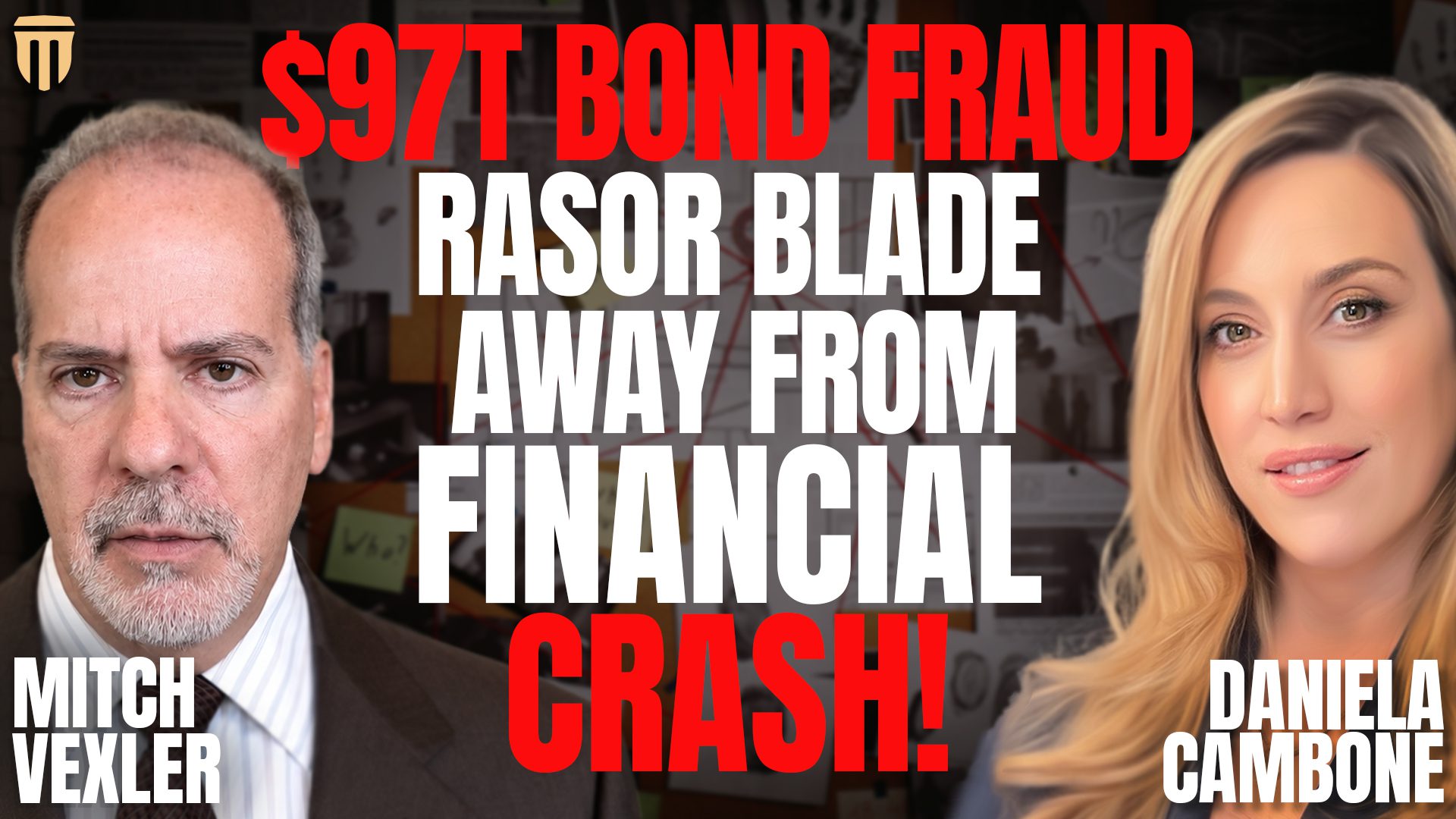
What happens when the debts supporting the financial system become larger than the ability of households, taxpayers, and governments to service them?
According to developer and financial researcher Mitch Vexler, that is the uncomfortable question hiding beneath today’s bond market crisis.
His argument is deliberately simple: “X cannot be greater than Y.”
X represents the financial demands created by debt and bonds. Y represents the income and economic capacity available to service those obligations.
And Vexler believes the gap has become mathematically unsustainable.
In his latest interview with Daniela Cambone, Vexler went further, arguing that alleged problems inside the municipal and school-bond system could ultimately produce what his proprietary model estimates as $93 trillion in losses under a severe contagion scenario.
That $93 trillion figure is Vexler’s model estimate—not the face value of outstanding municipal bonds. For perspective, SIFMA reported approximately $4.5 trillion in U.S. municipal securities outstanding as of Q2 2026.
But the broader concern extends well beyond municipal debt.
Government borrowing is enormous, bond yields remain elevated by recent historical standards, and investors are being forced to reconsider an assumption that has underpinned portfolios for decades:
What happens when the assets considered “safe” become a source of systemic instability themselves?
The $93 Trillion Bond Crisis Warning
Vexler’s analysis begins with what he calls the “ultimate bond lie detector”—a proprietary 37-tab model designed to test whether the revenue supporting debt obligations can realistically cover those obligations over time.
His fundamental rule is:
X ≤ Y.
The demands on the system cannot sustainably exceed the resources available to support them.
Vexler argues that this rule is already being violated across parts of the municipal and property-tax system.
He divides the potential consequences into two stages.
Dynamic Contagion Level One
Under Vexler’s model, a breakdown in confidence surrounding lower-level bonds could cause investors to scramble for liquidity.
He estimates this scenario could ultimately generate losses approaching $93 trillion across interconnected assets, including effects extending well beyond the municipal securities at the center of his allegations.
Again, this is a scenario generated by Vexler’s analysis, not an established estimate from federal regulators.
But there is no question that municipal finance itself is enormous.
Federal Reserve data show state and local governments issued $576.5 billion of new and refunding securities during 2025, up sharply from $370.5 billion in 2023. Education accounted for roughly $90.7 billion of new-capital issuance in 2025.
SIFMA reports another $408.5 billion in municipal issuance through August 2026, 4% higher than the comparable 2025 period.
That does not establish Vexler’s fraud allegations.
It does show the scale of the market being discussed.
Dynamic Contagion Level Two
This is Vexler’s nightmare scenario.
If losses undermine confidence in government debt itself, he argues that the problem could migrate from municipal finance into Treasuries, derivatives, banks, and eventually global liquidity.
His warning is stark:
“We’re dancing on a razor blade. One little slip, and this is game over.”
Recent bond-market conditions explain why investors are paying closer attention to these risks.
Reuters reported this month that U.S. government bond yields were trading near their highest levels in roughly two decades, while federal debt had reached $40 trillion.
Higher yields create their own pressure: when market interest rates rise, existing lower-yielding bonds generally lose market value.
For retirees who were taught that bonds represent the quiet, conservative side of a portfolio, that distinction matters.
Credit risk is not the only risk in bonds. Duration, inflation, liquidity, and interest-rate risk can also destroy purchasing power or principal value.
The Bond Fraud Case Has Reached the Supreme Court
One important part of Vexler’s story can be independently confirmed.
His case is indeed before the Supreme Court of the United States.
Supreme Court records identify Mitchell Vexler, et al. v. Don Spencer, Chief Appraiser, Denton Central Appraisal District, et al. as Docket 26-179.
The petition for a writ of certiorari was filed August 5, 2026. Vexler also filed a motion requesting expedited consideration. On September 9, the petition was distributed for the Court’s September 28, 2026 conference.
That procedural status is important.
The existence of the Supreme Court petition does not mean the Supreme Court has accepted Vexler’s allegations as true or ruled that fraud occurred.
Rather, Vexler is asking the Court to review issues arising from his litigation against the Denton Central Appraisal District and others.
That distinction matters because his accusations are sweeping.
Vexler argues that property valuations and the bonds connected to them have relied on data that were not adequately verified. He further alleges that government officials and institutions knew—or should have known—about these problems.
Those remain allegations being advanced by Vexler and his legal team.
But his broader question deserves attention regardless of how the litigation ends:
Who verifies the assumptions underneath trillions of dollars of public debt?
The Property Tax Squeeze: When X Becomes Bigger Than Y
This is where an abstract bond-market discussion arrives at the kitchen table.
Vexler argues that households increasingly face taxes, debt service, housing costs, insurance, and other expenses that collectively consume an unsustainable share of income.
His framework asks something almost embarrassingly basic:
Can the taxpayer actually afford the obligation being created?
If the answer is no, extending the repayment period doesn’t necessarily solve the underlying problem.
It can simply push the reckoning further into the future.
This is particularly important when public entities issue long-duration debt based on assumptions about:
- Future property values
- Tax collections
- Population growth
- Household income
- Interest costs
- Refinancing conditions
If those assumptions are too optimistic, the bond may still exist on paper—but the economic capacity supporting it can deteriorate.
Debt doesn’t create the income needed to repay debt.
And issuing more debt to manage old debt does not eliminate that fundamental constraint.
Inflation Is the Hidden Variable
Vexler takes the argument another step.
He calls inflation a “hidden tax” because it erodes what a dollar can purchase.
The historical decline in the dollar’s purchasing power is real, although characterizing that decline as fraud is Vexler’s interpretation.
The Bureau of Labor Statistics maintains CPI data going back to 1913, allowing households to see directly how the purchasing power of money has changed as consumer prices increased.
And inflation creates a particularly uncomfortable problem for fixed-income investors.
Suppose a bond pays 5%.
That sounds attractive.
But the investor still has to consider inflation, taxes, duration risk, and what happens to the market value of that bond if yields rise.
A supposedly conservative investment can therefore deliver a very different real-world result than its coupon suggests.
The number printed on the bond isn’t necessarily the number that determines your purchasing power.
The “Safe Asset” Problem
This is where Vexler’s argument becomes especially relevant to retirement portfolios.
For generations, traditional portfolio construction treated government bonds as the stabilizing counterweight to stocks.
But bonds are not immune to losses.
If you purchase a long-duration bond and yields rise sharply, its market price can fall substantially. Holding until maturity may eliminate that particular mark-to-market loss if the issuer pays as promised, but doing so can lock capital into a lower-yielding asset while inflation continues working against purchasing power.
That creates several separate risks:
- Interest-rate risk: Rising yields reduce existing bond prices.
- Inflation risk: Fixed payments can buy less over time.
- Liquidity risk: Market stress can make selling more painful.
- Credit risk: Some issuers can fail to meet their obligations.
- Concentration risk: Investors may own far more financial-system exposure than they realize.
Vexler’s concern is that these risks could begin reinforcing one another during a liquidity event.
That is why he repeatedly returns to the same equation:
X cannot sustainably remain greater than Y.
Gold and Silver: What Is the Alternative?
Near the end of the interview, Daniela asked the question that ultimately matters for savers:
If bonds, stocks, and real estate all carry significant risks, where does capital go?
Vexler pointed toward precious metals.
His reasoning was not that gold and silver never decline. They do.
Rather, physical precious metals have fundamentally different characteristics from bonds.
A Treasury security is ultimately a financial claim.
A corporate bond is a promise to repay.
A bank deposit is a liability of a financial institution.
Physical gold held outright is not somebody else’s promise to pay.
The World Gold Council makes this distinction explicitly: gold produces no regular cash flow, but it also carries no credit risk and no counterparty risk when owned outright.
That difference becomes particularly relevant when the central concern is confidence in financial counterparties themselves.
Gold vs. Dollar: The Wealth Preservation Question
Gold’s appeal as a wealth preservation asset is not merely a retail-investor phenomenon.
Central banks have accumulated extraordinary quantities of it.
They purchased a net 863 tonnes in 2025, following three consecutive years in which annual buying exceeded 1,000 tonnes.
And despite uneven buying during the first half of 2026, central banks purchased an estimated 289 tonnes in Q2 alone.
In a 2026 World Gold Council survey, 89% of reserve managers expected global central-bank gold reserves to increase over the following 12 months, while a record 45% expected their own institution to increase its holdings.
That does not mean gold only rises.
It means institutions responsible for national reserves continue treating gold as a strategic diversification asset.
For individuals concerned about an inflation hedge, counterparty exposure, or the long-term gold vs. dollar equation, that deserves attention.
Silver offers another form of tangible ownership, although it historically carries considerably more price volatility than gold.
Both metals share one important characteristic:
Physical gold and silver are tangible assets that do not require a debtor to make good on a promise for the asset itself to exist.
The Financial System Doesn’t Need to Collapse for This to Matter
Vexler’s most severe forecasts are exactly that—forecasts generated from his own analysis.
A $93 trillion contagion event is not an established government projection.
Hundreds of bank failures are not a predetermined outcome.
And allegations of systemic bond fraud remain allegations unless established through evidence and legal proceedings.
But investors do not need to accept every part of the thesis to recognize the underlying vulnerabilities.
Government debt is enormous.
Bond yields have returned to levels rarely seen during the post-financial-crisis era.
Municipal borrowing remains substantial, with approximately $4.5 trillion of securities outstanding.
Inflation has steadily reduced the purchasing power of the dollar over generations.
And central banks themselves continue accumulating gold.
The bigger lesson isn’t that investors should predict the exact moment something breaks.
It’s that wealth preservation becomes much harder when a portfolio depends entirely on the continued stability of the same financial system.
“We’re Dancing on a Razor Blade”
Mitch Vexler believes the mathematics beneath the bond market are approaching a breaking point.
Whether his most severe contagion scenario ultimately proves correct remains unknown.
His legal battle is also still a legal battle—not a final judicial determination validating his allegations.
But the underlying question is difficult to dismiss:
How much debt can households, municipalities, and governments support before the promises embedded in the financial system outrun the income available to honor them?
For financially conservative Americans approaching or already in retirement, waiting until a crisis answers that question may be a dangerous strategy.
This is why understanding your exposure to debt-based assets—and considering the role of physical gold and silver as part of a diversified wealth-preservation strategy—matters before markets become disorderly.
Because if confidence disappears quickly, the time to understand what you actually own was yesterday.
About ITM Trading
ITM Trading has over 28 years of experience helping clients safeguard their wealth through personalized strategies built on physical gold and silver. Our team of experts delivers research-backed guidance tailored to today’s economic threats.
THINKING ABOUT PURCHASING GOLD & SILVER?
Get expert guidance from our team of analysts with 28+ years of experience.
👉 [SCHEDULE YOUR CALL HERE] or call 866-706-9061