It’s a Wartime Economy, Gold Will Be Used as America’s WEAPON – Graham Summers
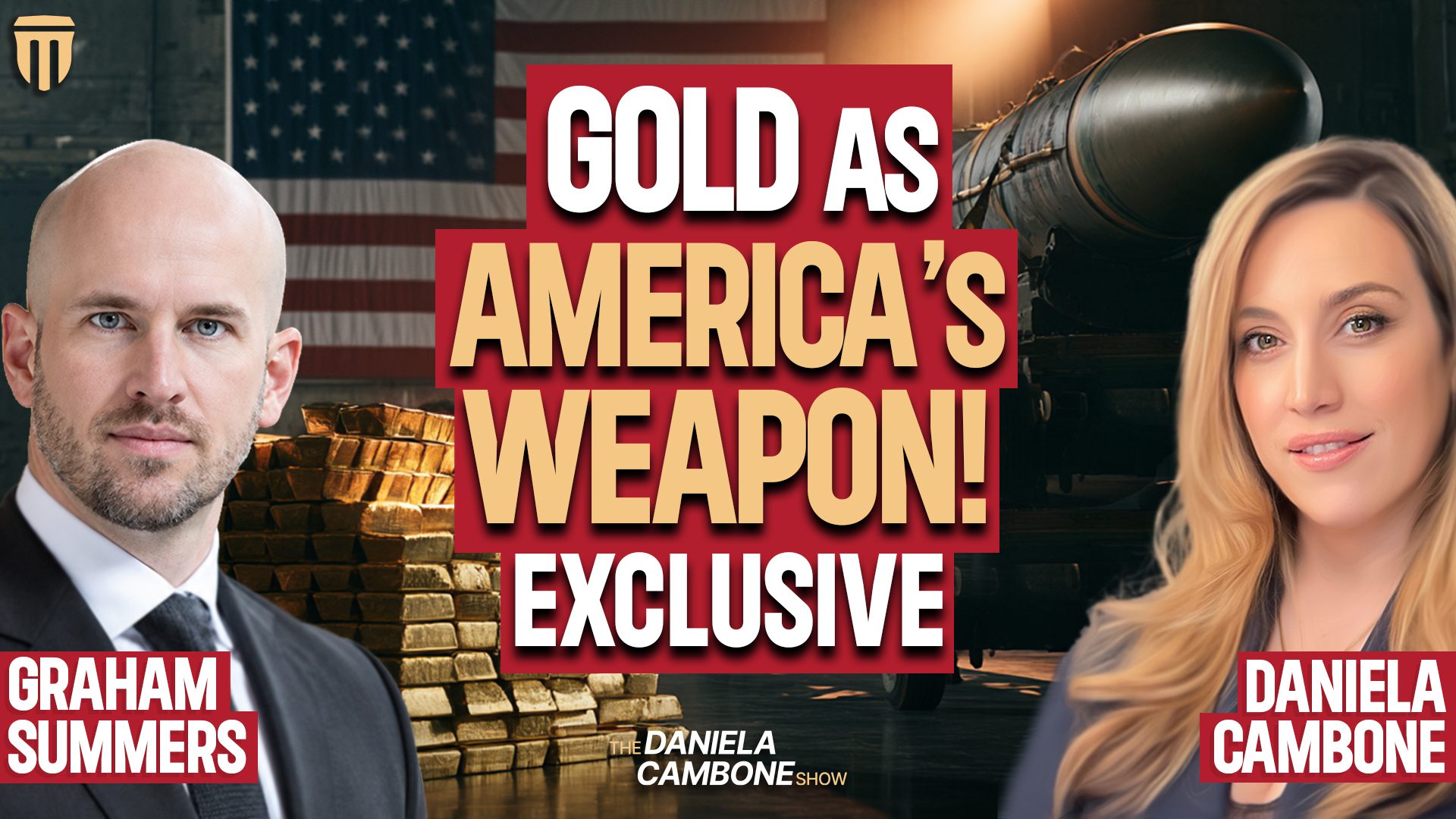
Something has changed in Washington’s relationship with gold—and Graham Summers believes most investors have not recognized the significance yet.
The idea of gold as a weapon may sound extreme. But Summers argues that a series of policy moves—from mineral-security policy to sanctions enforcement—shows that gold is increasingly being treated not merely as an investment or inflation hedge, but as an asset with geopolitical and national-security significance.
The public record supports an important part of that argument.
President Donald Trump’s March 20, 2025 Executive Order 14241 explicitly included gold among the minerals covered by a sweeping effort to accelerate U.S. mineral production. Then, on August 24, 2026, the Treasury Department named gold as one of five sectors targeted under its new sanctions campaign against Iran. (The White House)
That does not mean the United States has returned to a gold standard.
It does not mean ordinary Americans holding physical gold are suddenly subject to sanctions.
And it does not legally transform gold into currency.
But it does raise a much bigger question:
Why is gold suddenly appearing in conversations about mineral security, sanctions enforcement, sovereign reserves, and economic warfare?
That is where Summers believes investors need to pay attention.
Washington Is Looking at Gold Differently
For decades, the standard argument for owning gold was straightforward.
Gold could act as an inflation hedge, a store of value, and a form of wealth preservation when confidence in fiat currencies deteriorated.
Summers believes that framework is now incomplete.
In the interview, he points first to Executive Order 14241, titled Immediate Measures to Increase American Mineral Production. The order was issued amid concerns about the security of U.S. mineral supply chains.
The language matters.
The order defines covered “minerals” to include statutory critical minerals as well as uranium, copper, potash, and gold. It also calls for accelerated permitting and financing measures intended to expand American mineral production. (The White House)
There is an important technical distinction: the order did not literally place gold on the statutory U.S. critical-minerals list. Instead, it specifically brought gold within the broader definition of minerals covered by the executive order.
That distinction does not erase the larger signal Summers sees.
Gold was deliberately included in a national-security-oriented mineral policy.
For investors accustomed to hearing gold discussed primarily in terms of inflation, interest rates, and portfolio diversification, that is a notable shift.
From Inflation Hedge to Gold as a Weapon
The argument became more significant in August 2026.
Treasury Secretary Scott Bessent announced Operation Economic Outcast, a new sanctions campaign against Iran. Treasury identified five sectors of the Iranian economy for expanded sanctions exposure:
- Digital assets
- Technology
- Gold
- Aviation
- Shipping
Treasury said Iran was increasingly using gold in an effort to stabilize its currency and that gold and hard cash were being moved through networks associated with the Iranian government. (U.S. Department of the Treasury)
This is the development behind Summers’ description of gold as a weapon.
His argument is not that owning bullion has become illegal. Rather, gold is being treated as something important enough to international financial flows that access to it can become part of economic pressure against a sanctioned government.
That is a significant difference.
Gold is not simply being watched for its price. It is being watched for what it can move, settle, preserve, and finance across borders.
Treasury’s policy remains targeted at transactions connected to sanctioned Iranian entities and sectors. It does not establish a general sanctions regime against American investors who legally own physical gold. (home.treasury.gov)
But the broader message is difficult to ignore:
In economic conflict, assets that can operate outside conventional financial channels suddenly become strategically important.
Gold is one of those assets.
The $300 Billion Warning That Changed the Reserve Conversation
Summers traces another piece of this story to 2022.
Following Russia’s invasion of Ukraine, the United States and its partners immobilized a massive portion of Russia’s central-bank reserves.
By June 2022, the U.S. Treasury reported that roughly $300 billion in Russian Central Bank assets had been immobilized by participating countries. (U.S. Department of the Treasury)
That was a historic demonstration of the power embedded in the modern financial system.
Foreign reserves held inside systems controlled by other governments can potentially become inaccessible when sanctions are imposed.
Whether governments support or oppose a particular sanctions policy, other central banks have an obvious reason to study what happened.
And their behavior around gold has been striking.
The World Gold Council reported that central banks bought more than 1,000 tonnes of gold annually in 2022, 2023, and 2024. Even after purchases slowed in 2025, they still totaled approximately 863 tonnes—well above the 2010-2021 annual average of 473 tonnes. (World Gold Council)
That does not prove every central bank is buying gold specifically because of sanctions risk.
Central banks cite several reasons for owning gold, including diversification, crisis performance, inflation concerns, and its long-term store-of-value characteristics.
But the scale of official-sector accumulation is difficult to dismiss.
Central banks are not abandoning gold. They are continuing to accumulate it at historically elevated levels.
Fort Knox Suddenly Entered the Conversation Again
Then came another unusual moment.
During a July 2026 television interview, Treasury Secretary Bessent discussed the history of gold- and silver-linked U.S. currency and said that U.S. gold reserves were “present and accounted for.”
He also said the United States held more than $1 trillion worth of gold at current market prices. (Fortune)
Summers views those comments as another piece of the puzzle.
By themselves, comments about Fort Knox do not establish a change in monetary policy. Bessent explicitly distinguished today’s fiat dollar system from the earlier era in which gold played a formal monetary backing role.
But put beside the other developments, Summers sees a pattern:
Gold keeps appearing in conversations where it was largely absent for decades.
Mineral security.
International sanctions.
Sovereign reserves.
Fort Knox.
Economic warfare.
That does not prove Washington intends to relink the dollar to gold—and Summers himself says he has no evidence that such a plan has been formally adopted.
But it does suggest that dismissing gold as an obsolete monetary relic may be increasingly difficult.
What Summers Means by a “Wartime Economy”
Summers describes the emerging environment as a wartime economy.
His point extends beyond military conflict.
The United States and other major powers are increasingly treating supply chains, minerals, technology, energy, finance, and payment systems as questions of national security.
Critical minerals are a clear example.
Modern military equipment, semiconductor manufacturing, communications infrastructure, batteries, aerospace systems, and advanced electronics all depend on access to materials whose supply chains can cross geopolitical fault lines.
Executive Order 14241 explicitly frames domestic mineral production in national- and economic-security terms. It also directs federal agencies to accelerate projects and expands potential financing support for mineral production. (whitehouse.gov)
That is the environment Summers wants investors to understand.
Economic security and national security are increasingly overlapping.
And once finance itself becomes part of geopolitical competition, hard assets begin to look different.
Not because every investor needs to predict the next conflict.
But because assets that do not depend entirely on another institution’s promise can take on additional strategic significance.
Gold vs. Dollar: The Old Debate May Be Too Simple
For years, investors framed the issue as gold vs dollar.
If the dollar weakened, gold should rise.
If inflation increased, buy gold.
If inflation fell, the argument for gold supposedly weakened.
But the current environment is more complicated.
The U.S. dollar remains the dominant international reserve currency, and Treasury officials continue to publicly defend the strength and credibility of the dollar-based system.
At the same time, the United States retains the world’s largest official gold reserves and is incorporating gold into both mineral policy and sanctions enforcement.
Those two realities are not mutually exclusive.
A government can support its fiat currency while still viewing gold as strategically important.
Central banks appear to understand that distinction as well.
Their continued purchases suggest that gold can coexist alongside large holdings of sovereign bonds and foreign currencies rather than simply replacing them.
The real question may no longer be gold versus the dollar. It may be why governments that issue fiat currencies themselves continue to value gold.
Why Physical Gold and Silver Still Matter for Wealth Preservation
For individual investors, there is an important difference between what governments are doing and what households should consider.
Central banks operate for different reasons, at different scales, and under different legal frameworks.
Still, the renewed strategic importance of gold reinforces one of the oldest arguments for physical precious metals:
They are tangible assets that do not depend on the solvency of a bank, brokerage, corporation, or government issuer to exist.
Physical gold and silver can play a different role from stocks, bonds, cash, or digital assets.
For financially conservative investors thinking about wealth preservation, the distinction matters:
- Gold has no corporate counterparty. A physical ounce does not depend on a company’s earnings or debt payments.
- Gold is globally recognized. Central banks themselves continue holding it as a reserve asset.
- Silver provides tangible-asset exposure at a lower price per ounce, while also carrying substantial industrial demand.
- Physical ownership differs from paper exposure. An ETF or futures contract represents a financial claim; bullion is the underlying asset itself.
- Gold has historically been used as an inflation hedge and store of value, although its price can still be volatile over shorter periods.
No asset is risk-free, and physical metals involve considerations such as premiums, storage, liquidity, and allocation size.
But in a world where financial systems themselves are becoming instruments of geopolitical policy, the attraction of an asset held outside that system becomes easier to understand.
Gold does not need to replace the dollar to matter. It only needs to preserve purchasing power when confidence in paper claims is under pressure.
The Bigger Signal Investors Should Be Watching
The strongest part of Summers’ argument is not a prediction that America is about to return to the gold standard.
There is no public evidence establishing that.
The stronger case is based on what has already happened.
Gold has been explicitly included in a major U.S. mineral-security executive order. (The White House)
Treasury has incorporated Iran’s gold sector into an aggressive sanctions framework. (U.S. Department of the Treasury)
The United States continues to hold the world’s largest official gold reserves.
And central banks globally continue buying hundreds of tonnes of gold every year, even at historically high prices. (World Gold Council)
Taken together, those developments tell us something important:
Gold is still relevant to the people running the global monetary and geopolitical system.
Perhaps the more interesting question is why so many individual investors continue treating it as though it is not.
Conclusion: Gold Is Moving Back Toward the Center
For decades, mainstream portfolio theory often treated gold as a peripheral asset—a hedge to be considered when inflation rose or markets became unstable.
The environment Summers describes is different.
In a wartime economy, supply chains become strategic.
Currencies become leverage.
Sanctions become weapons of financial policy.
And assets capable of preserving value outside conventional payment systems become more important.
That does not mean every dramatic prediction about gold will come true.
It does mean investors should pay attention when governments themselves begin changing how they use and discuss it.
The question is no longer simply whether gold goes up next month or next year.
The larger question is what role tangible assets such as physical gold and silver could play if the global financial system continues becoming more fragmented, politicized, and strategically contested.
For people focused on retirement security and long-term wealth preservation, that is a question worth answering before the next crisis—not during it.
About ITM Trading
ITM Trading has over 28 years of experience helping clients safeguard their wealth through personalized strategies built on physical gold and silver. Our team of experts delivers research-backed guidance tailored to today’s economic threats.
THINKING ABOUT PURCHASING GOLD & SILVER?
Get expert guidance from our team of analysts with 28+ years of experience.
👉 [SCHEDULE YOUR CALL HERE] or call 866-706-9061