What China Knows: Why It Suddenly Tripled Its Gold Buying- Clive Thompson
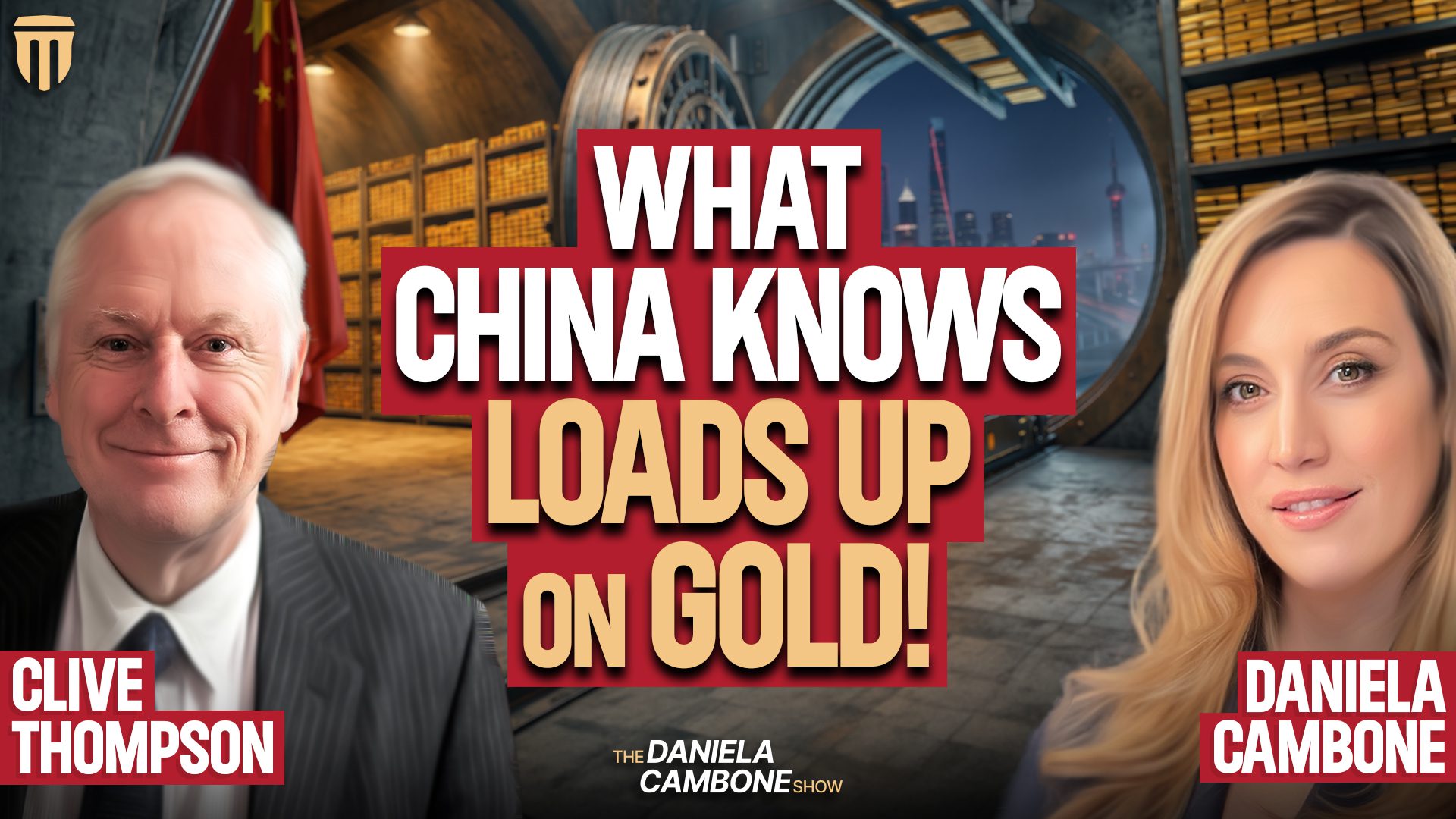
China just made its largest monthly addition to official gold reserves since 2023 and the timing should get every dollar-based investor’s attention.
The China gold buying story is no longer about a few incremental additions to a central-bank vault. In July, Beijing added roughly 20 metric tons, extending its buying streak to 21 consecutive months and bringing reported holdings to a record level.
For Clive Thompson, the acceleration raises the obvious question: Why now?
His answer is less sensational than an imminent financial “Armageddon.” China may simply believe gold has become attractive relative to the alternatives.
But the alternatives happen to include a nearly $40 trillion U.S. debt load, sovereign bonds vulnerable to higher yields, and dollar reserves that recent history has demonstrated can become inaccessible under sanctions.
That makes this much bigger than a story about the price of gold.
It is a story about what central banks consider money when trust becomes conditional.
China Gold Buying Just Shifted Into a Higher Gear
China did not wake up in July and suddenly discover gold.
What changed was the pace.
During his conversation with Daniela Cambone, Thompson highlighted a striking progression in reported Chinese purchases: approximately 160,000 ounces in February, 260,000 ounces in April, 320,000 ounces in May, 480,000 ounces in June, and roughly 640,000 ounces in July.
Independent data confirms the latest surge. The People’s Bank of China added about 20 metric tons in July, its largest monthly increase since October 2023. Reuters reported that China’s official gold reserves reached roughly 2,377.5 tons after the purchase.
And this did not begin in July.
The World Gold Council reported that China’s official buying streak had already reached 19 consecutive months in May, when official holdings stood around 2,332 tons. Another 15 tons were added in June.
The important part is not simply that China is buying. It is that Beijing has been accelerating while the global monetary system becomes more politically fractured.
That leaves investors with two competing explanations:
- China sees an attractive opportunity to accumulate gold after price weakness.
- China wants greater protection from financial, geopolitical, and sanctions risk.
- Or, most plausibly, both forces are operating at the same time.
Thompson favors the less dramatic explanation.
China may simply like the price.
But that doesn’t make the underlying shift insignificant.
China May Be Buying the Gold Dip
Gold’s 2026 price action created precisely the kind of environment in which a patient central bank could step in aggressively.
After gold’s early-2026 peak, bullion suffered a substantial correction. Analysts cited by MarketWatch estimated that China acquired about $5.7 billion in gold during the first half of 2026, with most of that buying occurring during the second quarter.
China appears to have kept accelerating from there.
Thompson’s interpretation is refreshingly simple:
Smart buyers often want to buy from distressed sellers.
In the interview, he points to countries facing circumstances that could make liquid reserves particularly valuable and argues that forced selling can create opportunities for stronger buyers.
That is an important distinction.
China does not necessarily have to believe the global financial system will collapse tomorrow to prefer gold today.
It only has to believe that:
- Gold is favorably priced relative to long-term monetary risks.
- Sovereign debt carries growing interest-rate and fiscal risk.
- Reserve diversification has strategic value.
- Physical gold provides something another country’s liability cannot.
That last point may be the most important of all.
The Russia Lesson Changed the Meaning of Central Bank Reserves
For decades, a country’s foreign exchange reserves were generally discussed as if ownership automatically meant access.
Russia demonstrated otherwise.
After Russia’s invasion of Ukraine in 2022, Western sanctions immobilized a substantial portion of the Russian central bank’s foreign reserves. Estimates have generally placed frozen sovereign assets in the $300 billion to $350 billion range, much of it held in currencies, securities and accounts located within Western financial jurisdictions.
Russia’s domestic gold was different.
Its bullion reserves were held inside Russia and therefore remained outside the direct reach of those freezes.
That distinction is impossible for other reserve managers to ignore.
A Treasury security is an asset to the holder—but simultaneously a liability issued within a financial system controlled by someone else.
A bank deposit involves a bank.
A foreign bond requires functioning markets and counterparties.
Physical gold held under a nation’s own control does not depend on another government’s promise to honor it.
As Thompson told Daniela, gold carries no conventional counterparty risk in the way a bond or bank balance does.
For China—a nation sitting at the center of increasingly complicated trade, technology and geopolitical disputes—that characteristic alone can justify greater gold exposure without assuming Beijing is preparing for war.
It may simply be preparing for a world in which financial neutrality can no longer be assumed.
China Still Has Room to Increase Its Central Bank Gold Reserves
There is another reason China’s purchases matter.
Even after years of accumulation, gold still represents a relatively modest portion of China’s overall reserve structure compared with several major Western economies.
The World Gold Council reported that after China’s June purchase, its official gold holdings represented about 8% of total official foreign exchange assets.
That means China doesn’t need an end-of-the-world thesis to keep buying.
It can make a straightforward portfolio argument.
If policymakers believe they have too much exposure to:
- foreign sovereign debt,
- dollar-based reserves,
- currencies vulnerable to political intervention,
- or bonds that can fall as yields rise,
then increasing gold is simply diversification.
Except when a central bank does it, diversification takes on geopolitical significance.
For an individual, buying gold can reduce exposure to financial assets.
For a sovereign nation, buying gold can also reduce exposure to another sovereign nation’s financial system.
That is a very different kind of hedge.
America’s Debt Problem Makes the Decision Easier
China’s gold buying is occurring against a backdrop that should be uncomfortable for anyone who assumes U.S. government debt can expand indefinitely without consequences.
As of mid-2026, gross U.S. federal debt was hovering around $39 trillion, and recent Treasury borrowing has continued at an enormous scale.
Meanwhile, the federal budget deficit reached $1.799 trillion for fiscal 2026 through July, with two months still remaining in the fiscal year.
Long-term borrowing costs are also becoming harder to ignore.
On August 13, the Treasury sold 30-year bonds at a yield of 5.22%—the highest borrowing cost for that maturity since 2001.
That creates a vicious fiscal problem.
Higher debt requires more borrowing.
More borrowing can increase interest costs.
Higher interest expense adds pressure to future deficits.
And larger deficits require still more financing.
That does not guarantee a dollar collapse. But it gives foreign reserve managers a powerful reason not to keep every egg in the Treasury market basket.
Gold becomes attractive precisely because it sits outside that debt structure.
It has no coupon.
But it also has no issuing government promising repayment.
Fort Knox Is Back in the Conversation—And That Matters
At almost the same moment China was increasing its gold holdings, Washington revived a debate Americans have been having for decades.
What exactly is sitting inside Fort Knox?
Senator Rand Paul visited the U.S. Bullion Depository in August and publicly discussed both America’s gold holdings and the decline in the dollar’s purchasing power. Reports said he viewed the facility containing roughly 147 million ounces of gold.
Treasury Secretary Scott Bessent had also recently said the gold was “present and accounted for,” although Bessent himself said he had not personally visited the facility; he pointed instead to a visit by the U.S. Treasurer.
But Thompson makes an important distinction.
Seeing gold is not the same as auditing gold.
A serious audit would require much more than walking through a vault.
Thompson argues that it would involve systematically identifying and counting bars—and potentially testing older material to verify weight and purity.
That does not prove anything is missing.
It simply means a political visit and a professional audit answer different questions.
And this renewed obsession with Fort Knox points to something deeper:
Even in a fiat monetary system, governments still treat gold as an asset worth protecting.
Gold vs. Dollar: What Changed After 1971?
Rand Paul’s broader criticism goes beyond Fort Knox.
It concerns what happened after the United States ended dollar convertibility into gold in 1971.
Since then, the supply of dollars, credit, and federal debt has grown enormously.
Thompson explains the monetary effect using Monopoly.
As more money enters the game, players have more dollars competing for the same desirable assets. Prices rise—not necessarily because the asset itself changed, but because the unit used to measure it became more abundant.
Real-world inflation is obviously more complicated than Monopoly.
But the long-term loss of dollar purchasing power is not controversial.
Using CPI data, $1 in 1971 would require roughly $8.24 in 2026 to purchase an equivalent basket of goods, implying that the 1971 dollar has lost approximately 88% of its purchasing power by that measure.
That is why debates over gold vs. dollar keep returning.
Gold does not promise stable prices over months or even years.
It can fall sharply.
But over long periods, investors have historically viewed scarce tangible assets differently from currency units that governments and banking systems can expand.
And central banks apparently still see a role for bullion themselves.
This Isn’t Just China: Central Banks Are Reassessing Gold
China’s July purchase is part of a much broader shift in how reserve managers think about gold.
Reuters reported that central banks purchased an estimated 289 tons in the second quarter of 2026, while a World Gold Council survey found that a record 45% of responding central banks expected to increase their gold holdings over the following 12 months.
There are important caveats.
Central-bank gold activity can be opaque, and estimates are routinely revised. The World Gold Council substantially revised its estimate of first-quarter 2026 purchases downward, illustrating just how difficult it can be to measure sovereign transactions in real time.
That uncertainty is itself worth noting.
Official numbers may tell investors what governments disclose.
They do not necessarily tell investors everything governments are doing.
Gold & Silver: Tangible Assets in a World of Counterparty Risk
This is where the China story becomes relevant to individual investors.
A retiree in Arizona is not managing China’s foreign exchange reserves.
But the principle behind reserve diversification applies at a smaller scale.
Stocks are claims on companies.
Bonds are promises of repayment.
Bank deposits exist within financial institutions.
Currencies depend on monetary and fiscal policy.
Physical gold and silver are tangible assets that can be owned directly.
That distinction is why precious metals have remained part of the wealth preservation conversation through wars, banking crises, sovereign defaults, inflationary periods and currency resets.
Gold in particular is commonly considered an inflation hedge and monetary reserve asset, although its price can be volatile and it does not rise mechanically every time consumer prices increase.
Silver occupies a different position.
It has monetary history, but it also carries significant industrial demand and tends to experience larger percentage moves in both directions.
For financially conservative investors, the case is not that gold or silver must replace every other asset.
It is that a portfolio concentrated entirely in financial claims may be exposed to risks that become obvious only after the system comes under stress.
Thompson’s advice reflects that distinction.
He does not advocate making an enormous, emotional bet on metals.
Instead, he suggests accumulating gold and silver gradually and maintaining enough diversification that a sharp move in either direction doesn’t force an emotional decision.
That may be one of the most important lessons in this entire discussion.
The goal of wealth preservation is not to guess tomorrow’s headline.
It is to avoid having your financial future depend on a single outcome.
What Does China Know?
Maybe China knows nothing secret at all.
Maybe Beijing is simply looking at the same facts available to everyone:
- U.S. debt approaching $40 trillion.
- Persistent fiscal deficits.
- Rising long-term borrowing costs.
- The precedent created by frozen Russian reserves.
- Increasing geopolitical fragmentation.
- A gold market that recently offered significantly lower prices.
- And a reserve portfolio still heavily exposed to financial assets issued by other governments.
Put those pieces together and buying gold does not require a conspiracy.
It may simply require risk management.
And that may be more important than any Armageddon theory.
Because if one of the world’s largest holders of foreign reserves has decided it wants materially more exposure to an asset with no conventional counterparty risk, American investors should at least understand why.
China’s gold buying does not tell us exactly what happens next.
But it tells us something about which risks Beijing apparently believes are worth hedging.
For investors concerned about dollar devaluation, inflation, sovereign debt and retirement security, the question is therefore not whether gold or silver will move higher next week.
The better question is:
How exposed is your wealth if the financial assumptions you’ve relied on for decades begin to change?
About ITM Trading
ITM Trading has over 28 years of experience helping clients safeguard their wealth through personalized strategies built on physical gold and silver. Our team of experts delivers research-backed guidance tailored to today’s economic threats.
THINKING ABOUT PURCHASING GOLD & SILVER?
Get expert guidance from our team of analysts with 28+ years of experience.
👉 [SCHEDULE YOUR CALL HERE] or call 866-706-9061