

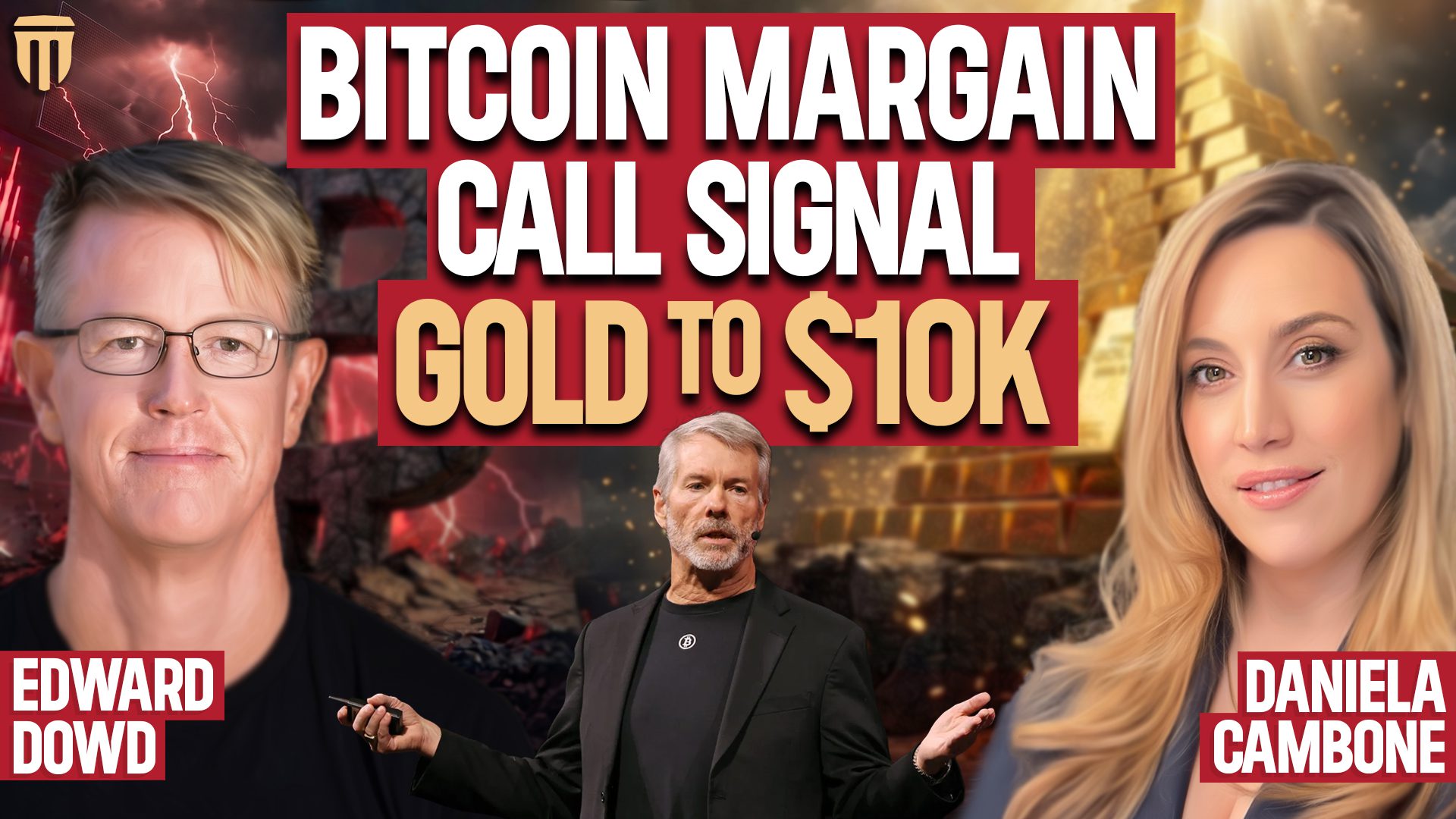
Michael Saylor Sells, While Bitcoin Levels Signal Margin Call Territory; Gold to $10K – Ed Dowd
The Market Is Celebrating—But Are We Standing on the Edge of a Cliff?
What if today’s record stock prices are actually signaling the final stages of a massive financial bubble?
That is precisely the warning former BlackRock portfolio manager Ed Dowd delivered in his latest conversation with Daniela Cambone. While Wall Street continues chasing AI stocks and momentum trades, Dowd sees a far different reality unfolding beneath the surface.
His thesis is simple: three major structural risks are converging simultaneously—an accelerating housing slowdown, a bursting AI bubble, and a deepening crisis in China. At the same time, Bitcoin is flashing liquidity warning signs while gold continues building the foundation for what Dowd believes could be a move toward $10,000 gold by 2030.
The disconnect between financial markets and economic reality may be reaching a dangerous tipping point.
Housing Market Weakness Signals Economic Trouble Ahead
According to Dowd, one of the most underappreciated risks facing the U.S. economy is the housing sector.
Housing represents roughly 20% of economic activity, making it one of the largest drivers of growth, employment, and consumer confidence.
Recent developments suggest the sector is beginning to crack:
- National median home prices have started rolling over
- Rental prices have weakened significantly
- Construction activity is slowing
- Housing-related employment faces increasing pressure
Dowd argues that a substantial portion of rental demand was artificially supported over recent years. As demographic and migration dynamics shift, that support is beginning to disappear.
The concern isn’t simply lower home prices.
The concern is what happens when housing weakness spreads into:
- Construction employment
- Consumer spending
- Banking activity
- Local government revenues
Historically, housing downturns rarely stay contained.
The AI Bubble Looks Increasingly Vulnerable
For the past two years, artificial intelligence has been the dominant investment narrative driving U.S. equity markets.
But Dowd believes investors may be ignoring a critical problem:
Where is the return on investment?
Several recent reports have highlighted growing concerns among businesses deploying AI technologies.
Key issues include:
- Rising infrastructure costs
- Massive computing expenses
- Escalating data center investments
- Limited measurable productivity gains
While AI adoption continues expanding, many corporations are discovering that implementation costs can exceed expectations.
Even more concerning, Dowd points to signs of speculative excess:
- Semiconductor stocks surging over 80% in weeks
- Extreme valuation multiples
- Massive capital expenditures by major tech firms
- Increasing dependence on equity financing rather than debt
These characteristics resemble previous market manias.
Investors who lived through the dot-com bubble may find the similarities difficult to ignore.
Why China’s Slowdown Matters More Than Most Investors Realize
Mainstream narratives frequently portray China as an unstoppable economic force poised to overtake the United States.
Dowd strongly disagrees.
His research suggests China may have already peaked relative to the U.S. economy.
Several long-term challenges continue mounting:
Demographic Collapse
China’s population trends are deteriorating rapidly.
Fewer workers and fewer consumers create structural challenges that cannot be solved through monetary stimulus alone.
Real Estate Crisis
China’s property market remains burdened by years of overbuilding.
Dowd estimates:
- New home permits have declined roughly 70%
- Construction activity continues contracting
- Excess supply could take years to absorb
Deflationary Pressures
Unlike inflationary economies, China increasingly faces deflation risks.
To offset domestic weakness, Chinese manufacturers have expanded exports aggressively, fueling trade tensions globally.
The danger is not merely slower Chinese growth.
The danger is contagion.
A severe Chinese slowdown could ripple through global supply chains, commodity markets, and financial systems.
Bitcoin’s Liquidity Warning Signal Is Getting Harder to Ignore
Bitcoin has long been viewed by traders as a barometer of global liquidity conditions.
And recently, Bitcoin has been sending a message many investors don’t want to hear.
Dowd notes that Bitcoin’s historical correlation with the Nasdaq has remained exceptionally high over time.
Yet recently:
- Bitcoin has weakened
- Semiconductor stocks have surged
- AI-related equities continue attracting speculative capital
This divergence creates a critical question:
Is Bitcoin signaling that liquidity conditions are tightening beneath the surface?
Dowd believes that may be exactly what’s happening.
Instead of participating in the speculative frenzy, Bitcoin appears to be losing momentum while capital crowds into a narrow group of AI winners.
Historically, narrow market leadership has often appeared near major market tops.
Michael Saylor’s Bitcoin Sale Raises New Questions
One of the more surprising developments in the Bitcoin market was Michael Saylor’s decision to sell Bitcoin holdings.
While the sale may have been related to dividend obligations and corporate financing needs, it has reignited debate surrounding leverage within the Bitcoin ecosystem.
Dowd highlighted growing concerns among analysts regarding potential margin pressure.
Some market observers have suggested that certain Bitcoin price levels could create increasing stress for leveraged holders.
Whether those concerns materialize remains uncertain.
However, the broader issue remains unchanged:
When liquidity tightens, leverage becomes vulnerable.
And vulnerable leverage can quickly become forced selling.
Investors have seen this movie before.
Why Gold’s Long-Term Bull Market Remains Intact
While Dowd sees growing risks across equities, real estate, and digital assets, his outlook for gold remains firmly bullish.
Importantly, he does not view recent gold consolidation as weakness.
Rather, he sees it as a healthy pause within a larger secular bull market.
Several powerful forces continue supporting gold:
Central Bank Accumulation
Central banks around the world continue purchasing gold at historically elevated levels.
This trend reflects growing concerns over:
- Sovereign debt levels
- Currency debasement
- Geopolitical uncertainty
Banking System Demand
Gold’s recognition as Tier 1 capital has increased its attractiveness within the financial system.
Commercial institutions increasingly view physical gold as a strategic reserve asset.
Global Retail Demand
Physical gold demand remains strong throughout:
- China
- India
- The Middle East
- Western economies
Unlike speculative assets, gold’s demand base is broad, global, and deeply rooted in wealth preservation.
Gold vs Dollar: Why Wealth Preservation Matters More Than Ever
Periods of excessive debt accumulation have historically ended the same way:
Through some combination of inflation, currency debasement, financial repression, or asset repricing.
Today, global debt levels continue reaching unprecedented highs.
Governments face difficult choices:
- Raise taxes
- Cut spending
- Inflate away obligations
- Expand borrowing
History suggests the easiest political path is often currency devaluation.
That reality is why many investors continue turning toward tangible assets.
Physical gold and silver offer characteristics that paper assets simply cannot replicate:
- No counterparty risk
- No default risk
- Thousands of years of monetary history
- Proven wealth preservation during periods of uncertainty
For investors concerned about inflation, debt monetization, or financial instability, the gold versus dollar debate may become increasingly important throughout the remainder of this decade.
Conclusion
Ed Dowd’s message is not that catastrophe is guaranteed.
His warning is that multiple risks are converging simultaneously while financial markets appear increasingly disconnected from economic reality.
A weakening housing market.
A potentially exhausted AI boom.
China’s structural slowdown.
Bitcoin flashing liquidity concerns.
Together, these developments create an environment where complacency could prove costly.
Meanwhile, gold continues quietly doing what it has done for centuries—serving as a trusted store of value during periods of uncertainty.
If Dowd’s thesis proves correct, the next several years may look very different from the optimism currently priced into financial markets.
And if gold’s long-term trajectory toward $10,000 unfolds, today’s consolidation may eventually be remembered as merely the calm before a much larger move.
About ITM Trading
ITM Trading has over 28 years of experience helping clients safeguard their wealth through personalized strategies built on physical gold and silver. Our team of experts delivers research-backed guidance tailored to today’s economic threats.
THINKING ABOUT PURCHASING GOLD & SILVER?
Get expert guidance from our team of analysts with 28+ years of experience.
👉 [SCHEDULE YOUR CALL HERE] or call 866-706-9061