

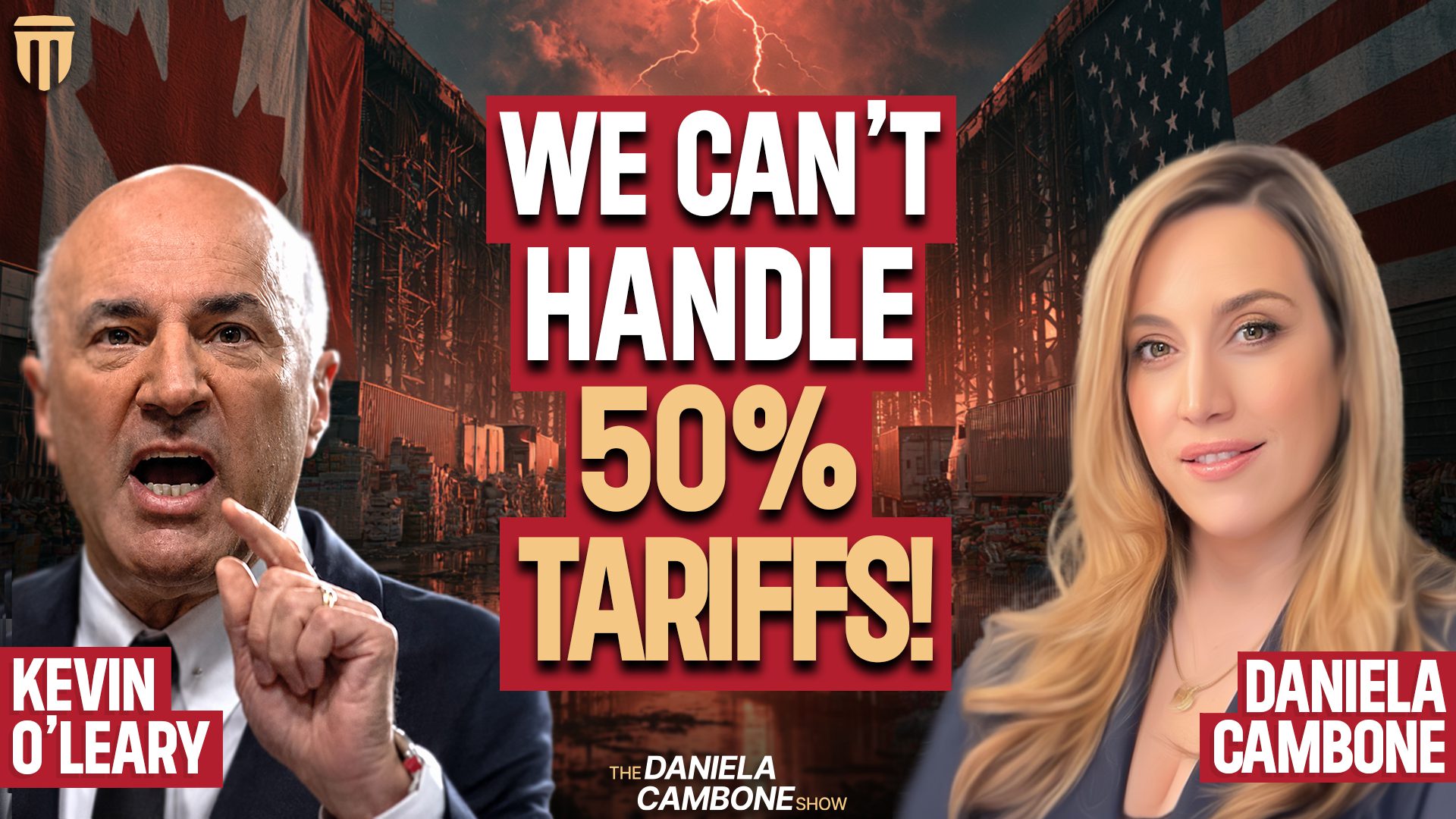
Kevin O’Leary Flips Stance on Carney But Warns of 3x Grocery Costs If Tariff Talks Fail
The political theater may be loud, but the grocery bill is louder.
As Canada-U.S. tariff talks unravel, Kevin O’Leary says Canadians should pay less attention to provocative headlines and more attention to what a prolonged trade war could eventually do to jobs, investment, and the cost of living.
The latest symbolic flashpoint is President Trump’s order renaming Lake Ontario “Lake America” for U.S. federal purposes—a move Google Maps has now reflected for American users. Canada, predictably, has rejected the name. (AP News)
But O’Leary’s message to Daniela Cambone was essentially this: the map is noise. The economics are not.
And the economics have become much more serious.
Prime Minister Mark Carney suspended the latest round of U.S. trade negotiations after describing last-minute American demands as “unfair” and “uneconomic.” The U.S. subsequently moved ahead with 50% tariffs on roughly C$28 billion of Canadian goods, while Canada announced dollar-for-dollar retaliation. (Canada PM)
O’Leary believes neither country can sustain that escalation indefinitely.
His most provocative warning?
The $100 grocery trip Canadians already complain about could become dramatically worse if the confrontation keeps escalating.
Kevin O’Leary Changes His Mind on Mark Carney
O’Leary has hardly been an automatic supporter of Canada’s Liberal leadership.
But when Daniela asked whether he had changed his stance on Mark Carney, his answer was unequivocal:
He has.
“When facts change, I change,” O’Leary said during the interview, describing Carney as highly intelligent and a “masterful politician.”
That reversal matters because O’Leary is viewing the situation less through partisan politics than through capital allocation.
His thesis is that Carney has managed to turn confrontation with Trump into something politically useful: a rallying point for Canadian nationalism at a moment when the country is wrestling with internal political fractures.
One of the biggest tests comes on October 19, 2026, when Albertans are scheduled to vote in a non-binding referendum that asks whether Alberta should remain a province of Canada or whether the government should begin the legal process toward a binding separation referendum. (Alberta.ca)
O’Leary speculates that once that political hurdle passes, Carney could move quickly back toward Washington.
That is O’Leary’s investment thesis—not an established government plan.
But the underlying economic pressure is undeniable.
Canada Cannot Simply Walk Away From the United States
Politicians can talk about diversifying trade.
Supply chains are less sentimental.
In 2025, 71.7% of Canadian merchandise exports still went to the United States, according to Statistics Canada. That was down from 75.9% in 2024, but it still leaves Canada overwhelmingly dependent on one customer. (Statistics Canada)
This is the structural weakness behind the Canada-U.S. trade war.
Canada can expand trade with Europe, Asia, and the Middle East. In fact, non-U.S. exports have been growing.
But replacing the U.S. market overnight is another matter.
The two economies have spent decades building deeply integrated supply chains spanning:
- Automobiles and auto parts
- Energy
- Agriculture
- Steel and aluminum
- Fertilizer
- Electricity
- Critical minerals
- Consumer goods
That is why the latest tariff escalation matters far beyond political rhetoric.
The auto sector is already staring at another potential shock. U.S. tariffs on Canadian vehicles are scheduled to climb from 25% to 50% on January 1, 2027 if no agreement changes course. Analysts warn the consequences could be severe for Canadian assembly plants and their suppliers. (Reuters)
Trade wars sound abstract until factories stop hiring, investment gets delayed, and higher costs reach the consumer.
Could Grocery Costs Really Triple?
This is where O’Leary issued his starkest warning.
Daniela noted that Canadians are already leaving grocery stores after spending roughly $100 for only a couple bags of food.
O’Leary responded with a hypothetical:
What happens if that becomes $300?
He connected that possibility to a prolonged environment of 50% tariffs moving in both directions.
That should not be interpreted as an economic forecast that Canadian grocery prices are literally projected to triple.
Current inflation data do not show anything close to that.
Statistics Canada reported that food purchased from stores was 3.1% more expensive year over year in July 2026, while headline inflation stood at 3.0%. (Statistics Canada)
But zoom out and the picture gets uglier.
The Canadian government says grocery prices have increased nearly 35% since 2019, with the average family now spending roughly C$10,000 per year on groceries. Canada also imports nearly 90% of its fresh fruit and nuts and more than 70% of its vegetables. (Canada PM)
That makes Canadian households vulnerable to disruptions involving transportation, currency movements, foreign suppliers, and tariffs.
And there is already evidence that tariffs make their way to retail shelves.
Bank of Canada researchers studying earlier Canadian counter-tariffs found prices of affected products rose gradually and peaked around 6% higher after three months, representing roughly one-quarter pass-through of a 25% tariff. (Bank of Canada)
So no, a 50% tariff does not automatically mean a 50% increase at the grocery store—much less a tripling of the entire grocery bill.
But O’Leary’s broader warning is difficult to dismiss:
The longer governments convince businesses that tariffs are permanent, the more likely businesses are to stop absorbing those costs and start passing them on.
That is precisely what Bank of Canada research has found. (Bank of Canada)
Carney’s Political Win Could Become an Economic Liability
Right now, confronting Washington appears to be helping Carney politically.
Reuters recently reported that 76% of Canadians supported his response to Trump’s latest trade escalation. (Reuters)
But public support can be remarkably elastic when unemployment rises or household bills accelerate.
That creates a dangerous clock for Ottawa.
Carney can argue that Canada must defend its sovereignty.
He can promise new markets.
He can encourage Canadians to buy Canadian.
He can accelerate infrastructure investment.
But he also has to prevent a patriotic trade confrontation from becoming a recessionary shock.
That is the contradiction O’Leary sees.
Carney may be winning the politics precisely because he is fighting Trump. Eventually, he may need to preserve that political victory by making a deal with Trump.
The pressure becomes even greater because Canada’s government is simultaneously trying to attract massive amounts of international capital.
Ottawa says more than 20 major nation-building projects involving ports, mines, energy, transportation, and nuclear infrastructure have already moved through its Major Projects Office, while foreign direct investment has reached its highest level in roughly two decades. (Canada PM)
Investors like opportunity.
What they dislike is uncertainty.
Why O’Leary Thinks Canada Could Be an Investment Opportunity
Here is where his argument becomes contrarian.
While others see chaos, O’Leary sees an entry point.
His reasoning is simple: Canada owns resources the United States cannot easily replace.
Among them:
- Uranium
- Potash
- Oil and natural gas
- Electricity
- Critical minerals
- Gold and other precious metals
O’Leary specifically highlighted Saskatchewan and Alberta as jurisdictions positioned to benefit from the long-term North American demand for energy and strategic resources.
Uranium is a particularly revealing example.
U.S. nuclear plant operators purchased 46.9 million pounds of uranium equivalent in 2025, according to the U.S. Energy Information Administration.
Yet domestic U.S. uranium concentrate production totaled only about 2.1 million pounds that year.
Canada was the largest foreign source, supplying approximately 32% of U.S. uranium deliveries. (U.S. Energy Information Administration)
O’Leary’s numbers in the interview were approximate, but his underlying point is supported by the data:
America remains heavily dependent on imported uranium, and Canada is strategically important to that supply chain.
Potash tells a similar story.
Statistics Canada reported C$4.2 billion in Canadian potash exports to the United States in 2024, making potash Canada’s largest mineral export to the U.S. within that category. (Statistics Canada)
That is why O’Leary believes Washington and Ottawa eventually have to find a way back to the negotiating table.
Geography has not changed.
Resource requirements have not changed.
And North America’s industrial supply chains cannot simply be disentangled by executive order.
Political Theater Can Move Markets—But It Cannot Rewrite Economics
Trump can rename a lake.
Carney can deliver a forceful sovereignty speech.
Premiers can threaten retaliation.
Markets still have to price the consequences.
That means investors should watch something more important than the rhetoric:
How long does the uncertainty last?
Tariff uncertainty affects business decisions before a single new factory closes.
Companies hesitate to make long-term investments when they cannot confidently estimate:
- Input costs
- Export prices
- Currency exposure
- Supplier relationships
- Future tax treatment
- Market access
The longer the uncertainty continues, the greater the potential damage.
And that risk is particularly acute in industries that require billions of dollars and decades-long planning horizons.
Nuclear facilities.
Mines.
Pipelines.
Manufacturing plants.
Electrical infrastructure.
These are not projects companies can turn on and off based on the political mood of the week.
Gold and Silver in an Era of Tariffs, Debt, and Currency Risk
There is another lesson in O’Leary’s argument that extends beyond Canada.
Governments are increasingly treating access to markets, energy, commodities, and currencies as instruments of national power.
That changes the conversation around wealth preservation.
Physical gold and silver occupy a very different place in a portfolio from stocks, bonds, bank deposits, or government currencies.
They are tangible assets that do not depend on the solvency of a corporation, a commercial bank, or a foreign trading partner.
That does not mean gold and silver rise every time inflation increases. Precious metals can be volatile, and neither produces cash flow.
Their appeal is different.
Gold has historically been used as a monetary reserve asset precisely because it exists outside another government’s promise to pay.
And central banks themselves continue to demonstrate that preference.
Central banks purchased a net 863 tonnes of gold in 2025, according to the World Gold Council. In its 2026 survey, 89% of central-bank reserve managers said they expected global official gold holdings to increase during the following 12 months, while a record 45% expected their own institutions to add gold. (World Gold Council)
That deserves attention.
The institutions responsible for managing national currency reserves are increasing their interest in an asset that cannot be printed.
The gold vs dollar question therefore goes beyond predicting next month’s inflation report.
It is about counterparty risk, monetary credibility, and what an investor wants to own when political decisions begin interfering with trade and currency relationships.
Silver adds another dimension.
Unlike gold, silver combines monetary demand with significant industrial demand. The Silver Institute reported that the market ran a supply deficit for a fifth consecutive year in 2025 and expects another deficit in 2026. (The Silver Institute)
For financially conservative investors, physical precious metals can therefore serve as one component of a broader inflation hedge and wealth preservation strategy—particularly when confidence in fiscal, monetary, or political stability is deteriorating.
The Real Risk Is What Happens If Nobody Blinks
Kevin O’Leary has gone from critic to reluctant believer in Mark Carney.
But his support comes with a warning.
Carney may have found an effective political strategy for confronting Trump.
That does not make a prolonged trade war economically sustainable.
Canada still sends more than seven out of every ten merchandise export dollars to the United States.
The U.S. still depends on Canadian resources.
Manufacturers still depend on cross-border supply chains.
And consumers on both sides still end up paying when political costs become business costs.
The danger isn’t that a tariff instantly turns a $100 grocery trip into $300.
The danger is that tariffs, retaliation, weaker investment, currency pressure, supply-chain disruption, and rising consumer prices begin feeding into one another.
That is how political theater becomes an economic problem.
O’Leary believes both sides will ultimately recognize that reality and make a deal.
Investors should hope he is right.
Because if the tariff talks remain frozen long enough, the argument may stop being about who won the confrontation.
It may become about who can afford it.
About ITM Trading
ITM Trading has over 28 years of experience helping clients safeguard their wealth through personalized strategies built on physical gold and silver. Our team of experts delivers research-backed guidance tailored to today’s economic threats.
THINKING ABOUT PURCHASING GOLD & SILVER?
Get expert guidance from our team of analysts with 28+ years of experience.
👉 [SCHEDULE YOUR CALL HERE] or call 866-706-9061