Japan Dumps $29.6B US Treasuries as $1.2T Debt Crisis Explodes – Gareth Soloway
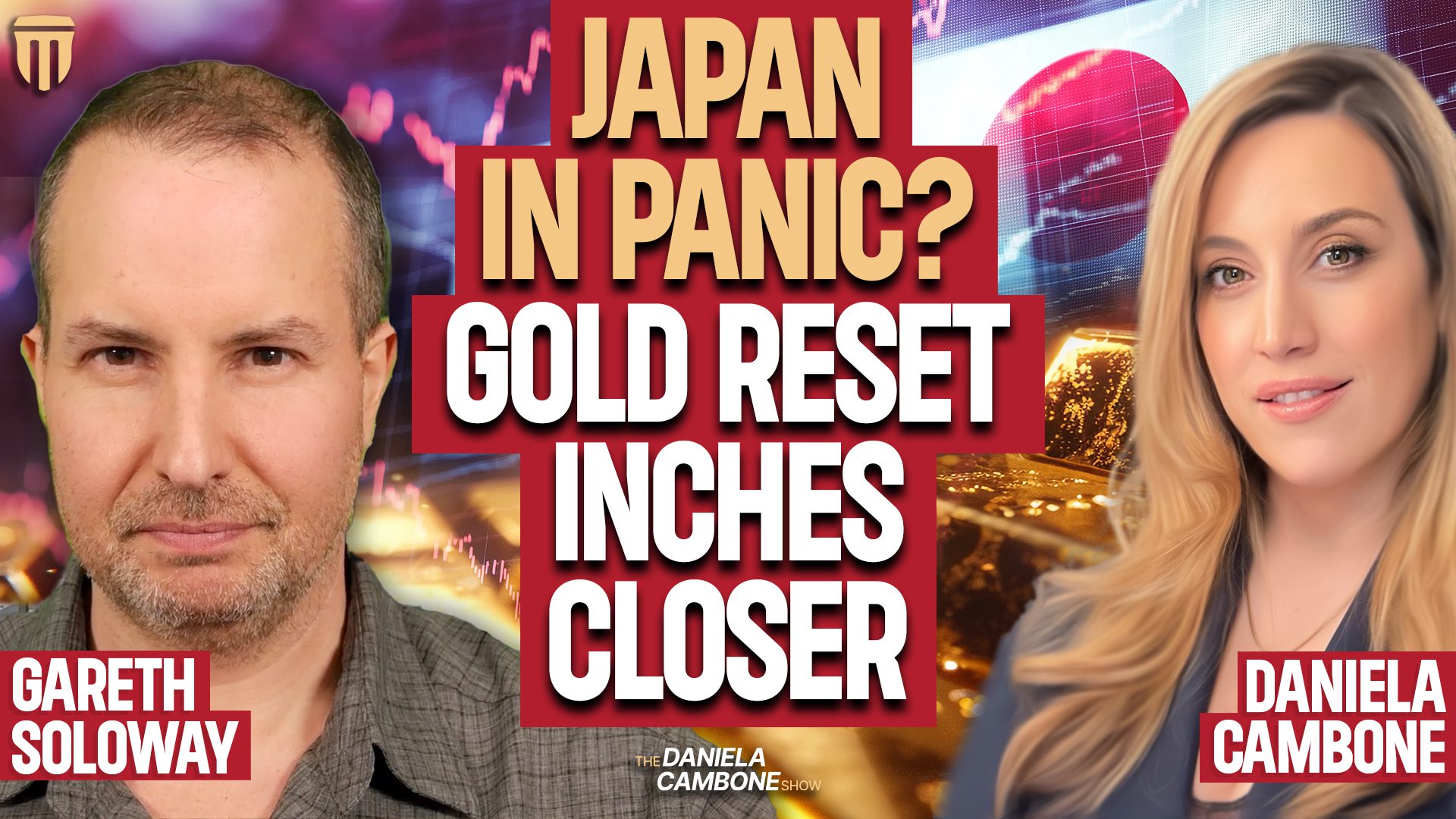
Japan dumps Treasuries as debt pressure rises. Gareth Soloway warns gold, silver, and bond markets may signal a coming reset.
What happens when one of America’s largest creditors starts heading for the exits?
That is the question markets can no longer ignore as Japan dumps US Treasuries while its own debt crisis begins to strain the global bond market. According to recent reporting, Japanese investors sold roughly $29.6 billion in U.S. government, agency, and municipal bonds in Q1 2026—the largest quarterly reduction in nearly four years.
This is not just a Japan story.
It is a warning shot for anyone holding dollars, bonds, retirement accounts, or paper assets tied to a debt system that increasingly depends on confidence, liquidity, and central bank intervention.
Gareth Soloway, Chief Market Strategist at Verified Investing, joined Daniela Cambone to break down what this means for gold, silver, Bitcoin, yields, and the possibility of a financial reset.
And his message was clear:
The system may not break tomorrow. But the cracks are no longer hidden.
Japan Dumps US Treasuries as the Bond Market Starts Flashing Red
Japan has long been one of the most important foreign holders of U.S. debt. That is why the recent Treasury selling matters.
The reported $29.6 billion reduction came as Japan faces rising yields, weakening currency pressure, and a fiscal structure that looks increasingly fragile. Japan’s 10-year government bond yield recently climbed to around 2.8%, its highest level since 1996, according to Reuters.
That may not sound high to American investors used to 4%–5% Treasury yields.
But for Japan, which has spent decades operating near zero interest rates, this is a seismic shift.
When yields rise:
- Government debt becomes more expensive to service
- Bond prices fall
- Banks, pensions, and insurers face pressure
- Capital may be repatriated from foreign markets
- U.S. Treasuries can become a source of liquidity
In plain English: Japan may need cash at home. And that could mean selling U.S. debt.
This is where the domino risk begins.
Because if Japan—the largest or one of the largest foreign creditors of the United States—starts reducing exposure, the U.S. Treasury market may need to absorb more supply at exactly the wrong time.
More supply. Fewer buyers. Higher yields. More interest expense.
That is how a debt problem becomes a debt spiral.
The $1.2 Trillion Debt Crisis: Interest Is Eating the System
Gareth Soloway pointed to one of the most dangerous realities in the U.S. fiscal picture: interest expense.
The U.S. Treasury’s own Fiscal Data platform tracks interest expense on the national debt, and the trajectory has moved sharply higher in recent years. The Peter G. Peterson Foundation reported that U.S. interest costs reached $970 billion in 2025, with costs projected to keep climbing under current debt and rate assumptions.
That is money that does not build roads.
It does not fund Social Security.
It does not strengthen Medicare.
It does not improve national productivity.
It simply services yesterday’s borrowing.
Debt interest is now becoming a tax on the future.
And when interest expense approaches or exceeds $1 trillion annually, the entire federal budget starts to change shape. Every additional rise in yields increases the pressure.
That is why Gareth warned that rising yields can eventually “break the debt system.”
Not because the U.S. runs out of dollars.
But because the system runs out of credibility.
Japan’s Crisis Is a Preview of the Global Debt Endgame
The mainstream narrative says bond markets are orderly.
The contrarian view is simpler:
Bond markets are being managed because they have to be.
Japan is the clearest example. For years, the Bank of Japan suppressed yields through massive bond purchases and ultra-loose policy. That worked—until inflation, currency weakness, and market pressure forced a different reality.
Now, Japan faces the same impossible equation confronting much of the developed world:
- Too much debt
- Too much spending
- Too much dependence on low rates
- Too little room for honest price discovery
Reuters reported that Japan is preparing fresh spending through an extra budget, potentially funded with new debt, even as long-term rates remain under pressure.
That is the trap.
Governments respond to crisis with more debt.
Markets demand higher yields because of the debt.
Higher yields create a bigger crisis.
Then central banks are asked to intervene.
This is not capitalism. It is a confidence game held together by policy duct tape.
And gold and silver investors have seen this movie before.
Gareth Soloway: Gold Is Still Long-Term Bullish, But Momentum Must Be Flushed Out
Gareth remains bullish on gold long term, but he warned that the short-term chart is still under pressure.
In the interview, he noted that gold has been behaving more like a risk asset than a traditional safe haven. That matters.
Historically, gold has served as a hedge against:
- Currency devaluation
- Sovereign debt risk
- Inflation
- Banking instability
- Geopolitical uncertainty
- Central bank policy mistakes
But when momentum traders flood into gold, they can temporarily distort the market. Gareth argued that gold may need to flush out speculative buyers before the next major leg higher.
His view:
Gold can pull back and still remain in a long-term bull market.
That distinction matters for retirees and conservative investors.
A trader panics over a correction.
A wealth preservation investor asks a different question:
Has the debt problem been solved?
The answer, so far, is no.
The U.S. still faces rising interest costs. Japan is under pressure. Global bond markets are flashing warning signs. Central banks remain trapped between inflation and financial instability.
That is the long-term case for gold.
Silver Prices: Volatility, Fear, and the Return of Perspective
Silver has been even more volatile than gold.
Gareth warned that silver could face deeper downside if key support levels fail. But again, the bigger picture matters.
Silver is not just a precious metal. It sits at the intersection of monetary history and industrial demand.
That makes it volatile—but also strategically important.
Silver has historically played a role as:
- A tangible asset
- A monetary metal
- An inflation hedge
- A crisis hedge
- A lower-cost entry point for precious metals investors
The irony, as Daniela noted, is that many investors once dreamed of $50 silver. Now, after higher prices, they fear a return to that level.
That is how market psychology works.
When prices are low, investors hesitate.
When prices surge, investors chase.
When prices correct, investors panic.
The disciplined investor does the opposite.
They plan ahead.
They identify levels.
They accumulate strategically.
And they do not confuse short-term volatility with long-term value.
AI Layoffs, Consumer Strain, and the Two-Speed Economy
The conversation also turned to the American consumer.
While headlines often point to strong spending, Gareth argued the reality is deeply uneven.
The top 10% may still be spending aggressively, supported by stock portfolios and asset gains. But the rest of the country is facing a different economy:
- Grocery bills remain painful
- Gasoline costs squeeze household budgets
- Insurance, rent, and services remain elevated
- Layoffs tied to AI and corporate restructuring are accelerating
- Consumer confidence is increasingly split by wealth level
This is the hidden fragility behind the official numbers.
A luxury watch line can still have buyers.
That does not mean the middle class is healthy.
A stock index can hit new highs.
That does not mean retirees feel secure.
A government can report growth.
That does not mean the household budget works.
The economy is splitting between asset owners and everyone else.
And when that divide becomes too wide, political and financial instability usually follows.
Gold and silver have historically mattered most during exactly these periods—when trust in paper promises erodes.
New Fed Leadership, Same Debt Trap
The Federal Reserve is also entering a sensitive transition. Reuters reported that Kevin Warsh is expected to be sworn in as the new Federal Reserve chair after Senate confirmation, while Jerome Powell has been named chair pro tempore until the transition is complete.
Markets are watching for one question:
Will the Fed remain independent, or will it bend under political pressure?
That question matters because the debt system cannot tolerate materially higher rates for too long.
But inflation makes rate cuts dangerous.
So the Fed faces the same impossible choice:
- Cut rates and risk reigniting inflation
- Hold rates high and risk breaking the debt system
- Intervene in markets and risk destroying credibility
- Do nothing and let yields rise
None of these are clean options.
That is why Gareth believes the long-term endgame may involve some form of financial reset.
Maybe not this year.
Maybe not next year.
But the math is becoming harder to ignore.
Gold Reset: Why Physical Gold and Silver Still Matter
This is where the conversation turns from markets to personal strategy.
A gold reset does not necessarily mean an overnight revaluation or a dramatic official announcement. It can also mean a slow repricing of trust.
Trust in sovereign debt.
Trust in fiat currency.
Trust in central banks.
Trust in the ability of governments to fund promises without destroying purchasing power.
Physical gold and silver stand apart because they are not someone else’s liability.
They are tangible assets.
They do not depend on a bank’s solvency, a government’s fiscal discipline, or a central bank’s credibility.
For financially conservative Americans, that matters.
Gold and silver have long been used for:
- Wealth preservation during currency devaluation
- Inflation hedge protection when purchasing power falls
- Portfolio diversification outside Wall Street volatility
- Tangible asset ownership in uncertain markets
- Gold vs dollar protection when confidence in fiat weakens
The gold vs dollar question is not theoretical anymore.
When the U.S. must borrow more just to pay interest…
When Japan dumps US Treasuries…
When central banks are trapped…
When consumers are squeezed…
When retirement security depends on markets that require constant liquidity…
Physical gold and silver become less about speculation and more about survival planning.
Japan’s Treasury selling may not be the collapse.
But it may be another warning flare.
A $29.6 billion quarterly reduction is not enough to break the U.S. debt market by itself. But it points to a much larger problem: creditors are becoming more selective, yields are rising, and the cost of debt is beginning to crowd out the future.
Gareth Soloway’s message was not panic.
It was preparation.
Gold may correct. Silver may remain volatile. Bitcoin may trade like a risk asset. Stocks may keep levitating until liquidity disappears.
But the debt math remains.
And math has a way of winning.
For investors sitting on cash, the question is not whether volatility will come.
It already has.
The question is whether your wealth is positioned for a system where paper promises are questioned, bond markets are unstable, and central banks are forced into choices they spent years pretending they would never have to make.
About ITM Trading
ITM Trading has over 28 years of experience helping clients safeguard their wealth through personalized strategies built on physical gold and silver. Our team of experts delivers research-backed guidance tailored to today’s economic threats.
THINKING ABOUT PURCHASING GOLD & SILVER?
Get expert guidance from our team of analysts with 28+ years of experience.
👉 [SCHEDULE YOUR CALL HERE] or call 866-706-9061