Fed Day: Warsh Could Shock Markets, ‘Forever Inflation’ & Gold’s Great Bull Return – Peter Grandich
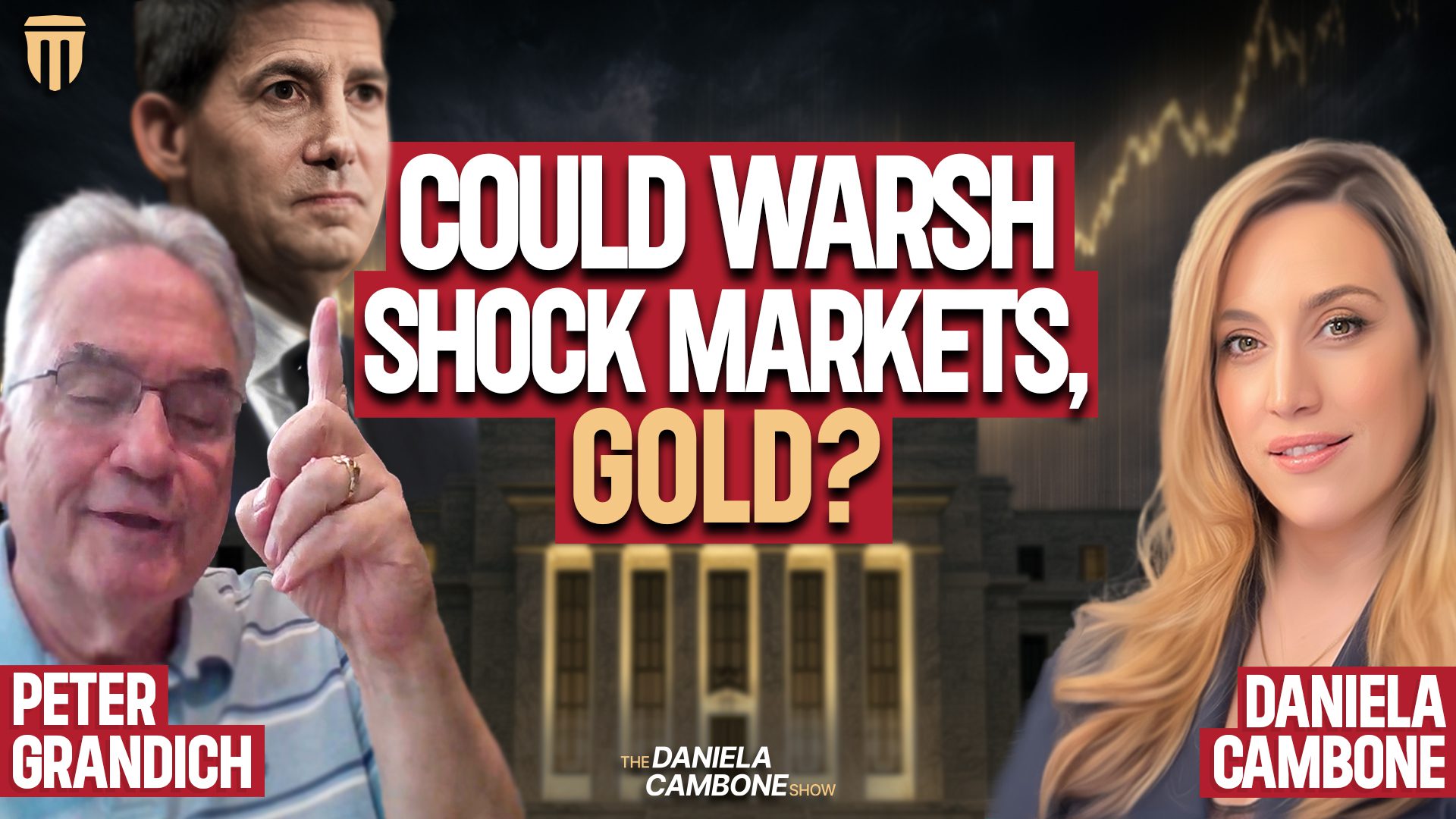
Could “Forever Inflation” Be the Real Legacy of This Fed Cycle?
As markets fixate on every Federal Reserve meeting, a far bigger question is emerging: Has the Fed permanently lost control of inflation?
That possibility—what many investors now call forever inflation—was front and center during Daniela Cambone’s conversation with market veteran Peter Grandich. While Wall Street remains obsessed with rate cuts, Grandich sees a different reality taking shape: persistent inflation pressures, exploding debt, geopolitical instability, and a renewed bull market for gold.
The implications could be profound for retirees, savers, and anyone relying on traditional financial assets to preserve purchasing power.
The Fed Faces an Impossible Balancing Act
For months, markets anticipated aggressive rate cuts.
Then reality intervened.
Inflation readings remained stubborn. Consumer spending proved resilient. Energy markets refused to collapse. Suddenly, expectations for monetary easing began to fade.
According to Grandich, the Federal Reserve may have little choice but to keep rates elevated longer than investors expect.
Why?
Because several inflationary forces remain firmly intact:
- Massive federal deficits
- Persistent government spending
- Higher structural energy costs
- Supply chain vulnerabilities
- Rising geopolitical tensions
The result is a policy trap.
Cut rates too soon and inflation reaccelerates.
Keep rates high and economic growth weakens.
The Fed finds itself caught between two increasingly painful choices.
America’s Debt Explosion Is Accelerating
While most headlines focus on inflation, Grandich highlighted what may be the bigger long-term threat: America’s debt burden.
The numbers are staggering:
- It took roughly 200 years for the United States to accumulate its first $1 trillion in debt.
- It took approximately 24 years to grow from $1 trillion to $10 trillion.
- Only 12 years were needed to move from $10 trillion to $20 trillion.
- Just six years later, total debt has surged toward $40 trillion.
That acceleration isn’t merely concerning.
It’s mathematically unsustainable.
Every additional trillion dollars creates future interest obligations that must be financed through:
- Higher taxes
- More borrowing
- Currency debasement
- Monetary expansion
Historically, governments burdened by excessive debt have often chosen inflation over austerity.
That’s one reason many investors view gold and silver as essential wealth preservation tools.
Gold’s Correction Shook Investors—But the Bull Market Remains Intact
Earlier this year, enthusiasm surrounding gold reached extreme levels.
Predictions of $10,000 gold became commonplace.
Then came the correction.
Many investors interpreted the pullback as the end of the precious metals rally.
Grandich disagrees.
In fact, he argues the correction was necessary.
After all:
- Gold posted triple-digit gains over the previous cycle.
- The metal has appreciated dramatically over the past several years.
- Investor sentiment had become excessively bullish.
Healthy bull markets require periods of consolidation.
What caught Grandich’s attention wasn’t falling prices—it was collapsing sentiment.
When nearly everyone becomes bearish after a correction, contrarian investors start paying attention.
Central Banks Keep Sending the Same Message: Buy Gold
Perhaps the strongest argument for higher gold prices isn’t coming from retail investors.
It’s coming from central banks.
Around the world, monetary authorities continue accumulating physical gold at a historic pace.
At the same time, many nations are repatriating their gold reserves, moving metal back within their own borders rather than storing it abroad.
This trend raises an uncomfortable question:
Why are central banks aggressively buying gold if fiat currencies remain perfectly stable?
The answer may be obvious.
Gold remains the ultimate monetary asset.
Unlike paper currencies, it cannot be printed into existence.
Unlike government bonds, it carries no counterparty risk.
And unlike digital assets, it has thousands of years of monetary history behind it.
The world’s largest institutions appear to understand this reality.
Could Gold-Backed Treasury Bonds Return?
One of the more intriguing developments discussed during the interview involves renewed conversations surrounding gold-backed Treasury instruments.
While still speculative, the discussion reflects growing concern about confidence in sovereign debt markets.
If investors begin demanding stronger collateral behind government obligations, gold could play an increasingly important role in restoring trust.
Whether such proposals become reality remains uncertain.
What’s clear is that confidence in fiat systems is being questioned more openly than at any point in decades.
That alone creates a favorable backdrop for precious metals.
Political Division Could Become the Next Market Catalyst
Markets often underestimate political risk.
Grandich believes that could be a mistake heading into future election cycles.
The United States remains deeply divided politically, economically, and culturally.
That division creates uncertainty regarding:
- Fiscal policy
- Taxation
- Regulation
- Government spending
- Monetary policy
Political instability rarely benefits traditional financial assets.
It often drives investors toward safe-haven assets like gold and silver.
As election-related tensions intensify, market volatility could rise substantially.
Why Gold and Silver Remain Essential for Wealth Preservation
Whether inflation stays elevated, debt continues expanding, or geopolitical tensions escalate, the case for tangible assets remains compelling.
Physical gold and silver have historically provided protection during periods of:
- Currency devaluation
- Financial crises
- Banking instability
- Inflationary cycles
- Government debt expansions
Unlike paper assets, physical precious metals are not dependent on a third-party promise.
That’s why many financially conservative investors continue viewing gold and silver as critical components of a long-term wealth preservation strategy.
The debate is no longer simply gold vs dollar.
It’s increasingly about whether purchasing power can survive an era of perpetual monetary expansion.
For those concerned about forever inflation, precious metals remain one of the few assets specifically designed to hedge against currency debasement.
Conclusion
The biggest takeaway from Peter Grandich’s outlook is simple:
The forces that launched gold’s bull market have not disappeared.
Runaway debt, persistent inflation pressures, central bank buying, geopolitical uncertainty, and declining trust in financial institutions continue to support the long-term case for precious metals.
While short-term corrections are inevitable, the broader trend may be pointing toward a future where gold and silver play an increasingly important role in protecting wealth.
As policymakers struggle to navigate mounting economic challenges, investors may want to pay closer attention to what central banks are doing—not just what they’re saying.
About ITM Trading
ITM Trading has over 28 years of experience helping clients safeguard their wealth through personalized strategies built on physical gold and silver. Our team of experts delivers research-backed guidance tailored to today’s economic threats.
THINKING ABOUT PURCHASING GOLD & SILVER?
Get expert guidance from our team of analysts with 28+ years of experience.
👉 [SCHEDULE YOUR CALL HERE] or call 866-706-9061