


+730% and the CEO Says It Hasn’t Even Started — Copper Giant’s 1.1 Billion-Tonne Bet
What happens when the world suddenly realizes it needs far more copper than the mining industry appears capable of delivering? Copper Giant may be sitting directly in the middle of that collision.
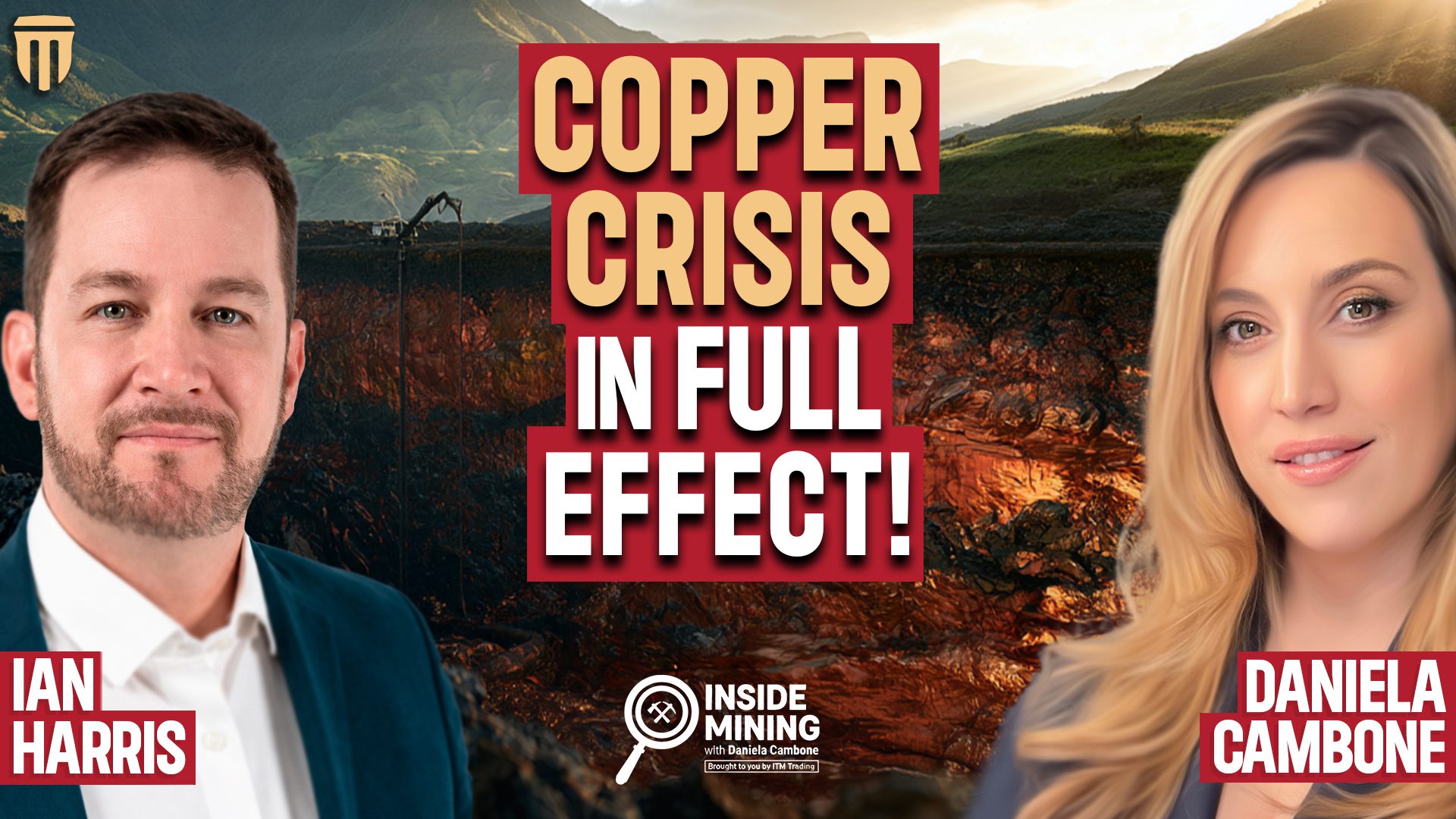
In a recent Inside Mining interview with Daniela Cambone, Copper Giant CEO Ian Harris laid out the case for why he believes the market is only beginning to recognize what the company has at its Mocoa copper-molybdenum project in Colombia.
Daniela opened with the number that gets attention: roughly 730% appreciation in Copper Giant’s stock over the prior year, according to the interview.
Harris’ response was even more striking.
His argument, in essence: the rerating has only begun.
That is a bold claim. But behind it is a project that has crossed an important geological threshold: 1.12 billion tonnes of inferred mineral resources containing an estimated 7.7 billion pounds of copper and 1 billion pounds of molybdenum.
And it is happening just as governments, traders, utilities, automakers, data-center developers, and defense industries are confronting the same uncomfortable question:
Where is all the copper going to come from?
Copper Giant’s 1.1 Billion-Tonne Resource Changes the Conversation
Size matters in copper mining.
Copper Giant’s Mocoa project in southern Colombia currently contains an inferred resource of approximately 1.12 billion tonnes grading 0.51% copper equivalent, including approximately 0.31% copper and 0.039% molybdenum. The company reports about 7.7 billion pounds of contained copper and approximately 1 billion pounds of molybdenum. (Copper Giant)
That billion-tonne threshold matters because the economics of major copper mines are fundamentally about scale.
Harris told Daniela that once a project reaches this size, it can begin attracting attention from much larger mining companies and strategic players because it is potentially capable of producing material quantities of metal over a long mine life.
But there is an important distinction investors should not overlook:
Mocoa’s resource is currently classified as inferred. It is not the same thing as a mineral reserve, and it does not yet demonstrate economic viability.
Copper Giant itself makes that qualification in its technical disclosure. (Copper Giant)
That’s why the next phase matters so much.
The company has already found the copper.
Now it has to demonstrate that it can economically extract it.
The Copper Supply Deficit Is Becoming Harder to Ignore
The larger story extends far beyond one Colombian mining project.
The International Energy Agency’s 2026 Global Critical Minerals Outlook projects that, based on currently announced projects, copper supply could fall roughly 25% short of primary supply requirements by 2035 under its stated-policies scenario. (IEA)
Read that again.
A roughly 25% projected supply gap in a metal embedded throughout the modern economy.
And demand isn’t coming from one industry.
Copper is essential to:
- Electrical grids and transmission infrastructure
- Data centers and AI infrastructure
- Electric vehicles and charging systems
- Conventional vehicles
- Housing and commercial construction
- Renewable-energy installations
- Industrial motors and machinery
- Defense and advanced manufacturing
The IEA says copper is expected to record the largest absolute increase among the minerals it tracks, with demand adding roughly 7 million tonnes through 2040. (IEA)
Meanwhile, the U.S. Department of Energy says America’s transmission system already faces growing infrastructure requirements from data centers, domestic manufacturing, industrial loads, and broader electricity-demand growth. (The Department of Energy’s Energy.gov)
This is where the conventional commodity-cycle argument starts to look inadequate.
Normally, rising commodity prices solve shortages.
Prices rise. Miners invest. New supply arrives.
Copper has a problem: new mines can require years—or much longer—to discover, permit, finance, construct, and ramp up.
You cannot manufacture a billion-tonne copper deposit because the price went up.
Record Copper Prices Haven’t Magically Created New Mines
The warning signs are already visible.
The IEA reported that base-metal prices including copper rose by roughly one-third between January 2025 and April 2026, with copper reaching record highs during that period. Yet it still forecasts a material long-term supply shortfall. (IEA)
This is the part of the story investors should be watching.
Higher prices are sending the signal. But geology, permitting, financing, infrastructure, and construction determine how quickly miners can answer it.
Investment isn’t standing still. Copper-focused company spending increased approximately 8% in 2025, according to the IEA.
But the same report found that overall critical-mineral investment declined 9%.
Translation?
The world may understand that copper supply is becoming strategic.
That doesn’t mean enough copper is arriving soon enough.
Why Trafigura’s 10-Year Deal Matters
Then there is Trafigura.
In August 2026, Copper Giant announced an agreement granting global commodities trader Trafigura rights to purchase 20% of future copper concentrate and 20% of future molybdenum concentrate from Mocoa for ten years following the commencement of commercial production, subject to the agreement’s terms. (FT Markets)
That agreement arrived before completion of the project’s Preliminary Economic Assessment.
Harris sees that as significant.
From his perspective, a major commodities trader seeking long-term access this early illustrates how valuable future copper supply could become.
It is not proof that Mocoa will become a mine.
But it is notable that a sophisticated global commodity firm has positioned itself for access should it reach production.
In a world supposedly swimming in future copper supply, why lock up potential concentrate a decade at a time?
That is the question worth asking.
C$31 Million Changes the Financing Picture
Money has historically killed plenty of promising mining projects.
Drill results can be spectacular. Resource estimates can be enormous.
But developing large mines requires capital—and usually lots of it.
Copper Giant closed a C$31 million strategic financing on August 21, 2026, including 40 million shares purchased by Denarius Metals. Frank Giustra and Harris also participated. (Copper Giant)
The company says the capital is intended to help fund:
- Resource-conversion drilling
- Additional exploration
- Geotechnical work
- Hydrogeological studies
- Environmental programs
- Advancement beyond the PEA toward a potential construction decision
The broader exploration story may also be getting larger.
On September 16, Copper Giant reported 13 exploration targets beyond the existing Mocoa resource and its interpreted extensions within the area examined by an independent geophysical study. (Copper Giant)
In other words, the current billion-tonne estimate may not define the entire system.
That possibility remains exploration upside—not a resource that investors should count before it is drilled and established.
But it explains why Harris continues to emphasize district-scale potential.
Colombia Just Became Part of the Critical-Minerals Chessboard
For years, geology wasn’t Mocoa’s only question.
Jurisdiction mattered.
That backdrop shifted materially in 2026.
Colombia’s new president, Abelardo De La Espriella, took office on August 7, 2026. Mining and energy companies welcomed signals from the new government favoring investment and faster permitting, although Reuters noted that some proposed reforms could encounter legal hurdles and resistance in a divided Congress. (Reuters)
Then came a development directly connected to the copper story.
On September 8, the United States and Colombia signed a critical-minerals framework aimed at building more resilient and diversified supply chains. The framework contemplates government and private-sector support mechanisms that can include loans, guarantees, equity, offtake agreements, insurance, and regulatory facilitation for qualifying mining and processing projects. (EBS PublicNow)
This does not mean Mocoa has been selected for U.S. government support.
It does mean the geopolitical direction of travel is becoming clearer.
Critical minerals are no longer merely a mining-sector discussion.
They are becoming national-security infrastructure.
China accounted for approximately 44% of world refined-copper production in 2024, according to U.S. Geological Survey data, while also representing roughly 63% of global copper ore and concentrate imports by value that year. (USGS Publications)
Western governments have noticed the concentration.
The scramble is no longer theoretical.
The PEA Is Where the Mocoa Story Faces Its Real Test
This is also where enthusiasm needs discipline.
A giant resource by itself does not automatically equal a profitable mine.
Copper Giant’s planned Preliminary Economic Assessment is expected in the fourth quarter of 2026. (Copper Giant)
That study should begin answering several much harder questions:
- What production scale makes economic sense?
- How much upfront capital might development require?
- What operating costs could the project face?
- What recovery rates can reasonably be achieved?
- What does the mine plan look like?
- How does the high-grade near-surface material affect early economics?
- What copper and molybdenum prices are required to generate acceptable returns?
This is the difference between having metal in the ground and having an economically viable mine.
Harris argues that Mocoa’s near-surface mineralization and existing regional infrastructure could provide advantages relative to projects requiring enormous underground development or major new infrastructure.
The PEA should give investors the first meaningful economic framework for judging that argument.
Until then, those economics remain projections rather than demonstrated outcomes.
AI Has Added Another Competitor for the World’s Copper
There was already a credible copper-demand case before artificial intelligence became a global capital-spending arms race.
Now data centers are being layered on top.
The grid must supply the electricity.
Transformers must move it.
Transmission lines must carry it.
Cooling systems and electrical equipment must distribute it inside increasingly power-hungry facilities.
And copper runs throughout that chain.
The IEA says demand for critical minerals is increasingly tied not only to traditional energy technologies but also to AI, digital systems, high-tech manufacturing, aerospace, and defense. (IEA)
The uncomfortable reality is that all these sectors are effectively competing for overlapping pools of strategic materials.
AI doesn’t replace EV copper demand. It gets stacked on top of it.
Grid modernization doesn’t replace housing demand.
Defense doesn’t replace industrial consumption.
Each new demand layer arrives while many existing mines age and new projects remain difficult to build.
That’s why Harris believes this copper cycle could be structurally different from previous commodity booms.
Whether that thesis proves correct will depend on actual supply, demand, substitution, recycling, new mine development, and ultimately price.
But the shortage risk is no longer confined to mining-company presentations.
The IEA is putting numbers behind it.
What Copper Is Telling Gold and Silver Investors
Copper, gold, and silver serve different economic roles.
Copper is principally an industrial metal. Its price can be highly sensitive to economic activity, construction, manufacturing, and global growth.
Gold plays a very different role.
For financially conservative investors focused on wealth preservation, physical gold has historically been valued precisely because it is a tangible asset that does not depend on a corporation’s earnings, a mine-development schedule, or another party’s promise to pay.
Silver occupies territory between the two.
It has a long monetary history but also substantial industrial applications, making it sensitive to both investment demand and industrial trends.
That distinction matters.
A copper shortage can potentially create extraordinary opportunities for miners—but mine development also carries exploration, construction, political, financing, operational, commodity-price, and dilution risk.
Physical gold does not need a PEA.
It does not need drilling success.
It does not need a government permit to prove a resource.
And it does not require a CEO to deliver a mine on schedule.
For people concerned about inflation, debt accumulation, currency debasement, or systemic financial risk, the gold vs. dollar question is fundamentally different from a speculative mining-equity question.
Gold and silver can therefore serve as tangible assets within a broader wealth-preservation strategy rather than simply as bets on higher commodity prices.
Gold has also historically been considered an inflation hedge, though its performance can vary substantially over shorter periods and no asset provides guaranteed protection.
The Bigger Copper Warning
Copper Giant is one company.
Mocoa is one project.
But the backdrop surrounding it is much larger.
The world’s electrical infrastructure is expanding.
AI is consuming more power.
Governments want domestic and allied supply chains.
Existing copper assets cannot be expanded forever.
And the IEA still sees a potentially significant copper supply deficit emerging over the next decade.
Against that backdrop, Mocoa has crossed the billion-tonne threshold, Copper Giant has secured fresh strategic capital, Trafigura has contracted for a portion of potential future production, drilling continues, and the project’s first economic assessment is approaching.
The 730% move may be what gets people’s attention.
The more important question is what happens if Harris is right about the copper market itself.
Because if the coming decade becomes less about finding buyers for copper and more about finding copper for buyers, the battle over viable, large-scale deposits may only be getting started.
And for savers watching governments, corporations, and nations compete for increasingly strategic tangible resources, the message extends beyond copper:
Scarcity matters. Counterparty risk matters. And owning tangible assets before everyone agrees they are necessary has historically been very different from trying to acquire them after a crisis becomes obvious.
About ITM Trading
ITM Trading has over 28 years of experience helping clients safeguard their wealth through personalized strategies built on physical gold and silver. Our team of experts delivers research-backed guidance tailored to today’s economic threats.
THINKING ABOUT PURCHASING GOLD & SILVER?
Get expert guidance from our team of analysts with 28+ years of experience.
👉 [SCHEDULE YOUR CALL HERE] or call 866-706-9061