

The Next Critical Mineral Supercycle? CEO Targets Rare Antimony Discovery in Canada
The Next Critical Mineral Crisis May Be Hiding in Plain Sight
What happens when a metal essential to America’s defense industry becomes a bargaining chip in a geopolitical standoff with China?
That question is fueling speculation about a potential antimony supercycle, as China’s grip on strategic mineral supplies exposes a vulnerability in America’s industrial and national security infrastructure.
Antimony rarely attracts the attention given to gold, silver, or copper. Yet this relatively obscure critical mineral plays an important role in ammunition, flame retardants, industrial applications, and emerging technologies.
The problem? The United States remains heavily dependent on foreign antimony supplies, while China holds considerable influence over the market.
According to the U.S. Geological Survey, America relied on imports for approximately 85% of its apparent antimony consumption in 2024. No marketable antimony was mined domestically that year. – Mineral Commodity Summaries 2025
Now, a critical deadline is approaching.
China’s temporary suspension of certain export restrictions on antimony and other strategic materials is scheduled to expire on November 27, 2026. Although the broader export licensing framework remains in place, the approaching deadline raises fresh questions about supply security. – State Council Information Office
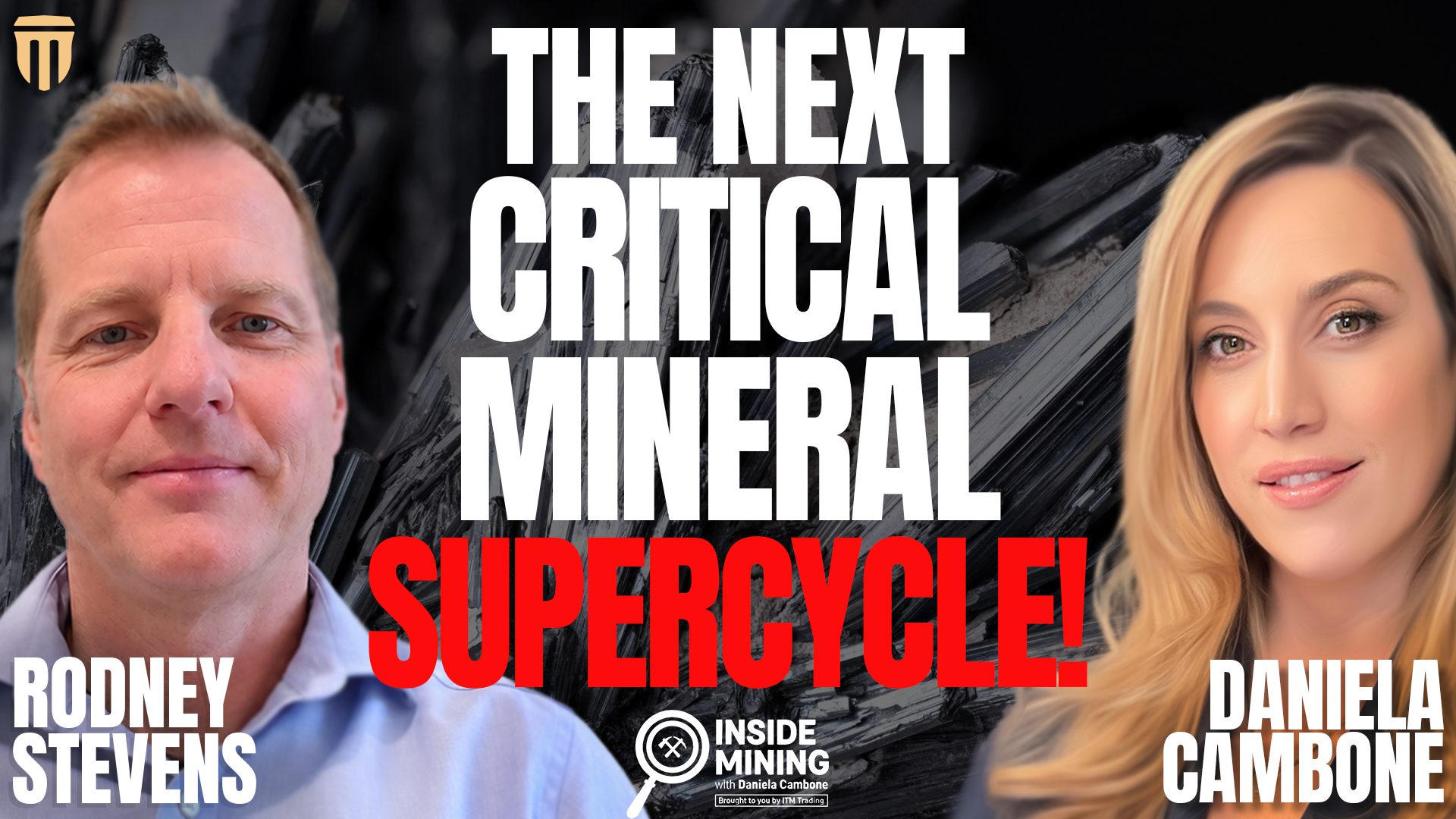
In a recent episode of Inside Mining, Daniela Cambone spoke with Rodney Stevens, CEO of NSJ Antimony Corp. (CSE: NSJ), about the possibility of another supply shock, the economics of antimony exploration, and the company’s search for a potentially significant new deposit in New Brunswick, Canada.
His central argument: The antimony market may be entering a prolonged supply squeeze that could take years to resolve.
China’s Antimony Export Controls Put U.S. Supply Chains at Risk
For years, antimony operated largely outside the spotlight.
Low prices discouraged exploration, limited investment in new mining projects, and left the industry dependent on established producers.
Then came China’s export restrictions.
In 2024, Beijing tightened controls on antimony exports, making a critical supply-chain vulnerability much harder to ignore.
The U.S. Geological Survey reported that China’s antimony ingot price increased approximately 71% during 2024, reaching $19,700 per metric ton at year-end. – U.S. Geological Survey
The export situation remains complicated:
-
September 2024: China introduced export controls affecting antimony.
-
December 2024: Beijing imposed additional restrictions targeting U.S.-bound dual-use materials.
-
November 2025: China temporarily suspended part of its U.S.-specific export prohibition, while broader licensing requirements remained in effect.
-
November 27, 2026: That temporary suspension is scheduled to expire unless the policy changes.
The distinction matters. China has not simply returned antimony trade to an unrestricted market. Export licensing requirements still apply, and restrictions affecting U.S. military end users were not completely removed.
Stevens believes the approaching deadline could bring another disruption.
In the interview, he warned that renewed restrictions could create another supply cliff and push antimony prices sharply higher.
That is a forecast, not a certainty. China’s next policy decision, available inventories, alternative suppliers, and demand conditions will all influence the outcome.
But the structural problem remains: America cannot quickly replace foreign antimony supplies with domestic production.
Why Antimony Could Be Heading Toward a New Supercycle
Antimony may be a small market, but that is precisely what could make a supply disruption so consequential.
Unlike copper or aluminum, antimony does not require massive changes in tonnage to experience significant pricing pressure.
Stevens estimates that the global market faces an annual supply deficit of approximately 30,000 metric tons, a figure he discussed as part of his market outlook rather than an independently established deficit.
His concern is that bringing sufficient new production online could take around five years.
That creates a potentially powerful imbalance.
Demand can accelerate almost immediately. New mining supply cannot.
Antimony also has applications in solar technology, adding another potential source of demand beyond traditional industrial and defense uses.
Stevens emphasized that military-related consumption can be particularly difficult to reduce when the material is needed for specific defense applications.
While substitutions may be possible in certain applications, qualifying alternatives for specialized defense uses can take time.
This is why the idea of an antimony supercycle deserves attention.
If strategic demand remains strong while mine development lags, prices could remain elevated or volatile for an extended period.
However, a sustained supercycle would depend on actual consumption, production capacity, recycling, inventories, and government trade policies—not simply the existence of export restrictions.
Why a Canadian Antimony Discovery Could Matter
As governments seek alternatives to Chinese supply, North American exploration projects are attracting renewed attention.
One such project is NSJ Antimony Corp.’s Antimony 2.0 property in New Brunswick, Canada.
The company is exploring near the historic Lake George antimony mine, once North America’s only primary antimony producer.

A historic mining district
Lake George operated intermittently from the 1860s until 1998 and at one point accounted for as much as 4% of worldwide antimony demand, according to company-reported historical information.
The geological relationship is central to Stevens’ exploration thesis.
The Antimony 2.0 property contains rock formations similar to those associated with the historic Lake George deposit, offering a reason to investigate the region for additional mineralization.
In September 2026, NSJ announced that it had expanded its property to approximately 57 square kilometers, adding new areas considered prospective for antimony. – Newsfile Corp
But geological similarities are not proof of an economically viable deposit.
NSJ remains an early-stage exploration company. Its investment case depends on what drilling establishes—not simply its proximity to a historic mine.
NSJ Antimony’s Drilling Program: What Investors Should Watch
Stevens described NSJ’s exploration program as an attempt to identify economically significant antimony mineralization, potentially accompanied by gold.
The company announced a 3,000-meter drilling program in September 2026, targeting areas identified through soil sampling and geophysical surveys. – Newsfile
During the interview, Stevens discussed drilling across approximately 11 initial targets or holes, with results expected to guide the next exploration phase.
He outlined several important milestones:
-
Initial assay results: Determine whether drilling has intersected promising grades and thicknesses of antimony mineralization.
-
Follow-up drilling: Test whether encouraging intersections connect to a larger mineralized system.
-
Resource definition: Establish the potential size, grade, and continuity of any discovery.
-
Economic studies: Evaluate mining costs, processing requirements, capital investment, and potential profitability.
-
Longer-term development: Consider financing, production, or a potential acquisition by an established industry participant.
The company has also pursued financing to support its exploration activities. An October 19, 2026 announcement outlined a proposed flow-through financing of up to C$924,000.- Stockwatch
Stevens believes that a commercially attractive antimony project could be developed at a smaller scale than many major base-metal operations.
He discussed hypothetical development costs of around $100 million for certain project sizes and potential annual cash flow of $50 million to $100 million.
Those figures are preliminary management scenarios—not a feasibility study, a mine valuation, or an indication that the current property can generate those returns.
The distinction is particularly important for speculative mineral exploration companies. Even a promising drill result does not automatically translate into a commercially viable mine.
The Antimony Supply Shortage Reveals a Bigger Problem for America
The antimony story extends beyond a single mining company or commodity.
It highlights a broader weakness in the global economy: strategically important supply chains can become geopolitical weapons.
For decades, the United States benefited from relatively inexpensive imported materials. But the financial advantages of globalization created dependencies that are difficult to unwind.
Rebuilding a domestic or allied-country supply chain requires more than discovering an ore deposit.
It requires:
-
Financing new exploration and mine construction.
-
Securing environmental approvals and operating permits.
-
Developing processing and refining capacity.
-
Establishing dependable buyers and transportation networks.
-
Making investments that remain economical through commodity price cycles.
Even a successful antimony discovery in Canada would not immediately eliminate America’s reliance on imported material.
And that raises an uncomfortable question: How many other critical supply chains remain vulnerable to political decisions made thousands of miles away?
Antimony may be attracting attention today, but similar concerns surround other strategic materials needed for defense, energy, and advanced manufacturing.
The broader trend is unmistakable. Resource security is increasingly becoming a national security priority.
[Link to related ITM Trading article on China’s critical mineral dominance]
What the Antimony Supercycle Could Mean for Gold and Silver
Although antimony, gold, and silver serve different purposes, their markets intersect with an important economic reality: the growing strategic value of tangible assets.
Antimony is primarily an industrial and strategic material. Its value depends heavily on manufacturing demand, supply availability, and specialized applications.
Gold and silver have different characteristics.
Gold has served as a monetary asset and store of value throughout centuries of currency changes, financial crises, and geopolitical upheaval.
Silver combines precious-metal investment demand with substantial industrial applications.
Gold vs. dollar: Why tangible assets matter
| Physical gold | Limited physical supply, no issuer credit risk when held directly, and a long history of monetary use |
| Physical silver | A tangible precious metal with monetary history and significant industrial demand |
| U.S. dollar | Highly liquid and widely accepted, but purchasing power can decline over time through inflation |
For Americans approaching or already in retirement, these distinctions are important.
A concentrated bet on an early-stage mining company is fundamentally different from holding physical precious metals as part of a long-term wealth preservation strategy.
Exploration stocks may offer significant upside following a successful discovery, but they also carry financing risk, dilution risk, commodity-price exposure, and the possibility that no economic deposit will ever be established.
Physical gold and silver do not depend on a drilling program or a mining company’s management team to establish their existence or ownership.
However, precious metals also fluctuate in price, can underperform for extended periods, and involve storage, insurance, and transaction costs. Neither gold nor silver is a guaranteed inflation hedge over every timeframe.
The lesson is not that antimony should replace gold or silver. It is that geopolitical instability reinforces the importance of understanding what underpins the assets in your portfolio.
For investors concerned about inflation, dollar devaluation, and the resilience of the financial system, tangible assets may deserve a place in a diversified wealth preservation strategy.
[Link to ITM Trading’s physical gold and silver wealth preservation guide]
The Next Critical Mineral Supercycle: Opportunity or Warning?
Rodney Stevens believes antimony is approaching a potentially significant turning point.
His thesis rests on three developments: China’s continued influence over supply, strategic demand from countries seeking reliable access to critical minerals, and the long development timelines required to establish new mines.
NSJ Antimony’s exploration program in New Brunswick represents one effort to identify a new North American source.
But the next chapter depends on results.
Investors watching this story should focus on the November 27 export-policy deadline, independently verified supply-demand data, NSJ’s drill assays, and evidence that any discovery can support economical production.
A mineral shortage does not guarantee a supercycle. And a promising exploration target does not guarantee a mine.
Yet the underlying issue is bigger than antimony.
The world is rediscovering that physical resources cannot simply be printed, created by monetary policy, or replaced overnight when geopolitical tensions disrupt supply.
For Americans concerned about protecting retirement wealth, that reality makes the distinction between financial promises and tangible ownership increasingly relevant.
Because when global supply chains become tools of economic pressure, what you own—and how securely you own it—matters.
About ITM Trading
ITM Trading has over 28 years of experience helping clients safeguard their wealth through personalized strategies built on physical gold and silver. Our team of experts delivers research-backed guidance tailored to today’s economic threats.
THINKING ABOUT PURCHASING GOLD & SILVER?
Get expert guidance from our team of analysts with 28+ years of experience.
[SCHEDULE YOUR CALL HERE] or call 866-706-9061