

When the Trade Is Obvious, It’s Already Wrong: Gold’s Bull Market Has Room to Run
What if one of the strongest signals for gold right now is that much of the investing public still isn’t convinced?
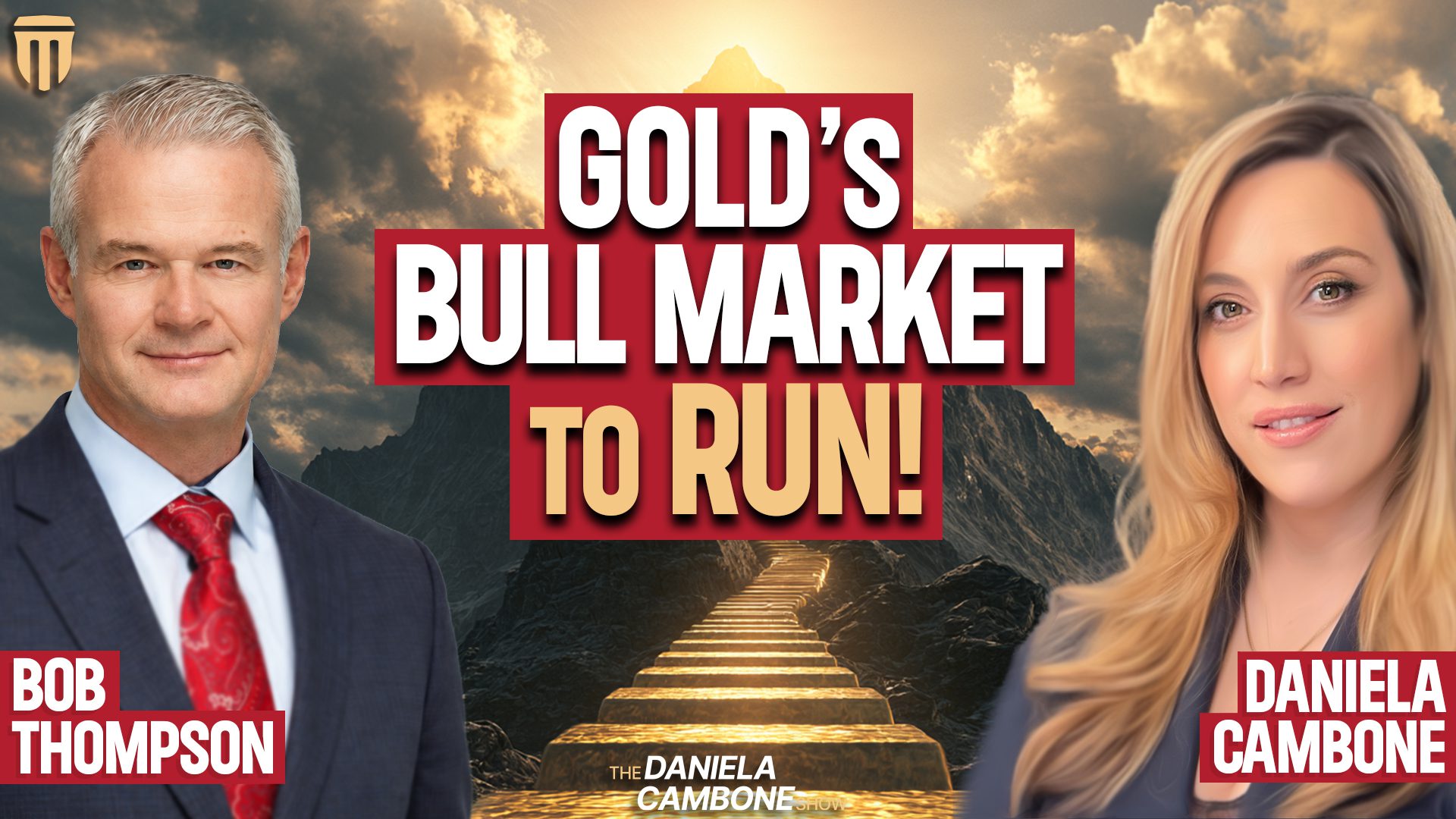
The gold bull market has already produced extraordinary price gains and repeated record highs. Yet Bob Thompson, senior portfolio manager and founder of Thompson Investment Partners, argues that the more important question isn’t how far gold has already traveled.
It’s whether the trade has become universally obvious.
His answer: not yet.
That distinction matters because major bull markets rarely end simply because an asset becomes expensive or reaches a new high. They tend to become more dangerous when virtually everyone agrees on the same narrative, positioning becomes crowded, and the expected catalyst finally arrives.
As Thompson put it in his conversation with Daniela Cambone, citing legendary investor Stanley Druckenmiller’s philosophy:
“When the trade is obvious, it’s obviously wrong.”
In other words, by the time everyone recognizes the trade, the market may have already priced it in.
Thompson believes gold and commodities are not at that stage yet.
Gold’s Bull Market Is About Perception Versus Reality
Thompson frames the current environment as a battle between two forces: perception and reality.
The reality, in his view, is a financial system struggling with persistent debt burdens and difficult monetary-policy choices.
The perception is that policymakers still have the tools to keep inflation, debt, interest rates, and financial instability under control.
Markets can exist in that gap for years.
And that gap can create opportunity.
Thompson points back to 2011 as an important example. Investors had spent years worrying about U.S. fiscal deterioration. Then the event many gold bulls had feared actually happened: Standard & Poor’s downgraded the U.S. sovereign credit rating.
It looked like confirmation of the bullish gold thesis.
But gold was already approaching the end of that cycle’s major advance.
The lesson?
A frightening headline is not automatically a buy signal.
Sometimes, when the catalyst everyone has been waiting for finally arrives, the market has already spent years anticipating it.
That is why sentiment matters.
If practically everyone owns the same asset for the same reason, the marginal buyer can disappear.
Thompson sees today’s gold market differently. Despite gold’s historic rise, he argues that many generalist investors still have not fully embraced precious metals and commodities.
That leaves a critical possibility:
Gold’s price may be at historic levels without gold itself becoming a universally crowded trade.
Gold Demand Is Already Sending a Powerful Signal
The numbers reinforce the idea that something significant has changed in the gold market.
According to the World Gold Council, total gold demand surpassed 5,000 tonnes for the first time in 2025, while the LBMA PM gold price registered 53 new all-time highs during the year.
Investment demand reached 2,175 tonnes, an 84% increase from 2024. Gold ETFs added 801 tonnes, while global bar and coin demand climbed to 1,374 tonnes—a 12-year high.
Central banks remained major buyers as well, purchasing 863 tonnes in 2025 after three consecutive years above the 1,000-tonne level.
This isn’t simply jewelry demand responding to fashion.
It reflects investors and official institutions treating gold as a strategic financial asset.
And importantly, supply cannot be increased at the push of a button.
Global mine production rose only about 1% in 2025, according to World Gold Council data.
That creates a radically different dynamic from fiat currency.
Central banks can create new currency units. Gold miners cannot create thousands of tonnes of new metal overnight.
In a Primary Gold Bull Market, Corrections Matter
One of Thompson’s most important points is also one of the simplest.
Investors must first understand whether they are operating inside a primary bull market or a primary bear market.
The strategy changes completely.
In a primary bear market, rallies can be opportunities to reduce exposure. Thompson recalls how gold-mining equities could experience enormous countertrend rallies during previous bear markets—sometimes 50% or more—only for weakness to return.
But in a primary bull market, Thompson says investors should think differently.
His framework is straightforward:
- Bull market: weakness and corrections can create accumulation opportunities.
- Bear market: sharp rallies can prove temporary and should not automatically be mistaken for a new bull market.
- Euphoric conditions: patience becomes increasingly important.
- Parabolic price action: the faster an asset rises, the greater the potential need for consolidation.
Thompson specifically warns against assuming that a bullish long-term thesis means investors should chase every rally.
He doesn’t like parabolic moves.
His preference is a healthier advance interrupted by corrections and periods of consolidation.
That is particularly relevant for gold and silver, because precious-metals bull markets are rarely smooth.
They overshoot.
They correct.
They shake investors out.
Then, if the underlying cycle remains intact, they can resume moving higher.
Gold and Silver Investors Should Watch for Euphoria
There is another side to Thompson’s thesis that gold bulls should not ignore.
No bull market lasts forever.
The danger eventually arrives when the narrative becomes obvious to nearly everyone.
Thompson’s 2011 comparison illustrates the point.
By the time a feared fiscal event became reality, the bullish story was widely understood. The very event investors believed would propel gold indefinitely occurred close to the end of that cycle’s major run.
That is why watching sentiment can be just as important as watching price.
Potential warning signs include widespread speculative enthusiasm, investors treating precious metals as incapable of falling, and a rush into gold or silver simply because prices are rising.
For now, Thompson argues the market has not reached that point.
Many investors remain heavily focused on technology and conventional financial assets. Commodities have attracted more attention, but he does not see the universal enthusiasm that typically accompanies the final phase of a major cycle.
The contrarian argument for gold, therefore, is no longer that nobody knows it is rising. It is that many investors may still underestimate why it is rising.
Debt, Inflation, and the Pressure on Monetary Policy
Behind the precious-metals cycle sits a larger problem: debt.
Thompson believes policymakers eventually face a difficult choice. Governments carrying heavy debt loads need manageable financing costs, but persistent inflation can require tighter monetary policy.
Those objectives can collide.
Higher rates may help restrain inflation, but they also increase borrowing costs.
Lower rates ease financial pressure, but they can undermine purchasing power if inflation remains persistent.
Thompson argues that some form of financial repression—where inflation and policy combine to produce weak or negative real returns for cash and bondholders—could ultimately become part of the solution.
Whether policymakers explicitly choose that path is uncertain.
But the tension itself matters.
Gold does not depend on a government promising to repay principal.
It does not depend on a corporation producing earnings.
And physical gold carries no counterparty liability in the same way a bond, bank deposit, or derivative contract does.
That helps explain why monetary uncertainty has historically strengthened investor interest in tangible assets.
Gold and Silver as Tangible Assets for Wealth Preservation
This is where physical gold and silver occupy a very different role from speculative trades.
The purpose of owning physical precious metals does not have to be predicting tomorrow’s price.
For financially conservative investors, they can instead be viewed through the lens of wealth preservation.
Gold and silver are:
- Tangible assets that exist outside purely digital financial claims.
- Assets with no central issuer capable of creating unlimited new supply.
- Historically recognized stores of value across monetary regimes.
- Potential diversification tools when confidence in currencies or financial institutions weakens.
The gold vs. dollar debate is therefore bigger than a short-term price chart.
The dollar is a currency designed to circulate through the economy. Gold is a scarce monetary asset whose supply expands slowly.
Silver adds another dimension because it combines monetary history with substantial industrial use, which can make its price significantly more volatile than gold.
Neither metal moves straight upward, and neither is guaranteed to outperform financial assets over any particular timeframe.
But for investors worried about long-term currency debasement, monetary intervention, and systemic financial risk, physical precious metals can serve as an inflation hedge and wealth-preservation asset rather than simply another ticker symbol to trade.
The Biggest Gold Signal May Be What Hasn’t Happened Yet
Gold has already broken records.
Investment demand has surged.
Central banks continue to accumulate substantial quantities of bullion.
Yet Thompson’s central argument is that the broader psychological shift may still be incomplete.
That matters.
Bull markets become increasingly vulnerable when skepticism disappears and confidence turns into certainty. Thompson believes gold and commodities have not reached that universal-consensus phase.
That does not mean prices cannot correct.
They can—and in a powerful bull market, corrections can be violent.
It does not mean investors should chase parabolic moves.
Thompson explicitly argues against doing so.
Instead, the bigger lesson is to understand the cycle.
If gold remains in a primary bull market, volatility is not necessarily evidence that the thesis has failed. But if gold eventually becomes the trade that everyone considers “obvious,” the risk calculation changes.
For investors focused on protecting purchasing power and preserving wealth across decades rather than weeks, that distinction may be far more important than predicting gold’s next $100 move.
About ITM Trading
ITM Trading has over 28 years of experience helping clients safeguard their wealth through personalized strategies built on physical gold and silver. Our team of experts delivers research-backed guidance tailored to today’s economic threats.
THINKING ABOUT PURCHASING GOLD & SILVER?
Get expert guidance from our team of analysts with 28+ years of experience.
👉 [SCHEDULE YOUR CALL HERE] or call 866-706-9061