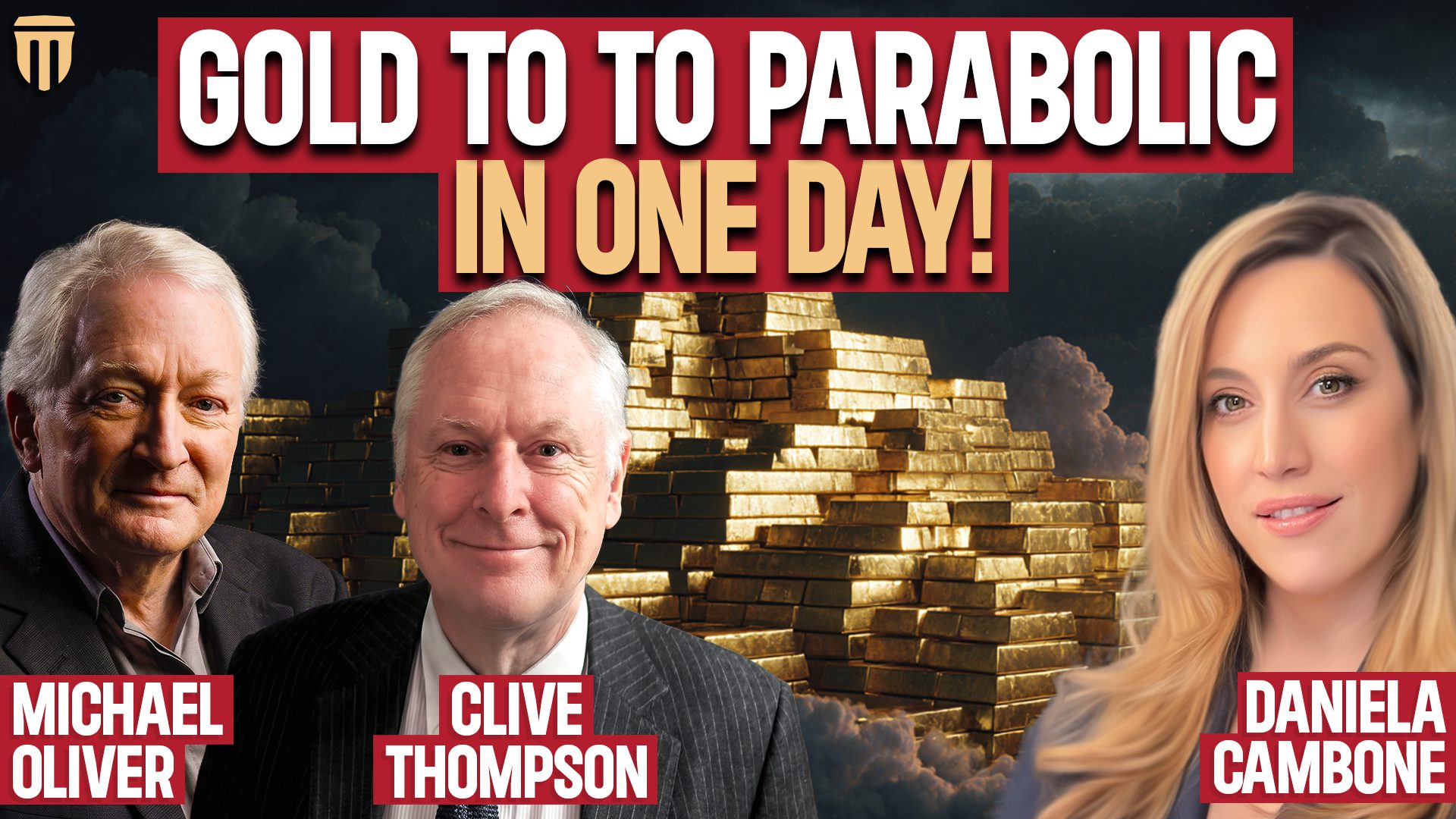
Why You’ll Buy $500 Silver — Gold to Go Parabolic in One Day: Michael Oliver, Clive Thompson
What if today’s gold and silver prices are still absurdly cheap?
That may sound outrageous after gold’s historic run and silver’s recent breakout, but according to market technician Michael Oliver and veteran Swiss wealth manager Clive Thompson, the real move hasn’t even started.
The case for $500 silver isn’t based on hype. It’s based on what many investors refuse to acknowledge: the global financial system is becoming increasingly unstable. Sovereign debt is exploding, central banks are accumulating gold at record levels, and confidence in fiat currencies is slowly eroding.
While mainstream financial media remains focused on AI stocks and the latest Fed headlines, a much bigger story may be unfolding beneath the surface.
And if Oliver and Thompson are right, investors waiting for a pullback could end up buying silver at prices they once considered impossible.
Why Central Banks Are Quietly Choosing Gold Over Treasuries
One of the most significant developments largely ignored by financial media came from the European Central Bank.
Gold has now overtaken U.S. Treasuries as a leading global reserve asset.
That shift didn’t happen overnight.
Central banks around the world have been:
- Accumulating physical gold
- Reducing reliance on dollar-based reserves
- Diversifying away from U.S. government debt
- Preparing for a more uncertain monetary future
According to Thompson, this trend is particularly visible among nations seeking greater financial independence from Washington.
The message is difficult to ignore:
The institutions closest to the monetary system are increasingly choosing gold over paper promises.
For investors, that’s a signal worth paying attention to.
The Bond Market Crisis Nobody Wants to Discuss
While headlines obsess over inflation reports and Federal Reserve speeches, Michael Oliver argues the real danger lies elsewhere.
The bond market.
For decades, government bonds were considered the safest asset in the world.
Today, that assumption is being challenged.
Several forces are converging:
- U.S. debt continues climbing at unprecedented levels
- Interest payments on federal debt are surging
- Higher rates are making refinancing more expensive
- Foreign demand for Treasuries is weakening
According to Thompson, much of America’s debt was issued during the era of near-zero rates.
Now those obligations must be refinanced at significantly higher yields.
The result?
A rapidly growing interest burden that threatens to consume an ever-larger portion of government revenues.
At some point, governments face only two options: austerity or monetary expansion. History suggests they choose the printing press.
Why Gold Is Not In A Bubble
One of the most persistent myths surrounding precious metals is that gold has become a bubble.
Thompson strongly disagrees.
A true bubble typically exhibits:
- Massive retail participation
- Extreme media excitement
- Widespread ownership
- Speculative mania
Gold displays none of those characteristics.
In fact:
- Most institutional portfolios allocate less than 1% to gold
- Pension funds remain heavily concentrated in stocks and bonds
- Retail ownership remains historically low
That’s not what bubbles look like.
Gold may be near all-time highs in nominal terms, but ownership levels suggest the public has barely entered the market.
Why $500 Silver May Not Be As Crazy As It Sounds
The Case For $500 Silver
This is where Michael Oliver’s analysis becomes particularly controversial.
Silver spent roughly five decades trapped beneath the $50 level.
According to Oliver, markets often experience dramatic repricing events after remaining artificially constrained for extended periods.
His argument rests on several observations:
- Silver recently broke out of a multi-decade trading range
- The silver-to-gold ratio remains historically depressed
- Industrial demand continues expanding
- Monetary demand is accelerating
Most importantly, silver remains dramatically undervalued relative to previous cycles.
Consider:
- In 1980, silver reached approximately 6.5% of gold’s value
- In 2011, silver reached roughly 3.1% of gold’s value
- Today, silver remains below 2% of gold’s value
If silver merely returned to historical relationships with gold, the upside could be substantial.
Oliver believes investors may eventually experience a psychological shift similar to previous commodity supercycles.
The biggest gains often occur during the final phase—when prices move vertically and mainstream investors scramble to gain exposure.
Could Gold Go Parabolic In A Single Day?
Perhaps the boldest claim from the discussion came from Clive Thompson.
His argument centers on the possibility of a government-led gold revaluation.
While controversial, Thompson notes that America’s debt burden is becoming increasingly difficult to manage.
One potential solution discussed among monetary historians involves:
- Revaluing official gold reserves
- Using higher gold prices to strengthen sovereign balance sheets
- Creating additional monetary flexibility
If such an event occurred, gold could potentially be repriced dramatically higher overnight.
Whether or not investors agree with that scenario, the broader message remains important:
Gold is increasingly being viewed as a strategic monetary asset—not merely a commodity.
The Myth That Rising Interest Rates Are Bad For Gold
Many investors still believe rising rates automatically hurt gold.
History suggests otherwise.
During the 1970s:
- Interest rates surged
- Inflation accelerated
- Gold experienced one of the greatest bull markets in history
The key variable isn’t nominal rates.
It’s real rates.
Real rates equal:
Interest Rate Minus Inflation Rate
When inflation rises faster than interest rates, real rates fall.
Historically, negative real rates have been one of the strongest drivers of gold appreciation.
Today, inflation pressures remain persistent while debt levels make dramatically higher rates increasingly difficult to sustain.
That combination creates a potentially favorable backdrop for gold and silver.
Gold, Silver, and Wealth Preservation In A Monetary Reset
Perhaps the most powerful takeaway from the discussion had little to do with price targets.
It had everything to do with ownership.
Thompson displayed a collection of obsolete currencies from around the world.
Brazil.
Turkey.
Argentina.
Numerous nations that experienced currency collapses.
The lesson?
Every paper currency eventually faces a crisis of confidence.
Gold and silver have survived every one of them.
Unlike fiat currencies:
- Gold cannot be printed
- Silver cannot be created digitally
- Neither carries counterparty risk
- Both have served as money for thousands of years
This is why precious metals remain essential tools for:
- Wealth preservation
- Portfolio diversification
- Inflation protection
- Protection against systemic financial risk
When confidence in financial institutions weakens, investors historically seek tangible assets.
That reality has not changed.
Why Physical Gold and Silver Matter More Than Ever
As debt levels rise, banking risks increase, and governments search for solutions to unsustainable obligations, physical precious metals continue attracting attention from central banks, institutions, and individual investors alike.
The debate is no longer simply about inflation.
It’s about trust.
Trust in currencies.
Trust in governments.
Trust in financial institutions.
For many investors, physical gold and silver represent something increasingly scarce:
A tangible asset outside the financial system.
Whether silver reaches $500 or gold experiences a dramatic repricing event, the underlying trend remains clear.
The world’s largest financial players are preparing for a different monetary future.
The question is whether individual investors will prepare alongside them.
Conclusion
Markets often change gradually—until they change all at once.
The themes highlighted by Michael Oliver and Clive Thompson point toward a financial landscape increasingly defined by rising debt, declining confidence in fiat currencies, and growing demand for hard assets.
Whether gold reaches $10,000, silver reaches $500, or prices settle somewhere in between, the underlying message remains the same:
The monetary system is changing.
Investors who understand that shift today may find themselves better positioned than those waiting for mainstream confirmation tomorrow.
About ITM Trading
ITM Trading has over 28 years of experience helping clients safeguard their wealth through personalized strategies built on physical gold and silver. Our team of experts delivers research-backed guidance tailored to today’s economic threats.
THINKING ABOUT PURCHASING GOLD & SILVER?
Get expert guidance from our team of analysts with 28+ years of experience.
👉 [SCHEDULE YOUR CALL HERE] or call 866-706-9061