Gold is The Only Exit Plan, $39 Trillion Doom Loop – Gold Rush Star Reveals
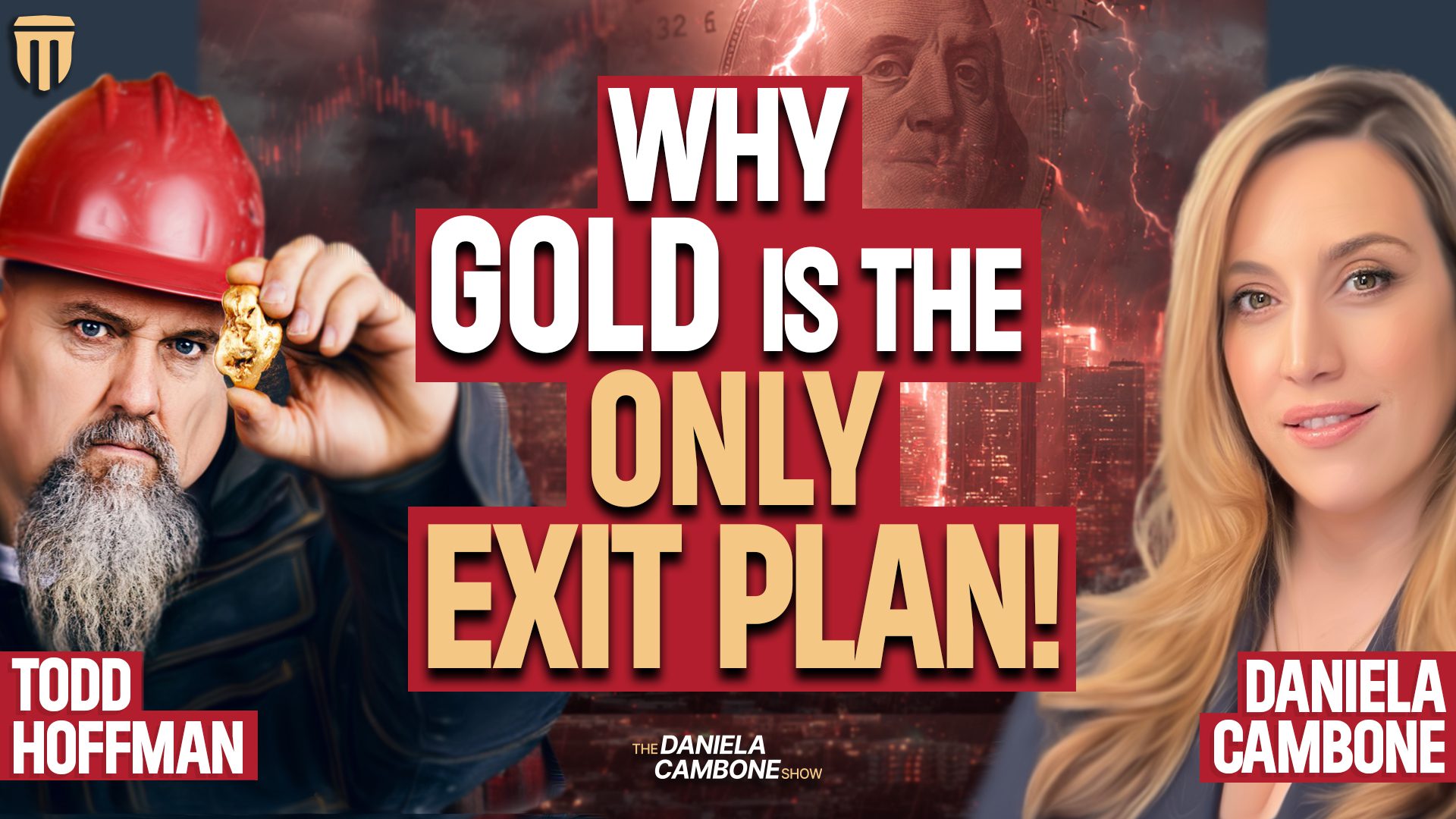
What happens when the debt becomes so large no politician, no central bank, and no “soft landing” narrative can plausibly explain it away?
That’s where we are now. The $39 trillion debt crisis is no longer some abstract talking point buried in Treasury reports and cable-news spin. It’s the giant, unavoidable financial reality looming over every retirement account, every dollar saved, and every promise Washington still pretends it can keep.
In a wide-ranging conversation with Gold Rush star Todd Hoffman, one message came through loud and clear: gold is no longer a fringe insurance policy—it’s becoming the obvious response to a system under strain.
And if the people who pull gold out of the ground for a living are telling you this rally is just getting started, it might be time to pay attention.
The $39 Trillion Debt Crisis Is the Real Story
Washington keeps changing the headline. One week it’s inflation. The next it’s tariffs. Then recession fears, bank stress, geopolitical conflict, or election-year theater.
But underneath all of it sits the same structural problem: too much debt, too much spending, and too much faith in a dollar-based system that increasingly requires confidence to survive.
Todd Hoffman didn’t mince words in the interview:
“We are $38 trillion in debt… you can’t pay that back.”
That number is now brushing up against $39 trillion, and the implications are hard to overstate.
Why this matters to everyday Americans:
- Debt this large can’t realistically be repaid through growth alone
- Governments often deal with debt burdens through:
- currency debasement
- financial repression
- inflation
- stealth taxation
- That means the burden doesn’t disappear—it gets transferred to savers and retirees
This is the part most Americans are never told clearly enough: when the system is cornered, your purchasing power becomes the release valve.
That’s why gold and silver are back in the conversation in a very serious way.
Why Gold Is Rising—and Why It May Not Be Finished
Mainstream financial media still treats every gold move like an anomaly. But this isn’t a random spike.
This is a confidence trade.
In the interview, both Daniela and Todd pointed to the same core drivers behind the gold breakout:
- Central bank gold buying
- Foreign governments reducing exposure to U.S. assets
- Growing distrust in the long-term strength of the dollar
- A broader search for safety outside the traditional financial system
Todd also raised what many insiders increasingly believe:
“China… probably has twice maybe three times the amount of gold that they’ve reported.”
That matters because if sovereign players are quietly accumulating gold while the public is still being sold “everything is fine,” then the signal is obvious:
The people closest to the monetary system are hedging against it.
Here’s what that suggests:
- Gold is not just responding to inflation
- It is responding to systemic distrust
- It is increasingly being treated as a neutral reserve asset
- It is re-emerging as a global monetary anchor
This is also why the old “gold doesn’t do anything” argument is breaking down.
Gold doesn’t need to produce yield when:
- bonds are politically manipulated,
- equities are overvalued,
- and fiat currencies are being diluted.
At some point, stability becomes the return.
“Gold Is Digital Gold”: Why the Narrative Is Breaking
For years, investors were told that newer, more “modern” alternatives had replaced gold.
Then reality showed up.
Todd Hoffman put it bluntly:
“All these guys that were talking… Bitcoin… digital gold… Gold’s digital gold.”
It’s a funny line—but it captures something serious.
When uncertainty rises, markets tend to separate into two camps:
Assets people speculate on
vs.
Assets people run to
That distinction matters more than ever.
Gold’s strength right now suggests that institutional and sovereign buyers are not looking for novelty. They’re looking for:
- durability
- liquidity
- history
- trust outside counterparty risk
That’s what physical gold has always offered.
And unlike digital assets, derivatives, ETFs, or synthetic financial products, physical gold doesn’t depend on a platform, a custodian, a power grid, or someone else’s balance sheet staying intact.
That’s a very different kind of security.
What a Gold Miner Sees That Wall Street Often Misses
One of the most compelling parts of this conversation was hearing from someone who doesn’t just analyze gold—but actually extracts it from the earth.
Todd’s perspective cuts through the usual financial abstraction.
He explained that while much of the mining industry revolves around exploration, speculation, drilling, and eventually trying to sell projects to larger players, placer miners like him live in a different world:
- They need to find real gold
- They need to produce now
- They need to survive based on what comes out of the ground—not what gets pitched in a deck
That distinction is important.
Because when gold prices surge, the public often assumes supply can just flood the market.
It can’t.
Gold supply is far more constrained than most people realize:
- New mines take years to move from concept to production
- Equipment costs are enormous
- Environmental approvals can stall projects for years
- Skilled labor and operational expertise are limited
- Political risk is rising in many mining jurisdictions
Todd described how even a relatively modest “micro mine” can require $1.5 million to $2 million in used equipment just to get operational.
This is critical for investors to understand:
Gold supply is not infinitely elastic.
If demand keeps accelerating while real-world supply remains bottlenecked, then higher prices aren’t a fluke—they’re a logical outcome.
The Quiet De-Dollarization Story Nobody Can Ignore
One of the strongest undercurrents in this conversation was the slow but unmistakable shift away from U.S. dollar dominance.
Daniela framed it clearly when she described what many countries appear to be doing:
“A sell America trade.”
That phrase should stop people in their tracks.
Because if foreign governments, central banks, and major institutions are gradually asking:
“If we don’t want to hold more U.S. assets… what do we hold instead?”
Then gold becomes the obvious answer.
Why this matters:
- Gold has no issuer
- Gold has no political allegiance
- Gold can’t be sanctioned, printed, or defaulted into existence
- Gold functions as a monetary asset without sovereign dependency
This is where the gold vs dollar conversation becomes unavoidable.
The dollar may still be dominant—for now. But dominance is not the same as permanence.
And if trust in U.S. fiscal discipline continues to erode, the long-term pressure on the dollar only intensifies.
That doesn’t mean collapse tomorrow.
It means repositioning today.
Silver Is Still the Sleeper Story
While gold gets the headlines, silver remains one of the most misunderstood hard assets in the market.
Todd noted that silver is different from gold in one major way: it’s tied not only to monetary demand, but also to industrial demand.
That makes silver especially interesting in an environment where:
- supply chains are under pressure,
- industrial metals are strategic,
- and investors are looking for hard assets that may still be undervalued relative to gold.
Why silver matters now:
- It has a long history as a monetary metal
- It remains critical in industrial and technological applications
- It may offer greater upside volatility in a precious metals bull cycle
- It can serve as an accessible entry point for investors building a hard-asset position
For many financially conservative Americans, the conversation isn’t gold or silver.
It’s increasingly gold and silver.
Why Physical Gold and Silver Matter in a Debt-Soaked System
This is where the conversation becomes personal.
Because if the real threat is not just volatility—but systemic fragility—then your strategy has to change.
Not everything in your portfolio needs to “perform.”
Some things need to protect.
That’s where physical gold and silver stand apart.
In times of financial stress, physical precious metals offer:
- wealth preservation
- tangible assets outside the banking system
- a long-term inflation hedge
- protection against currency debasement
- optionality during periods of market dislocation
This is the core difference between paper wealth and real wealth.
Paper wealth depends on:
- counterparties
- policy stability
- market structure
- confidence
Physical gold and silver depend on none of those things.
And in a world increasingly shaped by debt expansion, monetary distortion, and institutional distrust, that distinction matters more than ever.
If the gold vs dollar debate intensifies from here—as it likely will—then holding at least a portion of your savings in hard assets is no longer “extreme.”
It’s prudent.
Conclusion
Todd Hoffman may be known for chasing gold through frozen rivers and brutal terrain, but his broader warning is hard to dismiss:
When the debt gets too big, the old financial assumptions stop working.
And that’s where we are now.
The $39 trillion debt crisis is not some distant macro problem reserved for economists and hedge funds. It’s the backdrop for:
- inflation risk
- dollar weakness
- retirement uncertainty
- and the growing appeal of real, tangible assets
If this debt spiral continues—and there’s little evidence it won’t—then gold and silver are not just “investments.”
They are increasingly being treated for what they’ve always been in times of uncertainty:
financial exits from a system under strain.
The question is no longer whether the elephant is in the room.
The question is: what are you doing before it starts breaking the floor?
About ITM Trading
ITM Trading has over 28 years of experience helping clients safeguard their wealth through personalized strategies built on physical gold and silver. Our team of experts delivers research-backed guidance tailored to today’s economic threats.
THINKING ABOUT PURCHASING GOLD & SILVER?
Get expert guidance from our team of analysts with 28+ years of experience.
👉 [SCHEDULE YOUR CALL HERE] or call 866-706-9061