


$845 TRILLION Derivative Crisis as U.S. Banks Prepare for Bail-Ins
$845 trillion in derivatives and rising synthetic risk transfers threaten banks. Is another 2008-style crisis brewing?
The Derivatives Market Is Bigger Than the Real Economy
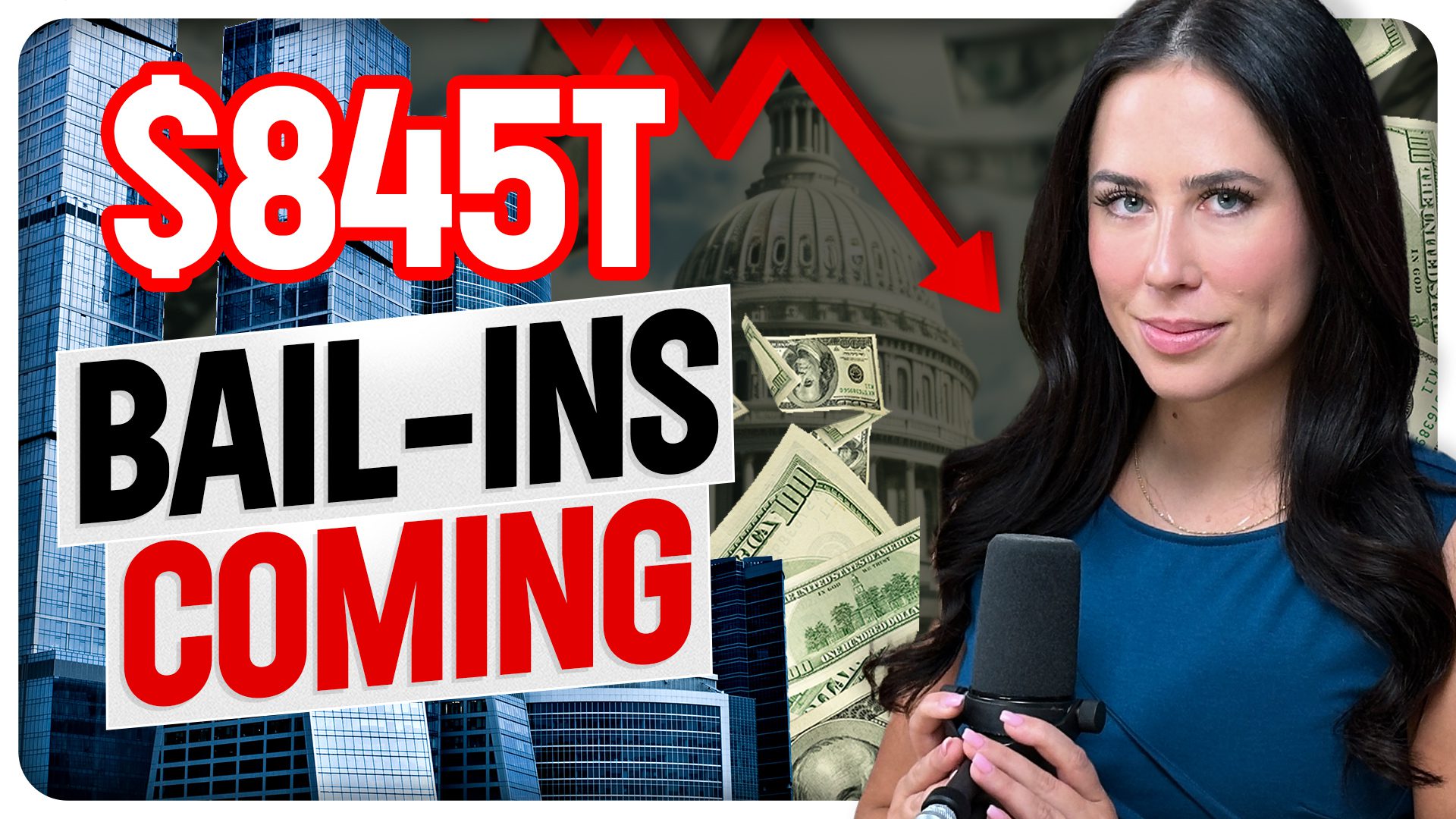
According to the Bank for International Settlements, global derivative exposure has climbed to $845 trillion, up roughly 16% year-over-year.
Let that sink in.
For comparison:
- Global GDP: ~$110 trillion
- U.S. GDP: ~$28 trillion
- Derivatives exposure: $845 trillion
These instruments:
- Multiply risk through leverage
- Repackage debt into layered securities
- Create interconnected obligations across banks, funds, and institutions
As we noted in prior analysis , systemic crises rarely explode overnight. They build quietly beneath the surface.
That’s exactly what’s happening now.
Synthetic Risk Transfers: The Illusion of Safety
What Are Synthetic Risk Transfers?
Synthetic risk transfers (SRTs) allow banks to shift credit risk off their balance sheets—without selling the underlying loans.
Here’s the simplified version:
- A bank holds a risky loan (commercial real estate, private credit, etc.)
- Instead of selling it at a loss, the bank pays an investor to absorb potential losses
- On paper, the bank reduces its capital requirements
- In reality? The risk still exists—it’s just moved elsewhere
Why Banks Love SRTs
- They avoid realizing massive unrealized losses
- They maintain the illusion of strong capital reserves
- They free up liquidity to issue more loans
- Executives collect bonuses tied to capital ratios
But the underlying loans? Still deteriorating.
This isn’t risk reduction. It’s risk redistribution.
The Shadow Banking Time Bomb
Who is absorbing these synthetic risk transfers?
Not traditional, heavily regulated banks.
Instead:
- Private credit funds
- Hedge funds
- Highly leveraged loan managers
- Non-bank “shadow banks”
Shadow banks now account for nearly half of global financial assets.
These institutions:
- Operate with limited oversight
- Use 10–20x leverage
- Fund companies that traditional banks would reject
And private credit defaults are rising sharply.
Meanwhile:
Commercial Real Estate Is Cracking
- Office vacancy rates in major cities approach 20%
- Loans from 2019–2020 must refinance at 2–4x higher rates
- Regional U.S. banks are heavily exposed
Losses haven’t fully hit balance sheets—yet.
Subprime Auto Loans Are Flashing Red
- Auto delinquencies at record highs
- Asset-backed securities tied to subprime loans collapsing
- Recent lender failures echo early 2007 mortgage cracks
If this feels familiar, it should.
2008 didn’t begin with Lehman. It began with small, “contained” failures.
Bail-Ins: The Hidden Rule Most Depositors Don’t Understand
Here’s what most Americans don’t realize:
After 2008, legal frameworks were quietly established allowing for bail-ins.
Unlike bailouts (government rescues), a bail-in means:
- Depositors become creditors
- Deposits can be converted to equity
- Accounts can be frozen
- Funds can be seized to recapitalize failing banks
This has already happened in:
- Cyprus
- Lebanon
And it is legally structured in the United States.
Yes, the FDIC insures up to $250,000.
But:
- The Deposit Insurance Fund is tiny relative to total deposits
- Multiple mid-sized bank failures could overwhelm it
- Access to funds could be restricted for extended periods
The real question is not if stress hits.
It’s how long you could function without access to your bank accounts.
Liquidity Is Tightening While Debt Hits Records
The U.S. is approaching a massive refinancing wall.
At the same time:
- Global debt is at record highs
- Private credit is under strain
- Commercial real estate losses are building
- Derivatives exposure continues to expand
The system is more interconnected than ever.
Systemic risk doesn’t usually explode instantly.
It builds quietly.
Then it happens all at once.
Gold vs Dollar: Why Tangible Assets Matter Now
When risk is embedded across:
- Banks
- Shadow banks
- Derivatives markets
- Pension funds
- Asset managers
You don’t eliminate risk by moving from one paper asset to another.
You reduce exposure by stepping outside the system.
Physical gold and silver are:
- Tangible assets
- No counterparty risk
- No derivative layers
- No bank dependency
Gold vs dollar is not a speculative debate—it’s about wealth preservation.
Historically, during:
- Banking crises
- Currency devaluation
- Systemic financial resets
Gold has functioned as an inflation hedge and stability anchor.
When liquidity freezes, tangible assets don’t.
The Real Question: What Are You Waiting For?
We know:
- Synthetic risk transfers are expanding
- Derivative exposure is growing
- Shadow banking leverage is extreme
- Commercial real estate losses are coming
- Bail-in laws are in place
No one rings a bell before systemic risk detonates.
Insurance only works if it’s in place before the event.
Physical gold and silver aren’t about panic.
They’re about preparation.
The Architecture Is Already Built
The architecture for systemic stress is already in place:
- Record derivatives
- Rising defaults
- Liquidity tightening
- Legal bail-in frameworks
This isn’t alarmism.
It’s arithmetic.
The only question left is whether you position yourself before or after the next tipping point.
About ITM Trading
ITM Trading has over 28 years of experience helping clients safeguard their wealth through personalized strategies built on physical gold and silver. Our team of experts delivers research-backed guidance tailored to today’s economic threats.
THINKING ABOUT PURCHASING GOLD & SILVER?
Get expert guidance from our team of analysts with 28+ years of experience.
👉 [SCHEDULE YOUR CALL HERE] or call 866-351-4219