Grant Williams: Why a US Dollar Crisis Could Happen OVERNIGHT
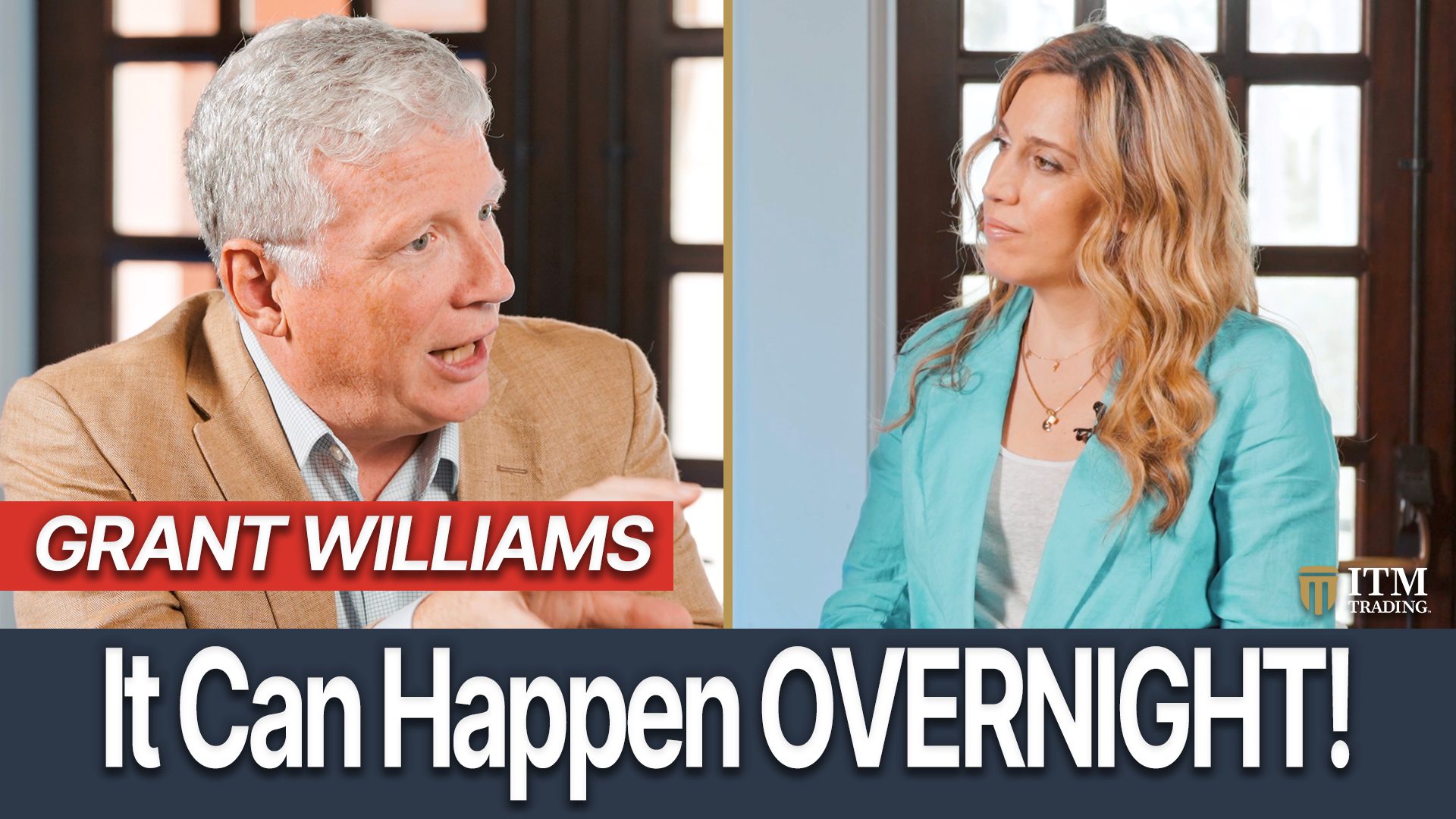
“At some point, there will be a currency crisis,” warns Grant Williams, author and publisher of Things That Make You Go Hmmm… and host of The Grant Williams Podcast. He tells Daniela Cambone that the crisis could happen overnight and, when it does, gold will become a solution to a collapsing financial system. “Every time there’s a financial crisis, we go back to gold,” Williams states. He also explains that the rising power of BRICS nations is a manifestation of defiance against Western dominance in the global financial game. “It’s not a case of the BRICS beating the West. It’s the case of the BRICS saying, ‘The status quo doesn’t work for us anymore,’” he explains. Watch the powerful interview to learn more about Williams’ views.
CHAPTERS:
00:00 Mining sector in general
4:13 Gold investment
6:24 Loss of purchasing power/US dollar
9:30 Currency crisis
12:15 BRICs
14:46 CBDC
17:08 Concluding words
TRANSCRIPT FROM VIDEO:
00:00
We are at the tail end of a monetary system that has been in place since post-World War II. At some point this is all going to kind of collapse in and of itself. So it’s going to take a lot to convince people who’ve never experienced a currency crisis in their lifetimes that they need to earn gold.
00:25
Hi everyone, Daniela Cambone here. Hope everyone is enjoying the summer series and your summer overall. I know it’s the time that we’re supposed to be kicking back and relaxing, but important that we don’t become complacent. And if you do not have a financial strategy in place, I strongly urge you to contact us. Book a Calendly appointment. We will offer you and give you a free information session. All you have to do is click on the link.
00:54
below in the description of the videos and choose a time and day that suits you best. And one of us here at ITM Trading will reach out to you and help you build a surefire, foolproof wealth preservation strategy. I strongly urge you to do that. Now check out today’s video.
01:15
Hi, it’s Daniela Cambone. Welcome back to the Daniela Cambone show here on ITM Trading. Still on the road. We are in Boca Raton, Florida for Rick Ruhl’s symposium. Thrill to be back with Grant Williams, publisher of the newsletter, Things That Make You Go Hmm, Grant. Always good to see you. How have you been? Likewise. I’ve been good. Yeah, I’ve been good. Running around the world.
01:37
trying to make sense of it, which is getting trickier every day, it seems. Well, that is a perfect intro to this interview because I want you to help make sense of a little what’s happening here. But first and foremost, I know I asked you offline your message and your role here at the conference, and you’re trying to help investors out here. I mean, this is a mining focused show, precious metals focused show. Where do you think a lot of confusion lies? Well, look, what I’m going to talk about tomorrow.
02:05
There’s a lot of confusion between investment and speculation, I think, particularly in this little corner of the markets, the precious metals. I’ve never seen so many speculators who think they’re investors. And it’s a very different mindset for the two. And so I’m going to challenge people. I’m going to ask them to figure out what they think they are. And then we’ll go through it all and see if that actually is what they are. Because I think if you’re an investor, or you think you’re an investor, but you’re really a speculator, it’s a really difficult thing to do.
02:32
and vice versa. And very few people can be both. Very few people can be successful speculators and successful investors. So I’m just going to talk to people about that, and we’ll see who ends up throwing fruit at me. Well, let’s break it down. I mean, it’s not a question of one is better than the other, right? No, absolutely not. No, no, absolutely not. The problem comes when you think you’re one but you’re the other. Because if you’re an investor, you’re a slow moving, hard working.
03:00
You put a lot of preparation into a lot of due diligence into figuring out what long-term investments you’re going to put your capital into. And speculators are much more interested in price movements and trends and momentum and all that kind of thing. And so we saw this recent frenzy in GameStop and AMC recently, when Roaring Kitty showed his tail again. And all the headlines were retail investors flock to GameStop. Not one of them was an investor. Not one.
03:28
They’re all speculators. And so if you think you’re an investor, but you’re speculating, or you think you’re a speculator, but you’re investing, you are setting yourself up for failure because they’re two completely different disciplines with different timeframes, with different areas of importance, with different emotions you have to manage, different strategies you have to employ. And so I’m gonna try and talk to people in the room and see if they are what they think they are. When you’re owning physical gold, you’re better off being
03:58
you should be an investor, true or false? Well, no, false. It doesn’t matter. It doesn’t matter what you do, but know who you are before you do it. So the perfect example of gold, and I will talk about gold, obviously, just being a resources symposium, which is a very fancy word. Gold is a perfect example. And I talk about my own personal journey with gold. In 2003, until then, I’d never earned an ounce of gold in my life. And I looked at the response to it.
04:23
the dot com bubble bursting, I looked at what was going on in Japan, and it became obvious to me that QE and low rates and unorthodox monetary policy, they were going to be the tools used going forward. And so at that point in time, I had a need to try and protect my purchasing power through precious metals. So that’s when I bought gold. So 2003, I paid $333 in cash for my first ounce of gold, right? And I handed the cash over in exchange for a gold coin. And that’s a, if you’ve never done it, that’s a very important thing.
04:52
It’s an important moment in understanding what wealth is versus money. And so in December 2003, the Dow Jones is trading at 8,500, and gold is trading at 333. So a dollar a point to buy one unit of the Dow, you need to give up 25 ounces of gold. Today, the Dow is trading at 3,950, it wasn’t Friday. Gold’s trading at 2,400. It costs you 17 ounces of gold to buy that same unit of Dow.
05:20
So you had a 36% uplift. The Dow’s are all time highs, but in gold terms, if you’re exchanging your gold for the Dow, it’s 36% cheaper now than it was back in 2003. Same with housing. Housing, the median house price was 200 grand in December 2003, it’s $417,000 now. It would have cost you 600 ounces of gold back in 2000. Cost you 173 ounces, so 71% cheaper. House prices are 71% cheaper in gold.
05:48
nowhere in 2003, despite every headline that says housing’s unaffordable, no one can afford houses, house price bubble. And so people get caught up in the price of gold. And that’s what speculators do. If you’re a speculator, you’re looking to buy something and sell it at a higher price. That’s what you’re looking to do. So I’m trying to explain to people, look, it’s fine to be a speculator, but you have to be looking at a whole lot of different things than if you’re being an investor. If you’re being an investor and you’re looking at the price every day.
06:16
it is counterproductive to what you’re trying to achieve. Yeah, you’re bringing up a very good point, the loss of purchasing power. The US dollar has lost over 50% since 2020. Let’s talk about where you feel the direction of the US dollar is heading here. Well, look, you have to break that down. There’s reserve currency status, which I don’t think is at risk.
06:43
Certainly not in the short to medium term. And there’s reserve asset status. And that is a much murkier situation. Reserve currency, the dollar is used in trade all around the world. It’s not going to go away anytime soon. It’s the primary energy currency. And even though some of the BRICS nations are trying to trade oil in their own currencies, which they are at the margin, that’s going to ultimately chip away at the dollar’s primacy. And obviously, every barrel of oil that’s transacted in the currency other than the dollar, you’ve got oil trading at $0.00.
07:11
Let’s call it $100. It’s a bit below that, but $100. That’s $100 of reserves that some country doesn’t need to hold. So that’s $100 of treasuries they don’t need to buy. So you’ve definitely got a problem with the reserve asset side of the equation. And that’s really where gold comes in. Because since the Russian invasion of Ukraine, and not necessarily when they crossed the border, but a few days later when the Treasury froze $325 billion of Russian central bank assets, they froze that. That to me-
07:40
was the biggest policy mistake and also the most important policy shift since August 15, 1971. Because when they did that, they sent a message to every central bank in the world, if you own dollars, there are a set of circumstances under which we will prevent you having access to them. And if that’s the case, you don’t have a choice here. The central bank that holds dollar assets, you have to have a plan B. You can’t have
08:08
leave yourself open to that particular problem. So that’s what’s happened. The central bank’s been buying gold now for two years. Before the Russian invasion, they were averaging 118 tons a quarter net purchases. Now it’s almost three times that. I’ve had some experts on who have gone so far to say that that move is enough to bring down the complete US Treasury market. Do you think it’s? Look, it’ll be a slow moving car crash. It’s not going to happen overnight. But you have set in motion.
08:38
a set of events. I interviewed Jeff Gundlach back in 2015, and he said something to me that stuck with me ever since. He said, fear and greed are powerful, but there’s one thing that’s more powerful than both, and that’s need. He said, if you need to do something, you don’t have a choice. And that’s where we are. Central banks and sovereign states now need to have an alternative to the dollar, because it can get taken away from them. And gold is the alternative. It’s the only viable alternative, frankly. I see that. And many gold investors see that.
09:08
Yet are you surprised that the appetite for gold is not really there yet in North America? I mean, we see it in China. But I mean, central banks see it. Yeah, it doesn’t surprise me. Look, I mean, we are at the tail end of a monetary system that has been in place since post-World War II, since Bretton Woods.
09:33
We’re at the end of that. It’s in its last phase now, because the debts have built up. At some point, this is all going to kind of collapse in and of itself. But in the US and in the West, there’s been no need to own gold. Through all that 60 years, there’s been no need to own gold. In Argentina, there has. In Asian countries, there has, because countries devalue. Currencies become worthless. It happens. So it’s going to take a lot to convince people who’ve never experienced a currency crisis in their lifetimes.
10:03
that they need to earn gold. At some point, there will be a currency crisis, and then it will very quickly dawn on people that, OK, gold is the solution to this. But we’re not there yet. How far away are we from that? I have no idea. Is it a 10-year, 20-year, 30-year? I have no idea. I mean, honestly, I have no idea. Could it happen overnight? It could literally happen overnight. It can happen. Doesn’t mean it happens tonight. Right. But look, look at what happened with Joe Biden, the debate. This is how these things work. It’s a horse of a different color. But if you’d been paying attention to Joe Biden’s public experience, you’d have been paying attention to Joe Biden’s public experience.
10:33
appearances over the last year, two years, you have seen his decline happen. If you weren’t paying attention, you’re shocked, and you watch the debate, you’re shocked. And so overnight, the view of Joe Biden has changed amongst millions of Americans. And we’re now, we’re still in the fallout. We’re 11 days later. Every news cycle is filled with talk about Joe Biden’s cognitive decline. It wasn’t a surprise to anyone who’s been paying attention, but the people paying attention is a much smaller group than…
11:03
everybody wasn’t paying attention. So it’s the same with everything. It will be the same with gold. At some point, people will wake up to a problem that gold is the solution to, a personal problem for them. And that’s when they’ll realize. You say post-Bretton Woods, we’re at the end of that cycle. But what comes next? What world comes after that? Well, we’ll see. It’s impossible to say exactly what it’ll look like. But I’m willing to.
11:30
bet, and I firmly believe that gold will have a place at the center of that, even if it’s only in the short term to stabilize and build a new system around, because it’s the only neutral reserve asset. It’s the only monetary asset that is acceptable in every country. And it’s the only reserve asset that just about every central bank in the world holds. So if you take gold and put it at the center of the monetary system as the anchor, as we’ve done countless times in the last 300 years, every time there’s a financial crisis, we go back to gold.
12:00
And we start again. And then ultimately, because the restraints that gold puts on politicians who want to kind of promise and spend, gold gets nudged aside. And then the system gets to where we are today. You brought up the BRICS. And yes, there’s been talk of whether they’ll develop a currency or whatnot. Are you concerned about the growing power of the BRICS? I’m not remotely concerned about it. I mean, I think concern about the BRICS power is-
12:29
a waste of energy. The BRICs are trying to do things to reshape the world in their own interest, which is what we’re all trying to do. It’s what America’s tried to do. It’s what the UK is doing. We’re all trying to shape the world in our interest. And it happens that we’ve had for 70-odd years a very strong West led by America, who have shaped the world to their preferences. And the BRICs now are in a position where they see weakness in America. They see weakness in the West.
12:57
and they finally have a moment where they can say, hey, look, this system doesn’t really work for us anymore, and we want to change it so that it actually benefits us a bit more than it does now. And that creates- Well, is that shift going to happen, that the BRICS beat the West? Look, it’s not a case of the BRICS beating the West. It’s the case of the BRICS saying, the status quo doesn’t work for us anymore. We want to move towards something that works for us. And we’re happy to work with you in a way that works for everybody, but it can’t just work for you. And we have to-
13:26
Because that’s really where we are now. Is Europe at risk of collapse? Always. I mean, anyone who’s grown up in Europe understands completely that Europe is a group of countries who have been at war with each other for 500 years. And they all got together 30 years ago and sang kumbaya. But at the end of the day, when the strains happen, they’re all at risk.
13:51
When times get tough, when interest rates happen, when inflation comes back, when social unrest happens, we saw this in the financial crisis. The very first thing when the Troika, remember then when the Troika went to the pigs to try and impose fiscal austerity on them, the very first thing that the Greeks said was, well, Germany still owes us reparations from World War II. That was their first response to that. So for the last 30 years, it’s been great because everyone’s had access to cheap money. Now-
14:20
There’s immigration crises right across Europe. There are fiscal crises all across Europe. And when the rubber hits the road and things get tricky, all the old antipathies will come back up. And it’s very possible that Europe could split apart, because Europe doesn’t work at a time when interest rates are rising. It just doesn’t hold together, unfortunately. The new world we were thinking about or imagining.
14:49
Are there digital currencies in that for you? Yes. I mean, Lagarde’s not hiding it anymore. No, no. You’re right. They’re not hiding it. There will be digital currencies. I mean, it’s difficult to say what they’ll look like right now. They make a lot of sense for central banks and governments to put these currencies in. The question is the reception they’ll get from the public. You know, there are still a lot of people in all these societies that-
15:18
that don’t want to get rid of cash. They want to be able to use cash. So it remains to be seen, but they will absolutely push for digital currencies, because right now, with the system the way it is, and the kind of tensions and the strains placed upon it, they need as much control as they can get. And central bank digital currencies are all about control. So they will absolutely try to implement them. And we’ll see how it goes. Let me ask you this. Is there anything that keeps Grant Williams up at night?
15:45
Well, when I’m looking after my grandkids, then for sure. For sure. On a world scale. For sure. Look, I think if you’re being kept awake at night, it shouldn’t be the problems that you can’t have any control of. It shouldn’t be a potential nuclear war. It shouldn’t be a potential collapse of the system, right? Because there’s nothing you being awake at night can do about that.
16:15
go wrong is in their portfolios, they have either stocks or positions that don’t allow them to sleep. And that should be telling you something. If you’re awake in the night worrying about the fact that I’ve got too little gold or too much gold or some of my junior miners, I’m really worried about them, those are the things you should take action on. There’s no point at all staying awake at night worrying about whether we’re going to have a nuclear war because we are. But in terms of protecting your assets in this landscape, do you still feel gold’s one of the-
16:45
best ways to go about it. To me the case of gold gets stronger and stronger and stronger. And I fully recognize that I run the risk of being a man with a hammer and everything looking like a nail. But my own personal journey with gold has proven that to me over a quarter of a century that it works. Let’s end with this. You mentioned Goon Lock. I know you’ve interviewed many Wall Street titans and legends. I mean, do you feel there’s a common denominator that you’ve…
17:13
encountered amongst these giants you’ve interviewed? I think the thing that sets a lot of these guys apart is a willingness to change their mind, is an understanding that I’m going to be wrong a lot, and when I’m wrong, don’t fight it. Just admit that I’m wrong and move on. And again, coming back to this investor speculator thing, the sooner you’re wrong, the more dangerous it can be.
17:42
Because if you do something and you’re wrong immediately, you tend to think, well, I’m smart. I can’t be wrong that quickly. I’ll let this ride a little bit longer. So in my experience, the successful guys that I’ve spoken to all have this ability and a willingness to change their minds no matter when it comes. It could come the day after they put a position on. They suddenly decide, no, no, something’s changed. I’m out. And that will save you an awful lot of heartbreak if you’re able to do that.
18:10
great newsletter, things that make you go, I’m looking forward to the panel presentation that you’re going to be on with Rickards, Nomi, DiMartino Booth, and of course, yourself. So, I’m going to be seeing that this afternoon. Great. And thank you. My pleasure as always. Good to see you. Catching up with you. And thank you all for watching. We’ll have more great content coming your way. So, be sure to stay tuned to the Daniela Cambone show here on ITM Trading and sign up at danielacambone.com, thanks for watching.
SOURCES:
https://nypost.com/2024/07/15/real-estate/analyst-warns-of-a-housing-market-crisis-in-the-south/