Price of Rare Gold Coins Could Outpace the Price of Gold Bullion – ITM Trading
Toll Free: 1-888-OWN-GOLD (696-4653)

Price of Rare Gold Coins Could Outpace the Price of Gold Bullion

RARE COINS

If the stock market is putting in a top, we could be sitting on a period in which rare coins begin to outpace the price of gold bullion by an even greater margin than we have seen over the past four or five years. There have been periods in history when rare gold coins have gone up, in some instances dramatically, while bullion was either flat or actually went down in price. The ultimate bull market for coins occurred in the late ‘80s, peaking in the summer of 1989. At that time gold was only trading for about $360 an ounce.

What drove rare coins higher, much higher in 1989 with gold at a much lower price than we have today? (At its most recent high, the price of gold was more than double that of 1989.)

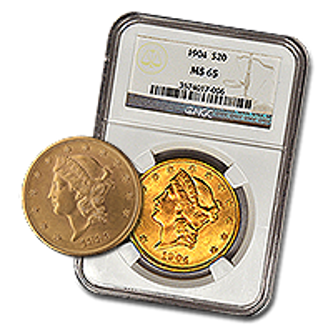
liberty gold coinsEconomic and market turmoil is the answer. In the late ‘80s interest rates were rising, and in October 1987 the stock market experienced its worst one-day downturn in history, dropping more than 25% in one day. On August 21, 1986, the Fed Funds Rate bottomed at 5-7/8% (higher than where we are today). By the time the Fed was done, the Fed Funds Rate had risen to 9.75% in February 1989. Rare coins were on fire! Investors became concerned about the stock market, mutual funds, bonds, and the dollar. I believe this may be what lies ahead!

We have seen this same occurrence in other periods, as well. For example, 1998 immediately comes to my mind. In August 1998, Russia defaulted on its bonds and Long Term Capital Management (a huge hedge fund) went belly up. On August 5 the stock market declined 500 points in one day. Gold bullion actually went down slightly in price, while rare coins exploded upward. The crisis was averted as the Fcd immediately dropped interest rates. Although the coin market returned to some normalcy, it became clear that rare coins were a place of diversification for the public in times of financial panic.

If we examine the period we have been in during the first stage of this bull market in gold, economically and financially the U.S. has remained relatively stable. Historically, instability is what drives gold, silver and rare coins higher, yet all these precious metals have been on a rampage during a period in which most Americans have felt relatively comfortable. However, the stability was maintained in large part due to an extended period of abnormally low interest rates, which spurred the economy through mortgage refinancing and a real estate boom heavily based upon debt. As I pointed out earlier, the Fed has a track record of going too far when raising interest rates. This makes the months in front of us very tenuous and I believe things are much more precarious today than they were in 1998 or at any other time in the last 75 years! Therefore, I believe the growth opportunity in rare coins is also much greater!

GOLD

I believe we are still entrenched in the early stages of the greatest bull market for gold in history! But this bull market in gold has been carried higher by big money, smart money. The public has not really entered the gold market yet. There are many more people talking about gold, but only a select few have purchased it. If you don’t believe it, Just ask your friends, family, or your neighbors and fellow workers. You will find that very few have entered the gold market. If you are acquiring gold, silver, and rare coins now, or have purchased them in the recent past, I think you are ahead of the curve, which is always where the big money is made.

During the first years of this gold bull market, gold rose from $255.20, its August 2001 bottom, to more than $500 an ounce, and hardly anyone noticed. Few seemed to show much interest until gold reached $625 an ounce. What does this tell me? It confirms what I said earlier: Gold is in the very beginning stages of its bull market. In 1982 when the Dow bottomed at 877 points, only 9.4% of the public were in the stock market. By the year 2000, when the stock market was at its peak, 56% of the public were in the stock market. Although I don’t have an exact figure for how many people own some form of gold and other precious metals today, my guess would be less than 2%, or even below 1%.

It is my opinion the June correction for gold occurred within a primary secular (long-term) bull market. This is normal action. Anything less would be an aberration. All markets rise and fall. As Richard Russell has taught me over the years, all markets are living organisms. They breathe in (inhale) and breathe out (exhale). Gold rose more than 24 times its value in the 1970s, and there were many ups and downs along the way. I believe any decline in gold at this point only offers a better buying opportunity.

I also believe that the bull market (upward trend) for gold has a long journey ahead of it before it reaches completion based upon the duration of the previous gold bear market (declining trend), which began in 1980 and spanned almost 20 years or more. The Adens wrote in their June 2006 edition of the Aden Forecast, “In previous issues we’ve often discussed the reasons why gold is headed higher and why this bull market will likely last for years to come. Basically, there are six major factors driving this bull market.”

“Briefly these are: 1. too much spending, 2. too much money is being produced, 3. inflation, 4. the weak U.S. dollar, 5. international tensions and 6. China’s growth and ongoing demand for commodities, which is coinciding with a new up move in the 200-year commodity cycle.”

“The last big bull market in gold was in the 1970s and it lasted 12 years. In recent years, we’ve seen many similarities to the 1970s, suggesting this rise could also be similar.”

Richard Russell wrote recently his opinion that this bull market for gold is much greater and more powerful than the bull market for gold in the 1970s. If I may remind you once again, that bull market took gold more than 24 times its beginning price. The beginning price of this bull market was around $255.20. You do the math.

Gold is real money. It has been real money for over 5,000 years. As Richard Russell says, “Gold is imbedded within the DNA of man.” Gold will never go bankrupt. In 1980, as inflation soared, there was a panic to buy gold. In the late ‘70s the American public was heavy into the gold market, just as they were with stocks in the late ‘90s and in early 2000, and the real estate market in the last few years. It will be the same for gold when it hits full stride. The public will be flocking to its door. “There is an old saying, from many years ago, THERE IS NO FEVER LIKE GOLD FEVER!”

As I close this letter, I want to recap some more of what I have written in the past for those of you who are reading my thoughts for the first time. There have been historical barometers that give us some insight into what gold might trade for, should gold come into some sort of historical relationship to these ratios. I have written about these factors before. They are meaningful to me; and since this is my newsletter, I am exercising my privilege to express my opinions about what is significant to me. I trust they will be meaningful to you, as well.

For instance, the Dow/Gold Ratio: If we calculated the price of the Dow in terms of just dollars - and let’s say the Dow is 11,000 (I don’t know where the Dow is while you are reading this) or Dow 11,000 equals $11,000. Take $11,000 and divide it by the price of gold, which, as of this writing, is around $650 an ounce. Eleven thousand dollars divided by $650 equals 16.92. As of this writing the Dow will buy 16.92 ounces of gold.

There have been periods in history when the Dow would buy only one or two ounces (approx.) of gold. For instance, in 1980 gold hit $850 an ounce, while the Dow was just over 800 points. In 1980 it could be said that the Dow would only buy one ounce of gold. Now, there are very bright and historic analysts that I follow who believe (as I do) that this ratio will return to its “historic ratio,” and that once again the Dow will only buy one ounce of gold. So, you pick the figure. But, as I pointed out earlier, if the Dow were to return to a state of extreme undervaluation, a point in which it returned an 8% yield (according to Decisionpoint.com), the Dow would decline to around 3,389 points. For the Dow to buy only one ounce of gold, gold would have to rise to $3,389 an ounce. You say you don’t think the Dow will ever return to 3,389 points? Well, maybe you are right. If the Dow were to drop to a lesser state of undervaluation and return to a yield of just 6%, for example, according to Decisionpoint.com, the Dow would have to decline to 4,519 points. For the Dow to buy one ounce of gold, gold would have to rise to somewhere in the neighborhood of $4,519 an ounce. If the bear market for stocks does escalate and the Dow does decline, but only drops to around 6,779 (which would equate to a yield of just 4%), gold would have to rise to $6,779 an ounce for the ratio to once again return to one. Once again, there are some very smart analysts who believe that at some price, at some point and time in the future, this will happen and historically these ratios do repeat themselves.

In 1982 when the Dow was trading for 877 points at its bottom, it would have been difficult to believe it would trade for 11,722 points in the year 2000. It was even harder to believe when the NASDAQ was trading below 200 points in the 1970s that it would trade above 5,000 in the year 2000. Yet, it might have been even more difficult in 1971 with gold trading at S35 an ounce for people to believe it would increase 24 times that value by 1980. Change is the hardest thing for people to envision and accept, and it is what keeps most from missing the new “mega-trends.”

Since oil is constantly on everyone’s mind, I guess I would be remiss if I didn’t write about the Oil/Gold Ratio. In brief, over the last 50 years there has been a fairly consistent correlation between the price of oil and the price of gold. But, as with all ratios, they float between their extremes. In 1986 the ratio hit an extreme peak when it took 32 barrels of oil to buy one ounce of gold. In August 2005, the ratio hit an extreme record low of 6.8 barrels of oil to buy one ounce of gold, the average being somewhere around 15 barrels of oil to buy one ounce of gold. As of this writing, with oil approximately $76 a barrel, it would take about 8.5 barrels of oil to buy one ounce of gold. If oil didn’t fall or rise (but, of course, we know it will), gold would have to rise to $1,140 an ounce to equal the Oil/Gold Ratio’s long-term norm.

Many are predicting $ 100 a barrel for oil by the end of this year. If oil were to hit $100 a barrel at any point and time in the future and the Oil/Gold Ratio were to return to its average of 15 barrels to buy one ounce of gold, gold would be selling for $1,500 an ounce. I have no doubt that the Oil/Gold Ratio will return to its average norm and probably its extreme high, but at what price and when that will happen - nobody knows. But remember, as I pointed out in the opening paragraph, today gold would have to increase to approximately $2,250 an ounce to equal 1980’s price of $850 an ounce in inflation-adjusted terms.

The bottom line: I believe gold is going to go higher, much higher. Since nobody really knows how long will it take to reach its ultimate high, I recommend that you adopt a mind-set to hold for the long-term when acquiring gold, silver, and/or rare coins.

I have written before that the dollar has only been the World’s Reserve Currency for 60 years or so, prior to that it was the British Pound/Sterling that held status as the World’s Reserve Currency. But the British went down the same road that the United States is currently traveling. They built up huge debt and deficits; and although their debt was nowhere near ours, its result was the ultimate ruin of their currency.

History has proven over and over again that a currency cannot stand such abuse, and gold will be the ultimate safe haven. Count on it!

gold account executive callfree gold informatio kit
Current Gold and Precious Metal Spot Prices
Prices are indications only. Call ITM Trading Inc. for most current spot prices

GOLD PRICES AND INFLATION

Jim Rickards talks about world inflation, and stocks and bonds priced in gold.


FINANCIAL MARKETS
EXPERT INTERVIEWS


Listen to an important interview with Jim Rickards Senior Managing Director for Market Intelligence at Omnis, Inc. and ITM Trading President Craig Griffin. The interview describes how Mr. Rickards view of gold at $7,000 per ounce is possible.

TESTIMONIALS
My husband and I have been quite impressed with the professionalism, knowledge, and courtesy ... (More)

Karen -
Dana Point, California


...they made it easy... I was very happy with every contact!... (More)

Sharon -
Chicago, Illinois