Home               About ITM Trading           Contact ITM Trading
       Gold Coins as Investments
       Rare Coin Grading
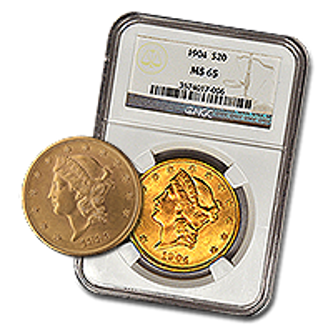
       Liberty $20 Gold Coin
       St. Gaudens $20 Gold Coin
       Eight Piece Gold Set
       1933 Executive Order
       Philosopher's Corner


Liberty $ 20 Gold Coin

Due to their weight, relatively low price, limited numbers, and worldwide popularity, pre-1907 U.S. $20 Liberty gold coins are much preferred by savvy gold investors seeking extra leverage to the precious metals market. These beautiful and historic gold coins provide complete financial privacy. The graded $20 gold coin market provides an excellent opportunity for those looking to increase the risk-to-/reward factor in their gold portfolio.

Because of their true scarcity and demand by avid collectors, $20 Liberty coins can quickly outpace gold bullion in a rising gold market; and there have been times when these gold coins have risen substantially while bullion gold declined in value, or remained flat in price.

Currently, some of the rarer, uncirculated pre-1900 $20 Liberty gold coins in Mint State-62 condition can be acquired for nearly the same price as common coins, making them one of today's better values on the rare coin market. The following minting dates are some of the rarest, as well as significant in value: 1854-O, 1855-O, 1856-O, 1870-CC, 1882, 1883, 1884, and 1887 (Proof-only issues), 1886, and 1891.

Prior to 1849, the largest gold coin issued by the U.S. Government was the $10 "Eagle," first minted in 1795. The first regular production $20 Liberty gold coin was struck in January 1850. Because it was twice the size of the U.S. $10 gold "Eagle," when the newly-minted $20 Liberty gold coin entered circulation it became known as the "Double Eagle." The $20 Liberty (Double Eagle) was also referred to as a $20 Coronet. This gold piece was used as legal tender and remained in production until 1907, when the United States Mint began releasing the U.S. $20 Saint-Gaudens gold coin piece.

James B. Longacre designed the $20 Liberty with the obverse side featuring Lady Liberty donning a crown inscribed with the word "LIBERTY" on the coronet. The elegant image of Lady Liberty is adorned by 13 stars arched around her head like a rainbow. These stars represent the original 13 colonies. The reverse side of the gold coin also features 13 stars, an eagle with a shield, and the words "UNITED STATES OF AMERICA" displayed in arch-like form, encircling the eagle and shield.

Due to the California Gold Rush of 1848 and the huge amount of gold extracted from Sutter's Mill, gold began pouring into the Philadelphia Mint in overwhelming quantities. This caused Congress, under the Act of March 3, 1849, to authorize the U.S. Mint to create the one-ounce $20 gold Liberty. Minting of the regular issue $20 Liberty gold coin began in 1850. At least two of these magnificent gold coins were minted in December 1849; one of the two is now permanently located in the Smithsonian.

The $20 Liberty gold piece was minted at five different mints throughout its production history: Philadelphia, San Francisco, Denver, Carson City, and New Orleans. During the era of the $20 Liberty's issue, the official price of gold was $20.67 per ounce. Gold content of the Double Eagle was fixed at .9675 per ounce, equaling its $20 value in gold weight.

The new $20 gold coin wasn't used much in daily commerce. Prior to the days of fiat currency, $20 was considered a substantial amount of money. As a result, this Liberty gold coin was most commonly used for bank transfers or payment of debts to foreign investors. Serving as one of the foundations of the fledgling U.S. economy and financial markets in the 19th century, the $20 gold coin provided much of this young nation's burgeoning wealth.

The $20 Liberty gold coin was minted with three small design changes, each representing its own time and space in history and designated by Type. Design Type and minting dates were as follows: Type I: minted 1850-1866, Type II: minted 1866-1876, and Type III: minted 1877-1907.

Type I

The production of Type I Liberty coins began in Philadelphia and New Orleans during 1850. San Francisco issues began in 1854, the same year the California mint initiated its first coin production. In the spring of 1861, the Confederacy seized the New Orleans mint. Although this event marked an end to production of the $20 Liberty Gold coin in New Orleans from 1862-1878, the New Orleans Mint was able to produce $20 Double Eagles for the U.S. government during the first half of 1861. During the latter part of 1861, the Mint continued its production of $20 Double Eagles with permission from both the Confederacy and the government of Louisiana. Regrettably, all of the coins were struck using the same dies. As a result, there is no known means to distinguish which coin was produced for which governing authority during that time. The New Orleans mint did issue the $20 Liberty again in 1879 (See Type III). The Type I $20 Liberty was minted without the motto "IN GOD WE TRUST," and "TWENTY DOLLARS" was expressed as "TWENTY D" on the reverse side of this coin.

Type II

Type II coins were issued in 1866. This alteration of the coin design became known as the "With Motto" variety. Type II Double Eagles were struck from 1866 to 1876 at the Philadelphia and San Francisco mints. In 1870, the brand new Carson City mint struck Type II $20 Liberty coins. Another Type II design change involved modifying the shield device on the reverse side from straight into the curved "rococo" style of that time. Again, "TWENTY DOLLARS" was expressed as "TWENTY D" on the reverse side of the coin.

Type III

In 1877, the denomination on this coin's design was updated to read "TWENTY DOLLARS" instead of "TWENTY D." Type III Double Eagles were minted in Carson City, Philadelphia, and San Francisco. They were also struck at the Denver mint during 1906 and 1907. In contrast to the other mints, the New Orleans mint restricted the issue of Type III $20 Liberty coins to one year-1879. Although the New Orleans mint continued to strike other denominations of gold and silver between 1879 and 1909, it only produced 2,325 $20 Liberty gold coins; all of which were struck during 1879.

Detailed Coin Information

Designer James B. Longacre
Gross Weight 33.436g
Gold Content

0.9675 oz

Composition 90% gold, 10% copper
Diameter 34mm
Edge Reeded
Dates 1849-1866 (Type I); 1866-1876 (Type II); 1877-1907 (Type III).
   
Dates of Mints

Carson City: (1870-1879; 1882-1885; 1889-1893)


Denver: (1906-1907)


New Orleans: (1850-1861; 1879)


Philadelphia: (All dates)


San Francisco: (1854-1885; 1887-1907)


$ 20.00 ST GAUDENS
Fine gold content:
.9675 Troy Oz
1907-1933
   Purchase Policies and Procedures and Risk Information
   ITM Trading, 14231 N. 7th Street, Suite B7, Phoenix, Arizona 85022. Phone: 602 404 4010, Fax: 602 404 3917, Toll Free: 1-888-OWN-GOLD
© 2007 ITM Trading   
design by diyitechnology.com